
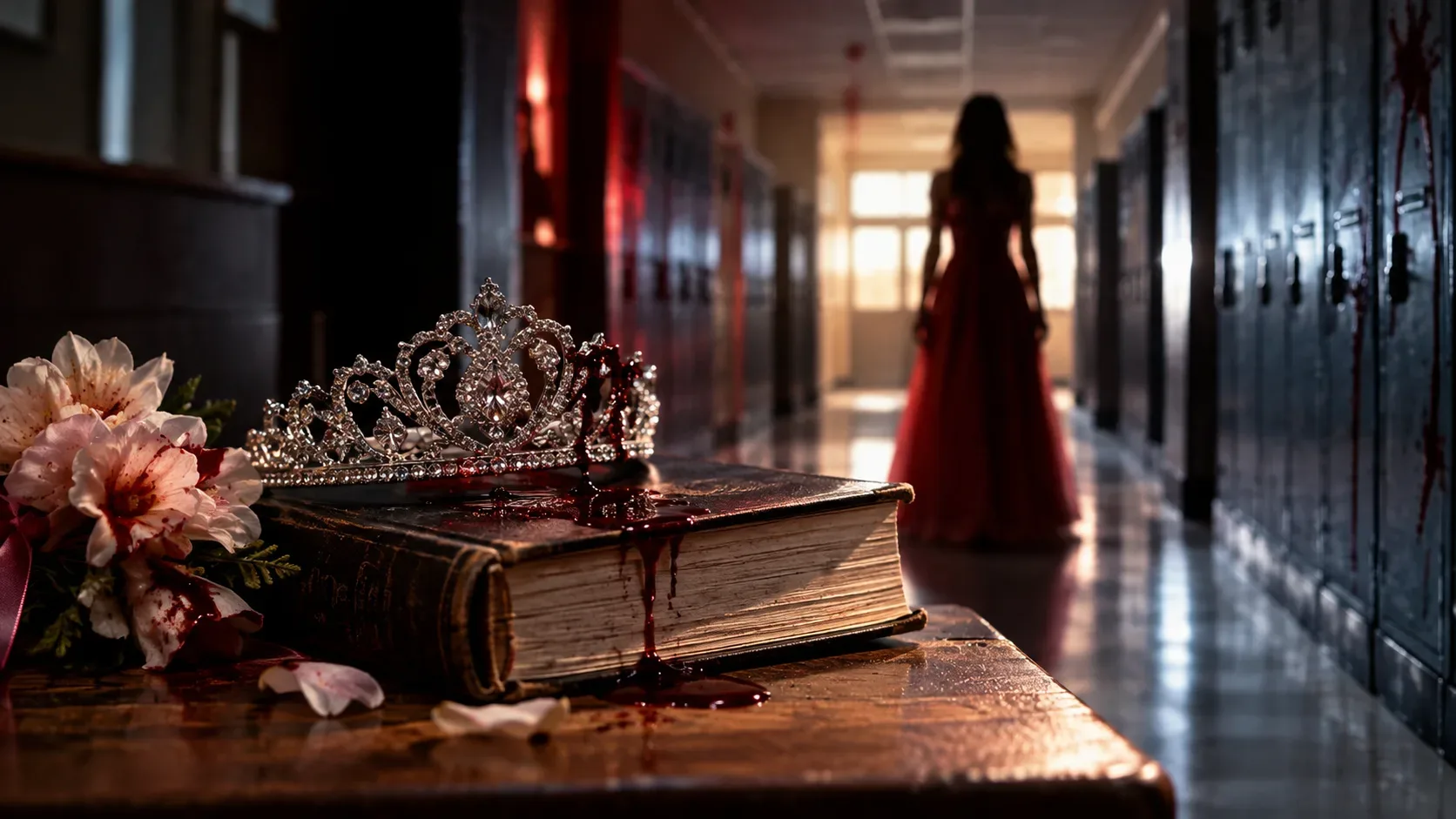
Short answer: Prime Video's new Carrie keeps the core of Stephen King's novel: Carrie White, Margaret White, school bullying, telekinesis, and the escalation toward prom. The biggest confirmed change is the starting point. In this version, Carrie has spent her life isolated at home and enters public high school after her father's sudden death. The series also moves the humiliation into the social-media era, turns the bullying into a viral scandal, and uses eight episodes to expand the characters, tensions, and choices that lead to the decisive night.
Prime Video has set the worldwide release of all eight episodes for October 7, 2026. Mike Flanagan is showrunner, writer, executive producer, and director of four episodes. The platform describes the production as the first series adaptation of Carrie.
What the series keeps from Stephen King's novel
Published in 1974, Carrie was Stephen King's first novel to reach bookstores. The central premise remains recognizable: Carrie White is an outsider teenager raised by a religious, controlling mother, tormented by her classmates, and gradually becoming aware that she has telekinetic powers. In the novel, an attempt at social inclusion leads to the school prom, where a planned act of cruelty triggers the catastrophe that defines the story.
Flanagan's adaptation retains several central characters from the book. Summer H. Howell plays Carrie; Samantha Sloyan is Margaret White; Siena Agudong is Sue Snell; Alison Thornton is Chris Hargensen; Joel Oulette is Tommy Ross; Arthur Conti is Billy; and Amber Midthunder plays Miss Desjardin, the teacher connected to the opening bullying incident and its disciplinary consequences.
The thematic core also remains: isolation, everyday cruelty, the desire to belong, abusive family relationships, and the fear surrounding the emergence of a power Carrie does not yet fully understand.
The biggest change: Carrie's father and her arrival at public school
In Prime Video's official material, the sudden death of Carrie's father is the event that sends her into public high school. That reorganizes the origin of the conflict. In the novel, Carrie is already a student and her social exclusion is longstanding. In the series, entering that world late becomes part of the plot itself.
This changes the dramatic question. The story is no longer only about a teenager who has always been targeted by classmates. It also follows someone raised in isolation who must suddenly learn social codes, technology, friendship, hostility, and public exposure. Her father's death therefore works as a new narrative trigger, confirmed by the official synopsis.
Viral bullying and social media: what is genuinely new
Prime Video confirms that Carrie will face a viral bullying scandal and the constant pressure of the social-media age. This matters because it changes the scale of humiliation. Embarrassment is no longer confined to the physical space of the school. It can circulate, be replayed, and spread across the wider community.
The 2013 film had already introduced phones and online posting into the locker-room humiliation. The series, however, presents digital exposure as a structural part of the story rather than only a period update. Before release, it is still impossible to say which platforms, videos, messages, or consequences will matter most because the official synopsis does not map that path in detail.
Why eight episodes could bring the series closer to one feature of the novel
King's novel is not told only as a continuous sequence of scenes. It intercuts the story with testimony, documents, articles, and later reconstructions of the events. Brian De Palma and screenwriter Lawrence D. Cohen removed much of that framing in the 1976 film and chose a more linear progression.
Prime Video says the series will deepen characters and tensions, following small choices that build toward the night at the center of the climax. An eight-episode format creates room to recover some of the novel's broader social scope, but that possibility must be separated from what has actually been confirmed. The platform confirms expanded characters and tensions, not a full recreation of the book's documentary structure.
Book vs. earlier adaptations vs. the 2026 series
| Version | Format | Narrative focus | Bullying and technology | Main changes or defining features |
|---|---|---|---|---|
| Novel, 1974 | Book | Carrie, her family, the school, and the collective reconstruction of the tragedy | In-person bullying within the social context of the 1970s | Combines narrative with documents, testimony, and later analysis; widens the impact of the events across the community |
| Film, 1976 | Brian De Palma feature, about 98 minutes | Carrie's emotional path and mounting tension toward prom | In-person bullying | Drops much of the novel's documentary framework and tells the story more linearly; the physical-education teacher is renamed Miss Collins |
| TV film, 2002 | Television production written by Bryan Fuller | Retells the story through investigation and flashbacks | Updates the setting to the early 2000s | Restores investigative and testimonial elements, but radically changes the ending by allowing Carrie to survive, in an attempt to open the door to a series that did not move forward |
| Film, 2013 | Feature directed by Kimberly Peirce | A new staging of Carrie's familiar trajectory | Phones, recording, and online exposure become part of the humiliation | Modernizes the digital context while keeping the general structure closer to earlier film adaptations |
| Series, 2026 | Eight Prime Video episodes | Carrie's entry into public school, expanded relationships, and choices leading toward prom | Viral bullying and social-media pressure are confirmed central elements | Her father's death now triggers Carrie's move into public school; the story gains serialized length and new or reshaped roles in the school ensemble |
Familiar characters and roles the series may reshape
The cast shows that the classic core remains in place: Carrie, Margaret, Sue, Chris, Tommy, Billy, and Miss Desjardin. At the same time, the regular ensemble includes names such as Emaline and Principal Grayle. Those names indicate an expansion or reorganization of the school environment, but Prime Video has not yet explained each character's detailed function. It is therefore safer to treat the difference as evidence of expansion, not as confirmation that a specific book character has been replaced.
There is also a change already built into the synopsis: Carrie's father has much greater causal importance in the new version because his death precedes her entry into public school. That separates the series from both the novel and the best-known films before any scene-by-scene comparison is possible.
What cannot be stated yet before release
- whether the series will reproduce the novel's documentary excerpts, hearings, and pseudo-scientific texts;
- how much destruction beyond the prom will be shown;
- whether the ending will follow the novel, an earlier adaptation, or a new path;
- which new characters absorb functions from minor figures in the book;
- how much the eight-episode length will shift perspective toward Sue, Chris, Margaret, and other characters.
Those points can only be answered definitively after release. The official material so far confirms the social and technological modernization, Carrie's new route into school, and the expansion of the cast and tensions, but it does not reveal the entire design of the adaptation.
So what is Mike Flanagan's version of Carrie actually focusing on?
Before release, the clearest answer is that Flanagan is not simply stretching a feature film into eight chapters. The series changes Carrie's initial condition. She arrives at public school after a life of isolation, goes through a bullying crisis with viral reach, and develops her powers while trying to understand a completely new social environment. Prom remains the recognizable destination of the story, but the road toward it has been reconfigured.
For readers and viewers familiar with the book and films, this is the most useful comparison: the novel offers the widest, most documentary view; the 1976 film concentrates the experience into a linear, highly visual narrative; the 2002 TV film restores part of the investigative frame but changes the ending; the 2013 film takes bullying onto the internet; and the 2026 series makes digital exposure and late entry into school central engines of the plot.
Sources
- Prime Video / About Amazon: release date, eight episodes, synopsis, cast, and creative team
- StephenKing.com: synopsis and information on the original novel
- AFI Catalog: data and synopsis for the 1976 film
- RogerEbert.com: context on Brian De Palma's linear adaptation
- The Guardian: the 2013 film's digital update and cyberbullying
- Dread Central: the 2002 TV film's investigative structure