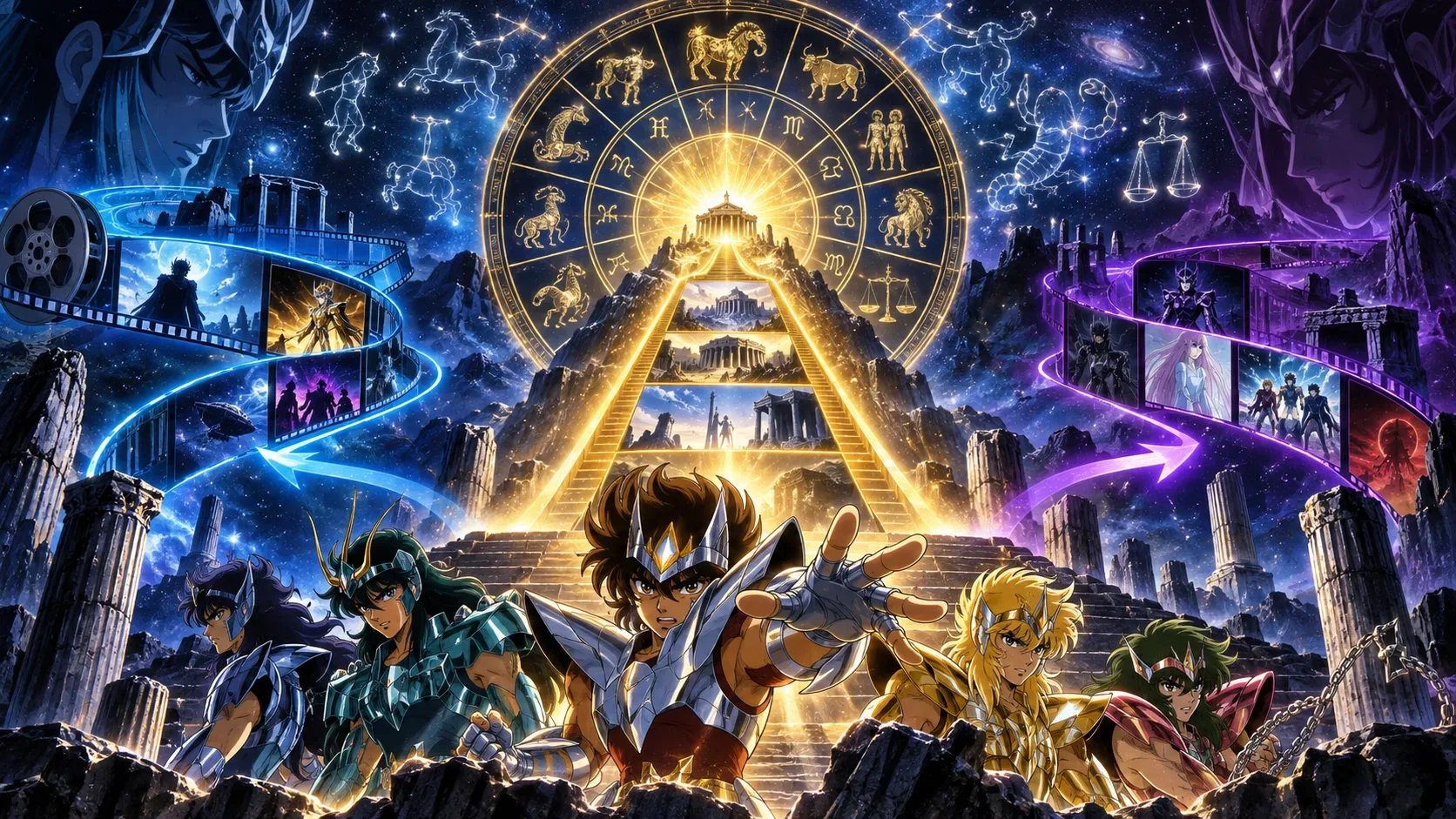
Short answer: to follow the main Saint Seiya story without mixing continuities, the safest route is to watch the complete 1986 anime, all 114 episodes, then continue with Hades: Sanctuary, Hades: Inferno, and Hades: Elysion. The classic movies are optional. The Lost Canvas, Saintia Sho, Soul of Gold, Omega, and the reboots should be treated as extensions, parallel stories, or new versions, not as required steps in that sequence.
The main order: what actually continues the 1986 anime
The starting point is Saint Seiya, the 1986 TV series. The official Toei Animation catalog lists 114 episodes. If you want to preserve the anime experience, watch the whole run in sequence, including Asgard.
- Saint Seiya (1986), episodes 1 to 114. In the organization most commonly used by fans and watch guides, episodes 1 to 73 cover the Sanctuary phase, 74 to 99 make up Asgard, and 100 to 114 finish with Poseidon. Asgard was created for the anime, but it belongs to the TV continuity and becomes relevant again in Soul of Gold.
- Saint Seiya: The Hades Chapter - Sanctuary, 13 episodes. Toei lists this first Hades section as a 13-episode production released from 2002. The Crunchyroll synopsis places Hades shortly after the battle with Poseidon, which makes clear why it is the direct continuation of episode 114.
- Saint Seiya: The Hades Chapter - Inferno, 12 episodes. This is the second stage of the same war, following the descent into the Underworld. Catalogs may split Inferno into two six-episode parts, but the story is continuous.
- Saint Seiya: The Hades Chapter - Elysion, 6 episodes. This is the animated conclusion of the Hades Saga. The official franchise history separates Sanctuary, Inferno 1, Inferno 2, and Elysion by format and release date, but together they form one narrative arc.
Counting only the core storyline, that is 114 classic episodes plus 31 Hades episodes. This is the route for viewers who want to reach the end of the main anime story without learning every branch of the franchise first.
Three routes that keep the continuities separate
| Route | What to watch | How to treat it |
|---|---|---|
| Main story | 1986 anime, Hades: Sanctuary, Inferno, and Elysion | Core sequence. Hades continues directly after Poseidon. |
| Optional classic movies | Four movies from 1987 to 1989 and, separately, Heaven Chapter: Overture | Watch them as extras. Do not force every movie between TV episodes as if it were required. |
| Parallels, extensions, and reboots | The Lost Canvas, Saintia Sho, Soul of Gold, Omega, Legend of Sanctuary, Knights of the Zodiac | Each title has a different relationship with the original. Some expand the anime, while others retell the story in another continuity. |
Where the four classic movies fit
The official animation history lists four theatrical releases from the era of the original series: Evil Goddess Eris in 1987, The Heated Battle of the Gods in 1988, The Legend of Crimson Youth in 1988, and Warriors of the Final Holy Battle in 1989.
These movies are not required to understand Sanctuary, Asgard, Poseidon, or Hades. Details involving Cloths, character relationships, and the state of Sanctuary do not fit neatly into one position between TV episodes. If your priority is to avoid mixing continuities, the simplest solution is to finish all 114 episodes and then watch the four films as a bonus block in release order.
- 1987: Evil Goddess Eris.
- 1988: The Heated Battle of the Gods.
- 1988: The Legend of Crimson Youth.
- 1989: Warriors of the Final Holy Battle.
If you want something closer to the historical release experience, you can watch them during the classic series, but that does not make the narrative more coherent. As a practical guide, treating them as self-contained side stories avoids arguments about what "really happened" in the main line.
What about Heaven Chapter: Overture?
Saint Seiya: The Heaven Chapter - Overture, released in 2004, is different from the four classic movies. It was conceived as a continuation after the events of Hades, but it reached theaters before the Hades animation itself finished in 2008. The franchise later moved in other directions through subsequent works.
For a marathon with minimal continuity conflict, the operating rule is simple: finish Hades first, then watch Overture as an alternate continuation or historical curiosity. It is not required to understand the ending of Elysion.
Spin-offs: when to watch them without confusing them with the main story
Saint Seiya: The Lost Canvas
The Lost Canvas is set in the 18th century, long before Seiya's era. Crunchyroll describes it as a new story set during that earlier Holy War, centered on Tenma, Alone, and Sasha. It is a strong entry into another interpretation of the mythology, but it is not the next chapter after Hades. The anime has 26 episodes and stops before adapting the full manga story.
Saint Seiya: Saintia Sho
Saintia Sho runs alongside events from the classic anime. Toei explicitly says that while Seiya and the others fight through the Galaxian Wars and the Twelve Houses, Saori and the Saintias are fighting another battle in the background. Its chronology therefore overlaps the 1986 series. To avoid spoilers and constant point-of-view switching, it is easier to watch after finishing the Sanctuary phase, rather than intercutting episodes.
Saint Seiya: Soul of Gold
Soul of Gold focuses on the Gold Saints and uses Asgard as its central setting. Toei introduced the series as a story following the events of Hades, with the Gold Saints reappearing in Asgard. Because it relies on references to both Hades and the anime's Asgard arc, the best entry point is after completing Hades. It is an optional extension of the animated continuity, not a required step for understanding Seiya and Athena's ending in Elysion.
Saint Seiya Omega
Omega introduces a new generation of Saints and keeps Seiya as a legendary figure from the past. Toei lists 97 episodes, aired from 2012 to 2014. For viewers coming from the classic, it works best as a long-term sequel branch. Watch it after Hades, preferably once you have decided that you want to keep exploring extensions of the anime continuity.
Reboots: start from zero and do not mix them into the 1986 series
Saint Seiya: Legend of Sanctuary (2014) retells the Sanctuary material as a CGI feature film. It condenses and changes the story, so it should not be inserted between episodes of the classic anime.
Saint Seiya: Knights of the Zodiac (2019 onward) also restarts the story in CGI. Toei itself announced it as a brand-new computer-generated series. It is an independent adaptation, not a continuation of episode 114.
The 2023 live-action film Knights of the Zodiac follows the same practical rule: it is another adaptation of the property and does not need to be part of a main anime marathon.
The practical watch order
If you only want the essentials, use this sequence:
- Saint Seiya, episodes 1 to 114.
- Hades: Sanctuary, 13 episodes.
- Hades: Inferno, 12 episodes.
- Hades: Elysion, 6 episodes.
After that, choose extras by interest instead of treating everything as one long queue:
- Want more nostalgia with the classic cast? Watch the four movies from 1987 to 1989.
- Want an alternate post-Hades continuation? Watch Heaven Chapter: Overture.
- Want another ancient Holy War? Watch The Lost Canvas.
- Want a parallel story around Sanctuary? Watch Saintia Sho.
- Want the Gold Saints in Asgard? Watch Soul of Gold.
- Want a new generation after the classic era? Watch Omega.
- Want a retelling from the beginning? Choose Legend of Sanctuary or Knights of the Zodiac.
The most common mistake when building a watch order
The mistake is treating release date as mandatory chronology. In Saint Seiya, later productions can run in parallel, restart the opening story, or follow a different branch. SagaList organizes precisely this difference between the core line, movies, side stories, and reboots.
If you keep only one rule, use this one: finish the 1986 series, then finish Hades; everything else is optional, and you should identify its continuity before adding it. That lets you explore the franchise without turning every spin-off into a prerequisite.
Sources consulted
- Toei Animation: Saint Seiya catalog.
- Toei Animation: Hades Chapter - Sanctuary.
- Saint Seiya Animation Official: release history.
- Toei Animation: Saintia Sho.
- Toei Animation: Soul of Gold announcement.
- Toei Animation: Saint Seiya Omega.
- Crunchyroll: The Lost Canvas.
- SagaList: franchise organization and watch order.