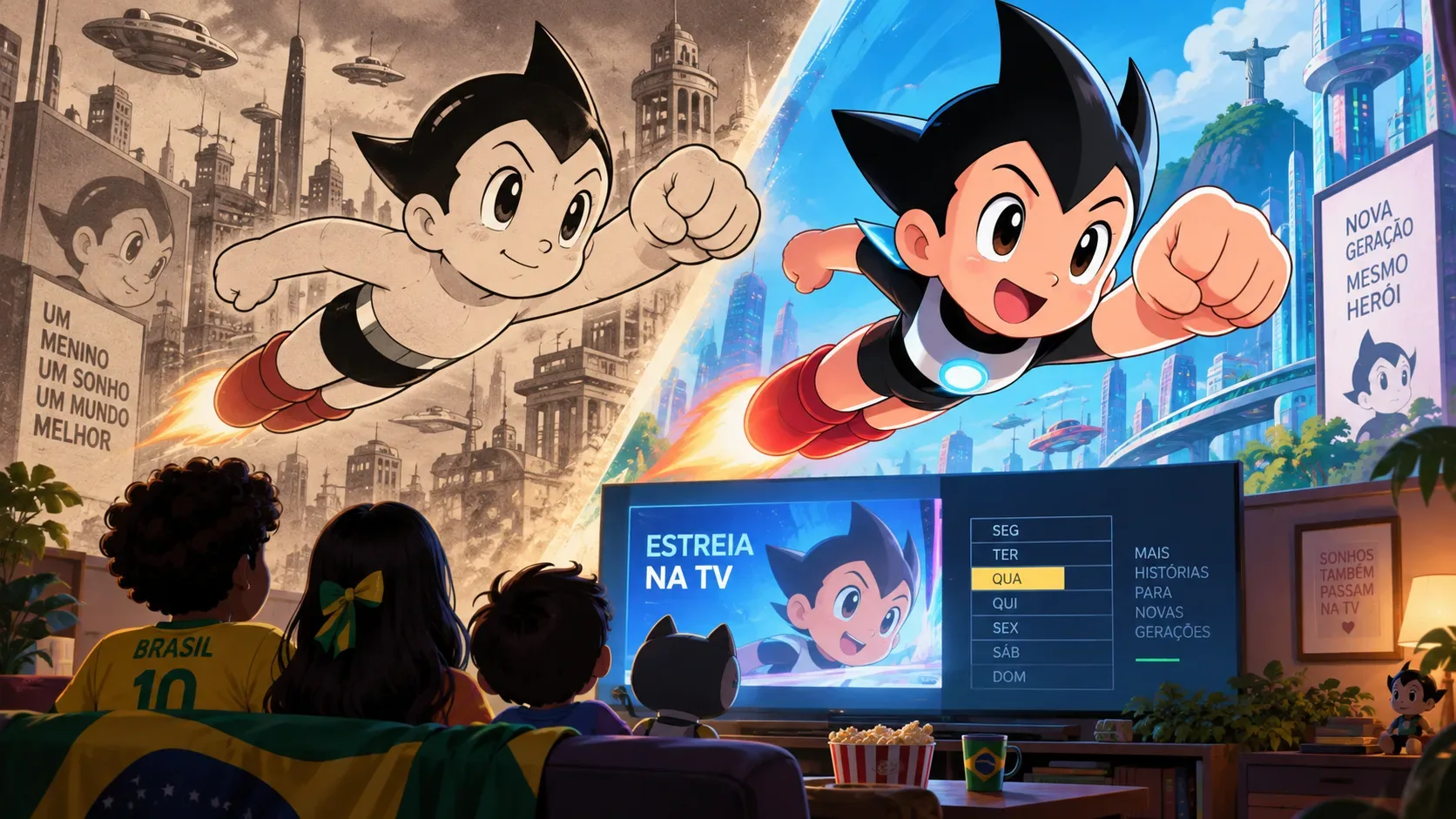
Go Astro Boy Go! premieres on TV Cultura on September 16, 2026, within Antimatéria: Energia Geek. TV Cultura’s official announcement, published on September 8, confirms the date and says the program airs at 6:30 p.m. A September 10 report from JBox adds that the animation itself is scheduled for Wednesdays and Thursdays from 6:30 p.m., with two episodes per day. Because those specific days and the double-episode format are not spelled out in the broadcaster’s premiere notice, they are best treated as complementary schedule information and viewers should check the current grid if it changes.
The main key to understanding the series is not to expect a direct continuation of the 1963 cartoon. Originally launched in 2019, Go Astro Boy Go! reintroduces Osamu Tezuka’s character for younger children, shortens the format to 11-minute episodes, and shifts the story engine toward science, nature, coexistence and problem-solving missions.
What is confirmed about the TV Cultura premiere
- Premiere date: September 16, 2026.
- Broadcaster: TV Cultura.
- Program: Antimatéria: Energia Geek.
- Program time: 6:30 p.m. In a September 9 post, TV Cultura itself states that Antimatéria airs Monday through Saturday from 6:30 p.m. to 7:30 p.m.
- Specific animation slot: according to JBox, Wednesdays and Thursdays from 6:30 p.m., with two episodes per day.
The important point is to separate two facts: TV Cultura officially confirms the September 16 premiere within Antimatéria; the Wednesday-and-Thursday distribution with two episodes comes from specialized coverage. For a service-oriented article, that distinction prevents a secondary detail from being presented as if it appeared in the broadcaster’s own premiere notice as of September 12.
What changes from classic Astro Boy
| Aspect | Tezuka’s Astro Boy | Go Astro Boy Go! |
|---|---|---|
| Protagonist’s identity | In the original manga, Astro is a robot boy created in the image of Tobio, Dr. Tenma’s deceased son. | The official presentation defines him as an advanced artificial intelligence with the appearance and personality of an eight-year-old boy. |
| Central conflict | The classic stories deal with justice, robot rights, prejudice, scientific responsibility, and coexistence between humans and machines. | The trio travels around the world to investigate phenomena, solve problems, and help people, animals and communities, emphasizing science, nature, teamwork and coexistence. |
| Recurring companions | The classic universe includes Dr. Ochanomizu and a broad cast of humans, robots, allies and adversaries. | Astro mainly works alongside Astro Kitty, a cat-like AI, and Suzu, a highly intelligent human girl. |
| Format | The 1963 TV series has 193 episodes of about 24 minutes and was produced in black and white. | The 2019 series has 52 episodes of 11 minutes. |
| Entry point | The classic builds a larger, often dramatic mythology around the relationship between technology and humanity. | The newer production uses short, self-contained adventures to introduce the character to a new generation. |
Calling Astro an “artificial intelligence” updates Tezuka’s central question
The official Tezuka Productions page for Go Astro Boy Go! calls Astro “the most advanced AI with a human boy appearance” and describes him as a child who is still growing. The official Atom character page, meanwhile, presents classic Astro as an immensely powerful robot whose role also raises the question of whether science and humanity can truly coexist.
This is where the new series has its most interesting conversation with Tezuka. The technological frame changes: the postwar atomic-and-robotic imagination gives way to today’s language of artificial intelligence. But the idea of a childlike machine learning how to act among humans remains. That is an editorial reading based on the two official descriptions, not a claim that the 2019 series reproduces the same conflicts as the manga.
What remains from Osamu Tezuka’s character
Even with the simplified format, several fundamental elements remain recognizable. Astro is still an artificial child with abilities far beyond human limits; he still has to learn how to use that power; and his decisions are placed in situations involving other people and other forms of life. Professor Ochanomizu — known in some localizations as Professor Elefun — is also part of the 2019 cast.
The connection to the original work is explicit in the credits: Tezuka Productions lists Osamu Tezuka and the original manga as the production’s source. That does not require the newer series to repeat the classic origin, tone or continuity. What it preserves is the character as a bridge between technology, ethics and learning.
Why the 11-minute format changes the experience so much
According to Tezuka Productions, Go Astro Boy Go! aired in Japan from October 3, 2019 to October 1, 2020, with 52 eleven-minute episodes. That format favors compact stories with a problem, discovery and resolution in a short span. By comparison, the 1963 series has episodes of about 24 minutes and 193 installments.
For viewers coming from classic Astro Boy, the difference in length helps explain why the newer version may feel less interested in large dramatic arcs and more focused on brief missions. For the Brazilian schedule, it also helps explain JBox’s report that TV Cultura plans to show two episodes per day in the animation’s slot.
Do not confuse Go Astro Boy Go! with other Astro Boy versions
The franchise spans several eras, and the names can make it easy to treat every animation as a single continuity. They are not.
- Mighty Atom/Astro Boy manga: serialized from 1952 to 1968. The official manga page describes Astro as a robot created from the image of Tobio and later cared for by Dr. Ochanomizu.
- 1963 series: a black-and-white TV adaptation with 193 episodes. Tezuka Productions describes it as a landmark in Japanese television animation.
- 1980 series: a new color adaptation with 52 episodes, rearranging stories for the audience of that period.
- Go Astro Boy Go!: a 2019 production with 52 eleven-minute episodes, centered on Astro, Astro Kitty and Suzu as an adventure team.
That means viewers do not need to “remember the previous story” before the TV Cultura premiere. The show works as a fresh entry point. For people who know the classic, the added value is seeing what has been repackaged: the artificial boy remains at the center, but the series trades some of the drama about robots and society for shorter adventures about science, nature, empathy and cooperation.
Is it worth watching for classic Astro Boy fans?
It depends on the expectation. If you are looking for a continuation of the 1963 series, the same dramatic weight or the same conflict structure, Go Astro Boy Go! was not designed for that. If you are curious about how a character created in 1952 can be translated for children today, the comparison is precisely the most interesting part.
The Brazilian premiere also creates an unusual situation: a historic manga and anime character returns to free-to-air television in a version that speaks today’s technological language. The result does not replace Tezuka’s Astro Boy; it works better as an introductory reinterpretation that preserves the idea of an artificial boy trying to understand the world around him.
Sources consulted
- TV Cultura — official Go Astro Boy Go! premiere announcement
- TV Cultura — updated Antimatéria schedule in September 2026
- Tezuka Osamu Official — Go Astro Boy Go! profile
- Tezuka Osamu Official — 1963 Astro Boy series
- Tezuka Osamu Official — Mighty Atom manga
- JBox — Wednesday/Thursday slot and two-episode detail