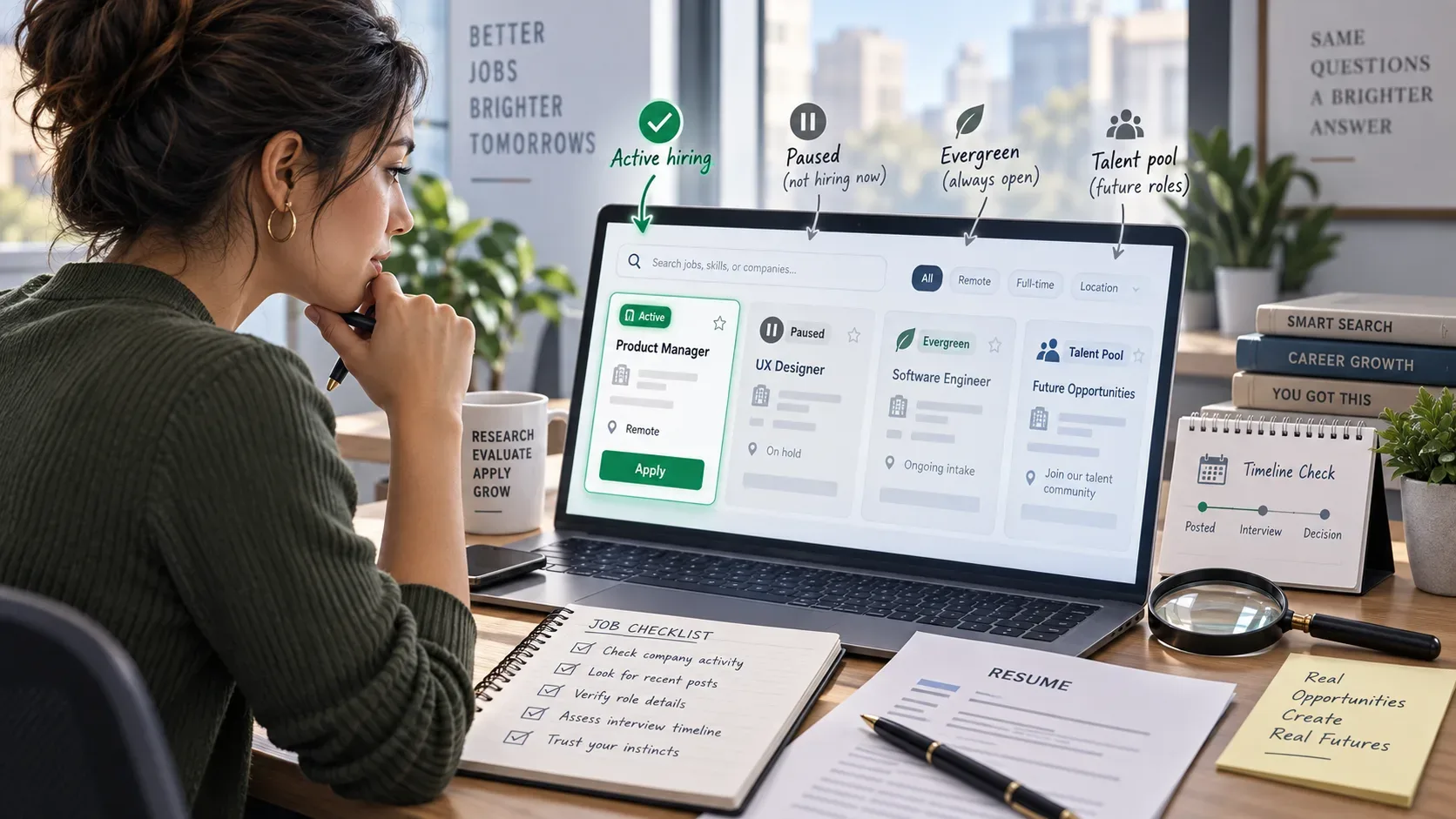
A vacancy can arrive via LinkedIn, WhatsApp, email, referral or external form and still be legitimate. It can also copy the name, visual identity and even real data of a company and be a fraud. Therefore, the most useful question is not “does this look professional?”, but “can I confirm, independently, that this vacancy, this company and this person are linked to each other?”.
Verification must take place before sending sensitive documents, bank details or money. The best method is to stop the impulse to respond quickly and rebuild the chain of trust: locate the vacancy on the official channel, confirm who the company is, validate the recruiter, check domain and contact, evaluate what is being requested and only then decide whether to move forward.
The protocol for checking a vacancy before moving forward
Stop before clicking, paying or sending documents
Urgency is a common fraud tool because it reduces the time available to check details. If the message says that the position “closes in minutes”, that you were “approved immediately” or that you need to pay now to avoid missing the opportunity, do not use the link you received as the only source of confirmation.
The first action is simple: stop the flow. Do not make a PIX, do not send a photo of a document, do not provide a password, do not install an application and do not open an executable file. Copy the company name, position, recruiter's name, telephone number, email and the domain mentioned. From there, check each element through a route that does not depend on the contact received.
Check if the vacancy exists on the official channel
Search for the company's institutional website by typing in the known address or arriving at it through an independent search. Then, look for the careers area, “work with us”, official selection process page or verified corporate profile. If the vacancy is not published,
this does not prove fraud: some companies recruit confidentially or use external consultancies. But absence increases the need to confirm contact directly with HR or an institutional channel.
Public alerts from 2026 show why this step is important. The Curitiba Health Care Foundation warned that scammers created a fake page for a real selection process and advised candidates to only use the official addresses of the foundation and the organizer. The lesson is clear: even a genuine process can have a fraudulent copy circulating at the same time.
Validate the company and the recruiter separately
Real company and real recruiter are two different verifications. A scammer can impersonate an existing company, use its logo, copy job descriptions and name real professionals. Therefore, finding an active CNPJ or a corporate page does not automatically validate the person who contacted you.
In Brazil, the public consultation of the CNPJ allows checking the registration status and information of the legal entity. Compare company name, business name, location and other available information with what appears in the vacancy. Treat this inquiry as confirmation that the company exists, not as proof that the approach is authentic.
Then validate the recruiter. See if the name appears on the company website, in a consistent professional profile or in corporate communications. On LinkedIn, a verification badge on a job may indicate that the company page has been verified and that the advertiser has confirmed a link to the organization. This seal is an additional sign of trust, not an absolute guarantee. The platform itself also warns that the absence of the seal does not mean, in itself, that the vacancy is fake.
Examine the domain, email and link path
Compare character by character the email and website domain with the company's official domain. Discreet letter changes, extra hyphens, misleading subdomains, and different extensions can go unnoticed on a quick read. An address using Gmail, Outlook or another free provider also deserves additional verification when the person claims to represent a company that has its own domain.
A generic email, however, is not sufficient proof of a scam. Small businesses and consultancies can use it. The point is coherence: can the sender be confirmed by another channel? Does the vacancy appear on a reliable page? Does the company recognize that recruiter? Does the address you were sent to belong to the organization or a supplier officially informed by it?
For domains ending in .br, Registro.br offers registration information consultation. The creation date and available data can act as additional clues. A domain recently created to imitate an old company deserves attention, but an old domain can also be compromised and a new domain can be legitimate. Data should never be used in isolation.
Treat payment as a sign of high severity
In a private selection process, requirements for PIX, transfer, gift certificate, deposit, mandatory purchase of a course, curriculum service or equipment to guarantee a place must be treated as a serious sign. LinkedIn advises candidates not to provide payments
nor account credentials as a condition of application and includes charges for training, background checks, resume services or equipment among the signs that call for caution.
There are situations in which a fee may legitimately exist, such as certain competitions or public processes provided for in a notice. In this case, the charge must be provided for in the official document, on the official channel, with a verifiable organizer and recipient. The Feas alert in Curitiba is a good example of the risk: there was a real selection process, but criminals created a fake page to capture the registration fee.
Work bodies have also warned about false offers. In June 2026, Funtrab reinforced that its referrals occur through official channels and that no server or representative is authorized to request deposits, transfers or PIX to guarantee a place or participation in selection. The advice was to stop contact and confirm the information directly with the institution.
Only deliver data compatible with the process stage
At the beginning of an application, it is normal to provide professional information necessary to evaluate the profile, such as name, telephone number, email, experiences, training, portfolio and availability. The risk changes when early requests for document photos, bank details, account credentials, passwords, authentication codes or information that have no clear relationship to the current step arise.
LinkedIn treats advance requests for bank details and identification images before formal hiring as a warning sign. This does not mean that documents will never be needed. After a confirmed proposal and at the admission stage, the company may need personal and banking details to fulfill obligations and process payment. The difference is in the moment, the purpose, the secure channel and the possibility of confirming the request with the official HR.
Passwords and authentication codes deserve a stricter rule: they are not admission documents. Do not share email, social network, bank account password or code received via SMS or authenticator app with a recruiter, company or supposed support.
Practical matrix: sign, severity and how to check
Request for PIX, fee, course or equipment to guarantee the place — critical severity
The problem is not just that there is a charge; the charge is linked to the promise of hiring, approval or continuity in the process. Stop the payment and confirm via the company's website and institutional telephone number. If it is a public selection with a fee, locate the original notice and check the organizer, domain and payment instructions. If the only proof is the link sent by the recruiter, the verification is not yet complete.
Immediate approval without interview or “guaranteed” position — high severity
Offers that are too good, instant hiring and the promise of a guaranteed position are signs highlighted by LinkedIn. Check whether there were steps consistent with the position, whether the person making the offer is linked to the company and whether the proposal document can be confirmed by official HR. A company can hire quickly, but speed is no substitute for verifiable identity.
Early request for document, bank account or photo ID
— high severity Question why the information is needed now. If there has not yet been an interview, proposal or clear identification of the company, avoid sending it. Confirm with HR using a number or email obtained from the official website. The more sensitive the data, the greater the independence of the check.
Pressure to immediately leave the platform — medium to high severity
Migrating a conversation from LinkedIn to WhatsApp, email or an interview platform can be normal. The signal worsens when there is pressure to leave immediately, when the new channel does not suit the company or when the change is accompanied by a request for money, documents or clicking on a strange link. The LinkedIn platform cites the urgent pressure to communicate outside the environment as a scam warning.
Generic email or domain different from the official website — medium severity
This sign demands explanation, not automatic condemnation. Recruitment consultancies can use their own domains and small businesses can use free providers. Confirm that the company recognizes the consultancy or recruiter and that the domain entered appears on institutional channels. A similar domain is not the same domain.
New, incomplete profile or with little connection to the company — medium severity
Fake profiles can be created to give the approach a professional appearance. Look for consistent history, connections to real employees, compatible activity, and verifiable linkage. Still, a complete profile can also be copied or compromised. The objective is to add evidence, not to look for a single “magic seal”.
Vacancy without verification badge on LinkedIn — low severity alone
The absence of a seal is not proof of fraud. LinkedIn itself informs that verification is not available for all vacancies and that a post without the feature may be legitimate. Use the seal, if available, as additional information and continue checking the company, position and contact.
Active CNPJ and existing company — favorable sign, but insufficient
A real business registration reduces one doubt, but does not answer the main one: does the person speaking to you have authorization to recruit on behalf of that company? Scammers can use public data from real companies. Confirmation must connect company, vacancy and recruiter.
How to apply the protocol on LinkedIn, WhatsApp and email
On LinkedIn
Start with the vacancy itself. Check the company page, the advertiser, any verifications and the coherence between position, location and institutional website. If the contact asks for payment, financial details, document photo too soon or urgent migration to
WhatsApp or Telegram, interrupt and confirm outside the conversation. LinkedIn allows you to report suspicious vacancies, profiles and pages; After the report, it is also possible to block the contact.
If the vacancy has a verification seal, click to understand what was verified. The resource may indicate the company's official page and advertiser link, but does not replace the evaluation of the rest of the process.
On WhatsApp
The phone number, photo and name displayed do not prove identity. Ask for the recruiter's full name, company, position, origin of your resume and corporate email. Then, don't just use the number provided: look for the institutional telephone number on the official website and confirm whether that professional or consultancy is conducting the selection.
If the conversation started with an “approval” without you remembering having applied, treat this as a point to clarify. Your CV may have been found in a legitimate talent pool, but the company needs to be able to explain where the contact came from and how the vacancy can be confirmed.
In email
Read the full sender address, not just the displayed name. Compare the domain with the official website and hover over links before opening when your email client allows it. Avoid entering a login, form or payment page via a dubious link. When possible, go to the official website yourself and find the same step there.
A PDF file with a “proposal letter” or “admission form” also does not prove legitimacy. Documents can be copied. Confirm sender, domain, title, person and process before filling in sensitive information.
Signs of a scam are not the same thing as proof of a scam
This distinction avoids two errors. The first is to move forward because a single detail looks professional. The second is to discard a legitimate vacancy because an element deviates from the standard.
WhatsApp can be used by real recruiters. Consultancies can speak on behalf of client companies. A small business can use free email. A public process may charge a fee. A vacancy may not appear publicly for confidentiality reasons. None of these facts conclude the analysis.
What greatly increases trust is convergence: you find the company in an independent source, confirm the vacancy or consultancy through an official channel, identify the recruiter, verify the domain, understand why each piece of data is being requested and do not encounter financial pressure incompatible with the stage.
What greatly increases the risk is the reverse accumulation: unexpected approach, immediate approval, urgency, similar but different domain, contact impossible to confirm, early document request and payment to free up the vacancy. In this scenario, don't continue just because the salary seems attractive or because the scammer knows real company data.
What to do when the vacancy seems fake
Stop the conversation and preserve evidence such as screenshots, emails, numbers, links, receipts and names used. Report the vacancy, profile or page on the platform where you
approach occurred. If the real company is being imitated, let them know through official channels so they can alert other candidates.
If there was a payment, immediately contact the financial institution through official channels and register the incident. If sensitive documents or data were sent, keep the case documentation and consider filing a police report, especially when there is misuse, threat, extortion or damage. Public bodies that issued warnings about false vacancies in 2026 also advised victims to contact the authorities.
If you have shared a password or authentication code, change the password immediately via the official website or app, end unknown sessions, and enable two-factor authentication when available. Don't wait for confirmation of the scam to protect an account whose credentials have already been exposed.
The final decision: move forward only when the chain makes sense
A real job doesn't have to look perfect, but it does need to be verifiable. Before handing over a sensitive document or money, be able to confidently answer five questions: the company exists, the vacancy or process can be confirmed, the recruiter is really connected to the company, the domain and contact channel make sense and what is being requested is compatible with the stage you are at.
If one of these answers continues to depend exclusively on the word of the person who contacted you, the check is not finished yet. The best filter against fake vacancies is not to memorize scam signs; is to create the habit of confirming the opportunity through independent paths before delivering something that you cannot recover later.