Tenzing has two official release windows: it opens in select theaters on October 9, 2026 and premieres globally on Apple TV on October 16, 2026. Apple presents the feature as a fact based adventure drama centered on Tenzing Norgay and his partnership with Edmund Hillary during the first confirmed ascent of Everest in 1953. To understand the movie without confusing screenplay choices with the historical record, it helps to separate what the production has confirmed from what expedition sources document.
When does Tenzing open in theaters and on Apple TV?
| Window | Date | What is confirmed |
|---|---|---|
| Theaters | October 9, 2026 | Release in select theaters. Apple's announcement does not list every city or venue. |
| Apple TV | October 16, 2026 | Global streaming premiere. |
The Brazilian Apple TV page also lists the movie for October 16 and gives a runtime of 2 hours and 5 minutes. Because the theatrical release is described only as “select theaters,” viewers who want the big screen experience should confirm local listings closer to the date. The official calendar is in the Apple Original Films announcement.
What has Apple confirmed about the movie's story?
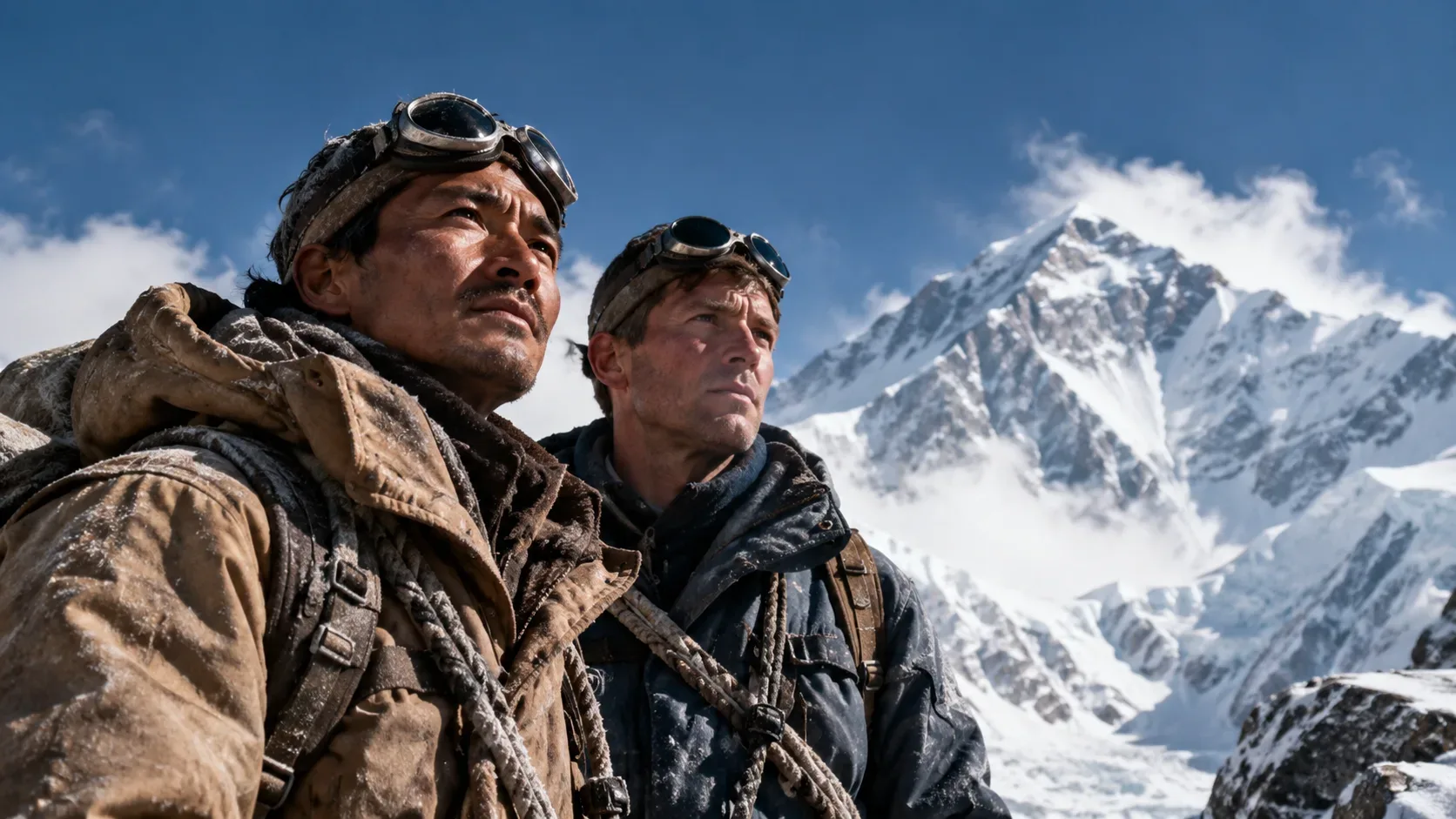
The official synopsis puts Tenzing Norgay at the center of the narrative. Genden Phuntsok plays the climber, Tom Hiddleston plays Edmund Hillary, Willem Dafoe portrays expedition leader John Hunt and Caitríona Balfe appears as Jill Henderson. The film is directed by Jennifer Peedom, who previously explored Everest in the documentary Sherpa.
According to the official movie page, the screenplay follows Tenzing's place on the 1953 British team, his relationship with Hillary and tensions involving class, background and ambition within the expedition. Apple also highlights a contrast between a Western idea of Everest as something to conquer and Tenzing's spiritual relationship with Chomolungma, the Tibetan name for the mountain.
What happened during the 1953 expedition?
The timeline documented by the Royal Geographical Society helps identify the historical milestones that form the backbone of the film.
| Date | Historical milestone |
|---|---|
| April 12, 1953 | The expedition led by John Hunt establishes Base Camp and begins building a chain of camps through the Khumbu Icefall, Western Cwm and South Col route. |
| May 26 | Tom Bourdillon and Charles Evans make the team's first summit assault, reach the South Summit and turn back before the main summit. |
| May 28 | Edmund Hillary and Tenzing Norgay begin their final attempt and establish Camp IX at about 8,503 meters. |
| May 29, 6:30 a.m. | The pair leave camp using open circuit oxygen equipment. |
| May 29, 9:00 a.m. | Hillary and Tenzing reach the South Summit. |
| May 29, 11:30 a.m. | They reach the summit of Everest after overcoming the steep rock and ice section later known as the Hillary Step. |
These details are compiled by the Royal Geographical Society, an institution closely connected to the history of British Everest expeditions. Its record also shows that Tenzing was already an exceptionally experienced mountaineer who had taken part in several earlier attempts.
Is Jill Henderson's role in the movie historically grounded?
Yes. Jill Henderson is not simply a fictional intermediary created for the screenplay. Himalayan Club records describe Henderson as the club's local secretary in Darjeeling and give her a concrete role in recruiting Tenzing for the 1953 expedition.
An article in the Himalayan Journal says Tenzing was recovering from exhaustion after the Swiss attempts on Everest in 1952 and that Henderson persuaded him to accept John Hunt's invitation. That gives historical support to the dramatic thread announced by Apple, although specific dialogue, private meetings and individual confrontations can still be cinematic reconstructions.
The point that needs caution: the character Dawa
Apple identifies Thinley Lhamo as Dawa, described in the synopsis as Tenzing's wife. Here there is an important difference between the movie's presentation and the family chronology found in historical sources.
A family profile published by the Himalayan Club says Dawa Phuti, Tenzing's first wife, died in the 1940s. The same source identifies Ang Lamu as his second wife and records her presence with the family in 1953. Until the filmmakers explain the choice, the character named Dawa should therefore be treated as part of the movie's dramatization rather than an automatically literal recreation of Tenzing's family life in the year of the ascent.
What is historical fact and what belongs to dramatization?
| Element | How to treat it |
|---|---|
| Tenzing Norgay and Edmund Hillary reached the summit on May 29, 1953 | Widely documented historical fact. |
| John Hunt led the 1953 British expedition | Documented historical fact. |
| Jill Henderson helped persuade Tenzing to join the team | Supported by Himalayan Club records. |
| The relationship of trust between Tenzing and Hillary | The partnership is historical, but specific scenes and dialogue belong to the screenplay. |
| Class, empire, ambition and identity conflicts shown in particular scenes | These are themes Apple has announced for the film. The exact form of each confrontation is dramatized. |
| Dawa as Tenzing's wife within the 1953 portion of the story | Needs caution because the family chronology published by the Himalayan Club does not literally match that presentation. |
Main cast and real historical figures
- Genden Phuntsok: Tenzing Norgay.
- Tom Hiddleston: Edmund Hillary.
- Willem Dafoe: John Hunt.
- Caitríona Balfe: Jill Henderson.
- Thinley Lhamo: Dawa, as presented by the official movie materials.
What is still worth checking near release?
The main dates are set, but Apple still uses the phrase “select theaters” without listing every theatrical market in its announcement. For anyone who wants to see Tenzing in a cinema, the practical step is to check local listings from October 9. For streaming, the announced global date is October 16, 2026 on Apple TV.
For viewers interested in the real history, the clearest approach is to treat the May 29, 1953 summit, John Hunt's leadership, Jill Henderson's role in recruitment and the Hillary and Tenzing partnership as documented pillars. Dialogue, domestic scenes and personal confrontations should be treated as dramatic reconstruction unless specific historical evidence supports each scene.