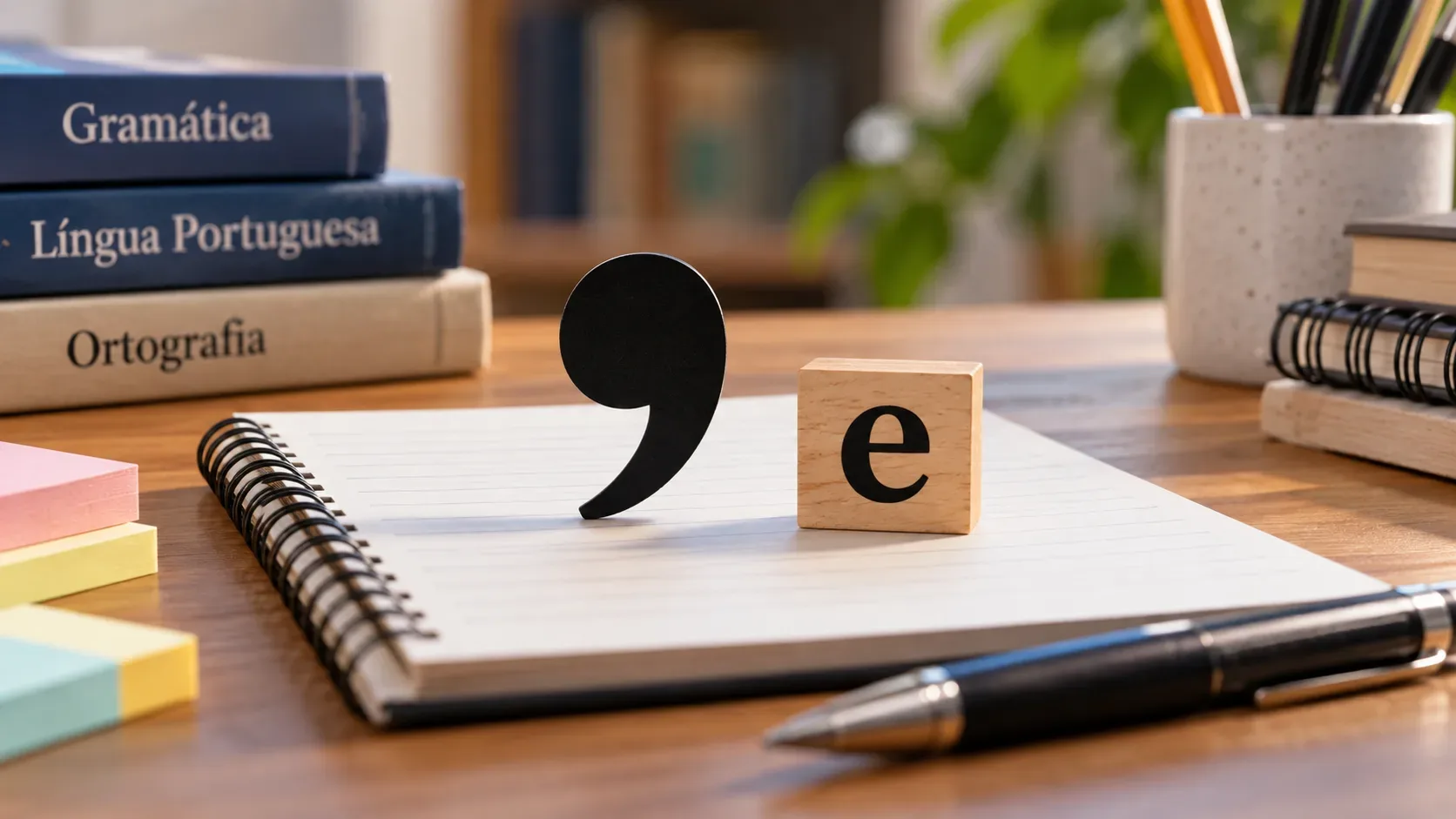
The most useful rule for deciding whether to place a comma before the Portuguese conjunction “e” (“and”) is to start with the normal case: in simple coordination, there is no comma. A comma appears when another syntactic reason requires punctuation, when a change of subject calls for clarity, or when the writer deliberately marks contrast, rhythm, or repetition.
This is why the statement “you never use a comma before e” is false — and also why automatically adding a comma whenever the subject changes creates a new problem. Some cases are required, some are optional, and some are inappropriate in neutral prose.
Starting rule: normally, there is no comma before “e”
When e links elements with the same function or clauses that continue the same structure, standard punctuation omits the comma:
- Comprei pão, leite e frutas. (“I bought bread, milk and fruit.”)
- Ana abriu o arquivo e revisou o texto. (“Ana opened the file and reviewed the text.”)
- O candidato leu o edital e enviou os documentos. (“The candidate read the notice and sent the documents.”)
In the last two examples, the subject is the same for both actions. Adding a comma before e without another reason — “Ana abriu o arquivo, e revisou o texto” — creates a break that the syntax does not require. In informative, academic, professional, or exam writing, the version without the comma is the safer choice.
The same applies to the last element of a list: “pão, leite, e frutas” is not the ordinary punctuation pattern in Brazilian Portuguese for a simple enumeration. A comma may appear in very specific stylistic contexts, but it should not be treated as a standard equivalent of the English Oxford comma.
Quick table: no comma, optional comma, or comma required by another structure
| Situation | Practical decision | Example |
|---|---|---|
| Same subject, coordinated actions | No comma | “Lia conferiu os dados e enviou a planilha.” |
| Simple enumeration | No comma before the final “e” | “Trouxe lápis, borracha e caderno.” |
| Clauses with different subjects | A comma may be used; it is especially helpful to prevent ambiguity or organize a long sentence | “A equipe terminou o relatório, e o diretor aprovou a versão final.” |
| “E” with a strong contrastive value | A comma may be used to mark the opposition | “Estudou durante meses, e não foi aprovado.” |
| Emphatic repetition of “e” | A comma may be used to mark rhythm | “Falou, e explicou, e insistiu, e voltou ao assunto.” |
| An inserted phrase ends immediately before “e” | The comma is required by the insertion, not by the conjunction | “O relatório, segundo a auditoria, e o anexo foram reenviados.” |
| An inserted phrase begins immediately after “e” | Use a comma after “e” to open the insertion | “Ele revisou o texto e, como combinado, enviou a versão final.” |
Different subjects: a comma is possible, but not universally mandatory
This is where simplified rules cause the most confusion. Grammars and style manuals recognize a comma before e when the second clause has a different subject, but they do not all formulate the guidance in the same way. A recent answer from Ciberdúvidas says that with different subjects a comma may be used. The Brazilian Senate Communication Manual, as an institutional style rule, limits the comma to cases in which the subjects differ and omitting it may create ambiguity.
In practice, compare:
- “Marina fechou a loja e Paulo chamou um táxi.”
- “Marina fechou a loja, e Paulo chamou um táxi.”
Both constructions can be defensible. The second marks the boundary between the two clauses more clearly. The longer the sentence, or the greater the risk of an initial misreading, the more useful the comma tends to become.
Here is a case where it helps considerably:
“A prioridade do setor é reduzir atrasos, e os supervisores devem acompanhar os novos prazos.”
Without the comma, the reader may initially parse “reduzir atrasos e os supervisores” as a sequence governed by the first verb and only later realize that “os supervisores” is the subject of the next clause. The comma acts as a boundary signal.
Insertions: sometimes the comma appears before “e” for another reason
One of the best ways to avoid memorizing isolated rules is to ask: if I removed the inserted phrase, would the comma still be necessary?
Consider:
“Resgatei um gato, que estava faminto, e levei-o para casa.”
The comma before e closes the explanatory relative clause “que estava faminto.” It is not there because of a special rule requiring a comma before the conjunction. Remove the insertion and the sentence becomes “Resgatei um gato e levei-o para casa,” with no comma.
The same reasoning explains punctuation after e:
“Vítor foi ao cinema e, como sempre fazia, comprou pipoca.”
The commas set off “como sempre fazia.” Dicio collects examples of this pattern when explaining commas before, after, and around e.
Repeated “e”: the comma changes the rhythm
When the conjunction is repeated emphatically — a rhetorical device known as polysyndeton — punctuation becomes part of the rhythm:
- “Ele falou e explicou e insistiu e voltou ao assunto.”
- “Ele falou, e explicou, e insistiu, e voltou ao assunto.”
The first sequence moves more quickly. The second creates stronger beats and draws attention to each action. Ciberdúvidas records the possibility of separating clauses with commas when the conjunction is repeated.
In literary, advertising, and opinion writing, that effect may be intentional. In technical writing, use repetition only when it serves a clear purpose; otherwise, restructure the sentence.
When “e” takes on a contrastive value
E normally adds ideas, but in some contexts it approaches the meaning of “mas,” “porém,” or “ainda assim” (“but,” “however,” “even so”). A comma can strengthen that change in expectation:
- “Estudou muito e não passou.”
- “Estudou muito, e não passou.”
In the first version, the sentence simply links the facts. In the second, the pause highlights the contrast between effort and result. This is an expressive use: it does not make every unexpected-result construction with e a mandatory-comma case.
When a comma before “e” becomes an error or a poor choice
In neutral writing, be suspicious of a comma when it cuts apart a structure that should stay together. The most common problems are:
- separating two verbs with the same subject for no expressive reason: “A aluna leu o capítulo, e respondeu às questões” → prefer “A aluna leu o capítulo e respondeu às questões”;
- separating the final item in a simple list: “Trouxe água, café, e chá” → prefer “Trouxe água, café e chá”;
- using commas as an automatic copy of spoken pauses: written punctuation follows syntactic structure and intended effect, not every breath;
- assuming different subjects always force a comma: many clear sentences allow both forms, and an editorial style may choose one.
It is also important not to confuse “a comma before e” with a comma that belongs to another construction. In “Ele prometeu voltar, apesar da chuva, e saiu cedo,” the comma before e closes “apesar da chuva.” Remove the insertion and the sentence returns to the normal pattern: “Ele prometeu voltar e saiu cedo.”
Sentence pairs: how punctuation changes the reading
1. Same subject
Neutral: “Clara abriu o arquivo e corrigiu os títulos.”
Marked: “Clara abriu o arquivo, e corrigiu os títulos.”
Without a deliberate stylistic effect, the first is preferable.
2. Different subjects
Continuous flow: “Clara abriu o arquivo e Bruno corrigiu os títulos.”
Clearer boundary: “Clara abriu o arquivo, e Bruno corrigiu os títulos.”
The comma helps announce the change of subject.
3. Contrast
Simple linkage: “Seguiu todas as instruções e o erro permaneceu.”
Emphasized contrast: “Seguiu todas as instruções, e o erro permaneceu.”
4. Insertion after “e”
Correct: “Ela revisou o contrato e, depois da reunião, enviou a nova versão.”
The comma comes after e because it opens the inserted adverbial “depois da reunião.”
5. Insertion before “e”
Correct: “Ela revisou o contrato, depois da reunião, e enviou a nova versão.”
The comma before e closes the inserted phrase.
A four-step test for deciding
- Identify what “e” is linking. Is it linking list items, two verbs with the same subject, or two complete clauses?
- Look for an insertion. If there is an explanatory or displaced phrase, punctuate that phrase first. A comma may end up next to e as a consequence.
- If the subjects change, test the sentence without a comma. If there is ambiguity, stumbling, or a long structure, the comma may improve the boundary between clauses.
- Ask whether there is a deliberate effect. Contrast, emphasis, and repetition can justify the comma; in neutral prose, do not invent a pause that the structure does not call for.
For exams, editing, and professional writing
When a question requires an objective answer, use this hierarchy: syntax first, clarity second, stylistic effect third. Do not insert a comma before e merely because you would pause while speaking. And do not remove a necessary comma merely because it happens to appear immediately before the conjunction.
For exams and exercises, also pay attention to the reference adopted by the testing body. Some teaching materials present “different subjects” as a direct rule; others treat the comma as optional or dependent on clarity. The safest formulation is that the comma is widely accepted in this context, but whether it is mandatory depends on the construction and the editorial standard being followed.
In short: “e” by itself neither forbids nor requires a comma. Identify the structure of the sentence. If nothing beyond simple coordination is happening, do not use one. If there is a change of subject, an insertion, contrast, or emphatic repetition, evaluate the specific reason — that reason, not the conjunction in isolation, determines the punctuation.