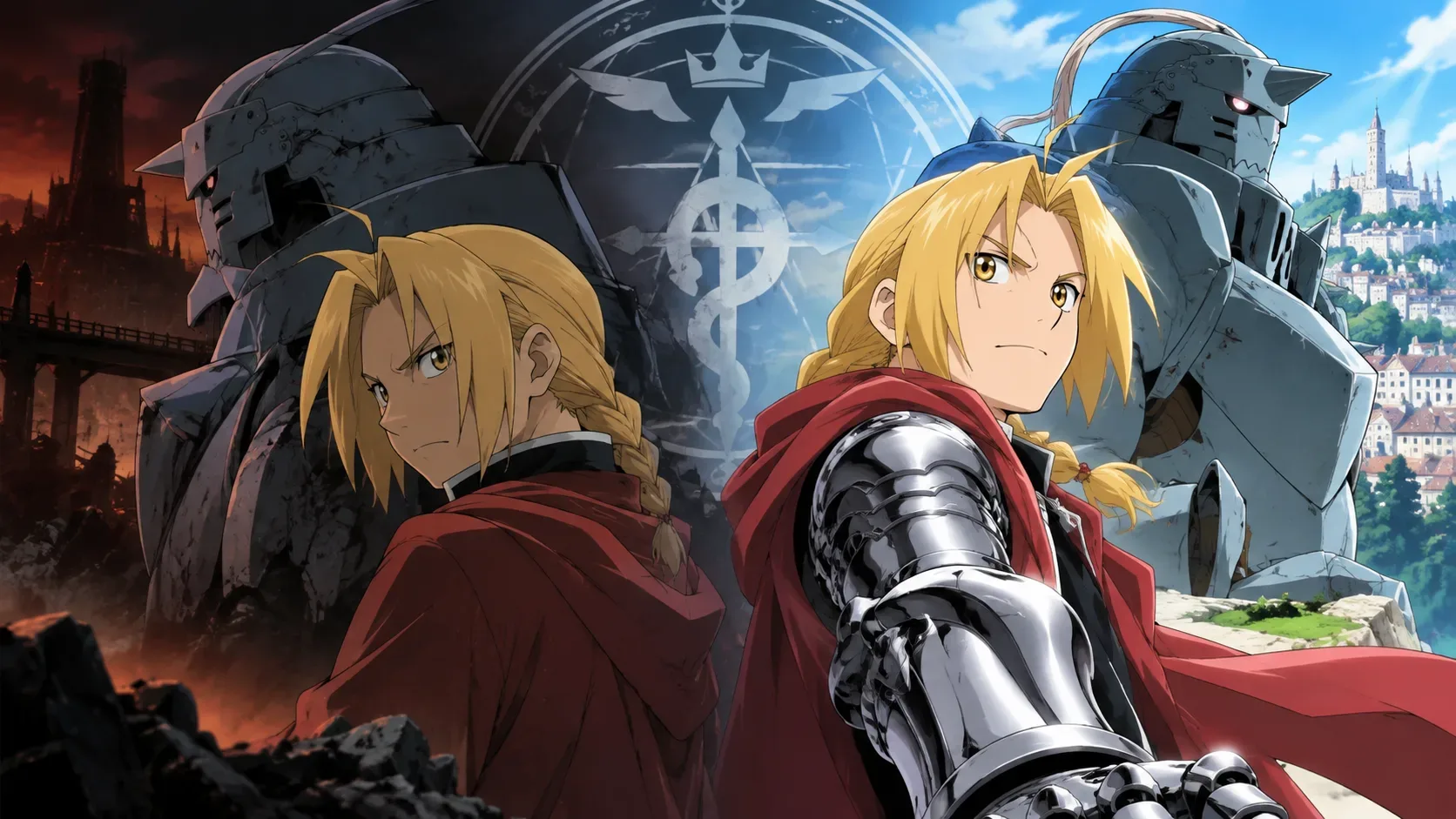
Short answer: the 2003 Fullmetal Alchemist and Fullmetal Alchemist: Brotherhood are not two seasons of the same continuity. They are separate adaptations of Hiromu Arakawa's manga. The 2003 series begins with the same premise and draws from early manga material, but gradually builds its own continuity. Brotherhood, released in 2009, starts the story again and uses the manga as its main reference through the conclusion.
If you only want to watch one version and prefer an anime that follows the manga's complete storyline, start with Brotherhood. If you want to experience both interpretations, a simple route is to watch the 2003 series first, then the film Conqueror of Shamballa, and only after that start Brotherhood from episode 1. The key is not to treat one as a continuation of the other.
Do Fullmetal Alchemist 2003 and Brotherhood tell the same story?
They share the central characters, the premise of brothers Edward and Alphonse Elric, the concept of alchemy, and several early events. That makes the opening stretches feel familiar. The overlap, however, does not mean you can safely watch part of one version and continue with the other.
The 2003 adaptation was produced while the manga was still being published. Aniplex's official page identifies it as the 2003 anime and credits Hiromu Arakawa as the original creator. The official box set lists 51 episodes. As the series progresses, changes in order, characterization, and anime-original material support a separate continuity.
Brotherhood had a new main creative team, with Yasuhiro Irie directing, and returned to the beginning of the story. Aniplex lists the production as a 2009 to 2010 TV anime, and the final home-video volume confirms episode 64 as the finale. For that reason, Brotherhood should be treated as a new adaptation, not a sequel to the 2003 version.
Spoiler-free table: what changes between the two versions
| Aspect | Fullmetal Alchemist (2003) | Fullmetal Alchemist: Brotherhood |
|---|---|---|
| Source approach | Begins from the manga and progressively develops a separate continuity. | Restarts the adaptation and uses the manga as its main framework through the ending. |
| Episode count | 51. | 64. |
| Early pacing | Spends more time on some early events and includes original episodes and scenes. | Handles part of the opening more compactly, then expands as the larger story develops. |
| Divergence | Gradual. Changes appear early and accumulate, so there is no single ideal episode where you can “switch” versions. | Follows its own adaptation from episode 1 and does not assume viewers watched the earlier series. |
| Characters and world rules | Some roles, relationships, explanations, and consequences are unique to this continuity. | Prioritizes the relationships, rules, and developments established in the manga. |
| Ending | Has its own conclusion and a direct film continuation. | Completes its main storyline within the 64 TV episodes. |
| Related film | Fullmetal Alchemist the Movie: Conqueror of Shamballa continues the 2003 series. | The Sacred Star of Milos is a theatrical adventure associated with the Brotherhood era, but it is not required to understand the TV finale. |
Why is there no perfect episode where you can leave 2003 and jump to Brotherhood?
Because the differences do not arrive at one clean cut. The 2003 version rearranges and alters elements from early on and introduces original material. Even when an event resembles something in the manga or in Brotherhood, its context may have been built differently.
That affects motivations, relationships, and the purpose of certain information. Jumping from one series to the other halfway through can create gaps or make an explanation seem contradictory. To avoid confusion, the safest approach is to treat each anime as a self-contained work and begin either one with episode 1.
Is the pacing really that different?
Yes, but the difference is not simply “one is fast and the other is slow.” The 2003 series gives more screen time to some early events and also uses that space to establish material that only matters inside its own continuity. Some early arcs therefore last longer, but part of that length comes from anime-original decisions.
Brotherhood reintroduces the origin, basic rules, and necessary characters, but handles some familiar material more compactly before moving into a much larger portion of the manga's storyline. After that opening stage, it develops characters, locations, and conflicts that the 2003 adaptation does not handle in the same way.
Your sense of pacing also depends on watch order. If you see 2003 first, the beginning of Brotherhood may feel more direct. If you start with Brotherhood, you may notice that 2003 lingers longer on certain stages and changes the function of familiar scenes.
Which one should you watch first if you are new to Fullmetal Alchemist?
Route 1: I want one version that tracks the manga's complete storyline
Start with Fullmetal Alchemist: Brotherhood. Its 64 episodes have their own beginning, development, and ending. You do not need to watch the 2003 series first because Brotherhood introduces the world and characters again from scratch.
This is the simplest route if you want to understand the manga-centered version of the franchise without first learning an alternate continuity.
Route 2: I want to compare both adaptations without mixing continuities
Watch Fullmetal Alchemist (2003) from episode 1 through 51. Then watch Conqueror of Shamballa, which Aniplex presents as the theatrical continuation of that era. After that, begin Brotherhood at episode 1 and continue through episode 64.
This order allows the 2003 version to work as a complete experience before you learn the manga-based solutions adapted by Brotherhood. It also makes it easier to see how the same starting points can lead to very different storytelling choices.
What if I watch Brotherhood first?
That works too. After the 64 episodes, you can go back to 2003 as an alternate interpretation. The only caution is not to expect the older series to function like a rough draft of Brotherhood. It has its own logic, additions, and answers.
If your priority is “see the manga-based continuity first,” Brotherhood makes sense as the opening. If your priority is “watch both and compare how the adaptation changed,” starting with 2003 creates a natural historical progression between the productions.
Where do the movies fit?
Conqueror of Shamballa, released in 2005, belongs to the continuity of the 2003 anime. Aniplex's official page begins directly from the situation left by the brothers at the end of that series. It is therefore not a film to place after Brotherhood.
The Sacred Star of Milos, released after Brotherhood, uses the characters and setting associated with that production for an additional theatrical adventure. It does not replace or extend the main ending of the 64 TV episodes. For a straightforward first watch, it can be left until after the TV series.
Do you need to watch both to understand Fullmetal Alchemist?
No. Each version can be understood on its own. The value of watching both is comparative: 2003 shows what an adaptation can do when it turns existing material into a different continuity, while Brotherhood shows how the same premise works when the anime follows the manga's broader path.
In short: do not mix episodes between the two versions. For a single experience aligned with the manga's complete arc, choose Brotherhood. To explore both interpretations, watch 2003 + Conqueror of Shamballa, then start Brotherhood from the beginning. That avoids unnecessary spoilers and, more importantly, avoids mistaking continuity differences for errors.