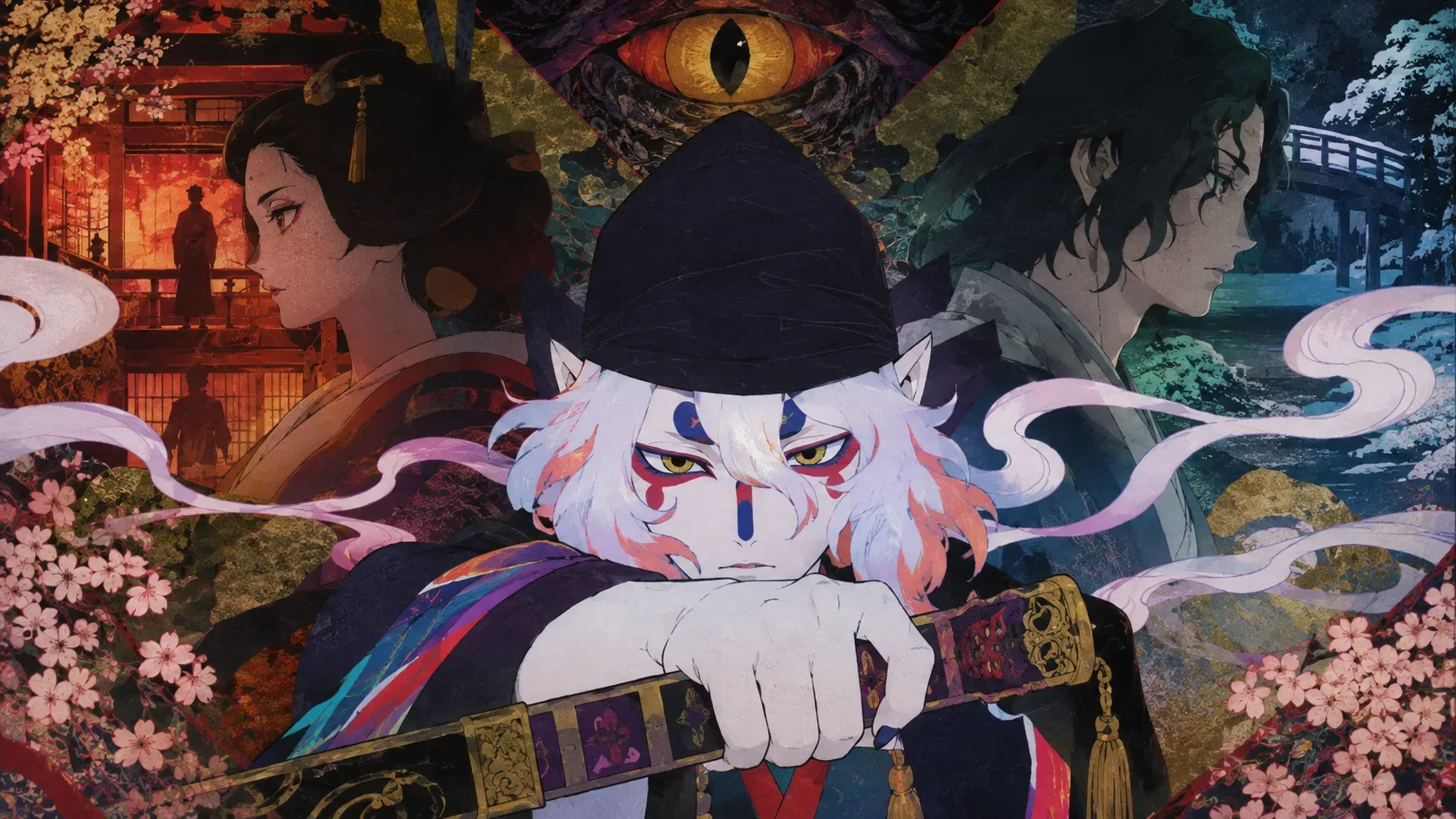
Warning: this guide contains spoilers for Mononoke The Movie: The Phantom in the Rain and Mononoke The Movie: Chapter II – The Ashes of Rage, but it avoids revealing the ending of the third movie.
If you want to reach the finale without rewatching the entire trilogy, the key point is that the movies form one continuous story inside the Ōoku — the space of power, service, and succession tied to the Emperor — and each chapter climbs one step higher in its female hierarchy. Netflix presents Mononoke The Movie: Chapter III – The Curse of the Serpent as the trilogy’s conclusion and has set its streaming premiere for September 29, 2026. That is the Netflix premiere: in Japan, the film had already opened theatrically on May 29, 2026.
The first two chapters are available on Netflix. If you mainly remember the visual style and the Medicine Seller, this is the minimum map you need to rebuild the story.
The essentials in 60 seconds
- The setting is still the Ōoku. The three movies are not disconnected anthology stories: events, survivors, and power struggles carry from one chapter to the next.
- The Medicine Seller cannot simply draw his sword. To exorcise a mononoke, he must identify three elements: Shape, Truth, and Reason. That is why investigating people, trauma, and power relationships is part of the battle.
- The first film shows the system through newcomers. Asa and Kame enter the Ōoku and discover the human cost of its rules, rituals, and silences.
- The second shifts the conflict to elite concubines. Botan takes over the administration, Fuki moves to the center of a succession dispute, and the Fire Rat emerges from another layer of violence surrounding motherhood and heirs.
- The third reaches the top. Netflix says the focus now moves to the Midaidokoro, the highest-ranking woman in the Ōoku, while foreshadowing planted since Chapter I converges in the finale.
How the three movies fit together
Netflix itself describes the trilogy as a progression of viewpoints. The Phantom in the Rain spotlights a newly arrived maid; The Ashes of Rage moves to the Ochurou, elite concubines of the Ōoku; and The Curse of the Serpent arrives at the Midaidokoro, the highest-ranking woman in the institution.
This structure matters more than memorizing minor names. What changes from film to film is the level of the hierarchy; what remains is the question of how an institution turns desire, duty, motherhood, ambition, and resentment into the conditions from which a mononoke can emerge.
Movie 1: The Phantom in the Rain — what actually matters
Asa and Kame enter the same system through different doors
Asa and Kame arrive as new maids. Asa is disciplined, ambitious, and wants to advance through her work; Kame seeks belonging and experiences the Ōoku more spontaneously. Their friendship gives the trilogy its first emotional viewpoint: the institution demands adaptation, obedience, and the surrender of parts of individual identity.
Right after entering, the newcomers take part in a ritual tied to Omizusama, the faith practiced inside the Ōoku, in which they must offer something precious. The imagery of water, the well, and what women are forced to leave behind is not just visual decoration; it becomes one of the symbolic and institutional threads the trilogy keeps carrying forward.
Karakasa turns repression into a supernatural threat
As the Ōoku prepares a ceremony connected to an imperial birth, strange phenomena and deaths begin. The Medicine Seller investigates until he can assemble Shape, Truth, and Reason and confront Karakasa, the mononoke tied to the emotions and discarded lives within that system.
For the third film, you do not need to reconstruct every step of the investigation. Keep the central idea: the mononoke does not appear separately from the social structure of the Ōoku. The supernatural gives form to a human history the palace itself tried to hide.
What remains from Chapter I
Asa stays connected to the Ōoku and returns in the continuing story. The official character material for the third film presents her working with public records and researching old documents about Omizusama on Botan’s orders. That explains why a character introduced as a newcomer still matters once the plot starts digging into the institution’s roots.
Movie 2: The Ashes of Rage — what leads directly into the finale
Botan takes command and clashes with Fuki
After the previous crisis, Otomo Botan, a woman from an influential family, takes charge of the Ōoku’s administration and tries to restore discipline and balance. That puts her on a collision course with Fuki, a common-born concubine who won the Emperor’s favor and rose through a very different path.
At the same time, the palace is discussing who will care for the baby born to Yukiko, the Emperor’s lawful wife. Succession stops being background texture and begins organizing alliances, fears, and conspiracies.
Fuki’s pregnancy turns motherhood into a political issue
Everything changes when Fuki becomes pregnant. Men in power treat the child as a problem for the succession order, and schemes intended to eliminate that “spark” expand the violence inside the Ōoku. In parallel, people begin spontaneously combusting and turning to ash.
The Medicine Seller discovers that the attacks are connected to the children of the Fire Rat, who are searching for their mother. Again, the supernatural case cannot be solved without understanding who wanted a life erased, who was silenced, and why the protection of children and mothers became the center of the manifestation.
Where the pieces stand after Chapter II
Official material for the third chapter shows that several relationships have shifted. Fuki has now given birth to a daughter, and her former rivalry with Botan has turned into friendship. Asa remains inside the Ōoku. Meanwhile, deaths among council figures alter the political balance and increase the influence of Suikoin, the Emperor’s mother. In other words, the finale does not reset the board: it finds an institution that survived two exorcisms but was politically rearranged by them.
Characters worth keeping in mind
| Character | What to remember before the third movie |
|---|---|
| Medicine Seller | Investigates mononoke and needs Shape, Truth, and Reason to release the exorcism sword. |
| Asa | One of the first film’s protagonists; she stayed in the Ōoku and now works with records and the history of Omizusama. |
| Otomo Botan | Took over the administration in the second film; began in conflict with Fuki and reaches the third in a different political and personal position. |
| Fuki | A common-born concubine favored by the Emperor; her pregnancy was at the center of the conspiracies in The Ashes of Rage. |
| Yukiko | The Emperor’s lawful wife and a key figure in the succession line; the final chapter moves the focus to the highest level of the female hierarchy. |
| Suikoin | The Emperor’s mother; she gains weight inside the Ōoku after the deaths and political shifts of Chapter II. |
| Hokuto Mizorogi | A priest tied to the Omizusama faith. Official finale material connects him directly to the mystery surrounding the origin of the new threat. |
What the third movie picks up without requiring a full rewatch
1. Omizusama. The water-linked faith and rituals appear from the beginning and stop being just local custom: official material for the third film again highlights the belief, its records, and the priest Hokuto Mizorogi.
2. Succession. Babies, heirs, pregnancy, and women’s rank in the Ōoku already drove Chapter II. The finale carries that tension to the top of the hierarchy.
3. Asa, Botan, and Fuki’s continuity. They are not simply memories from closed cases. Their presence shows that the first two movies changed the human board on which the final mononoke appears.
4. The Medicine Seller’s method. When the third film presents a new mononoke, the useful question is not only “how can it be defeated?” but “what human history provides its Shape, Truth, and Reason?”
5. The idea that the Ōoku accumulates history. Netflix says the final chapter ties together foreshadowing planted since the first film. Recurring elements — water, records, lineage, rules, offices, and erased memories — therefore matter more than isolated combat details.
What is detail you can safely leave behind
If your goal is simply to be ready for the finale, you do not need to memorize the order of every death, every tool used by the Medicine Seller, or every official and councilor from the previous chapters. You also do not need a scene-by-scene reconstruction of the Karakasa and Fire Rat resolutions.
Prioritize relationships and institutions: who remained in the Ōoku, who gained or lost power, how motherhood and succession became political, and why Omizusama keeps returning. That set of ideas explains the third movie’s starting point better than a purely chronological recap.
How to be ready for September 29
If you have very little time, keep four ideas in mind before pressing play: Asa stayed in the Ōoku; Botan and Fuki went through a conflict that ended in a new relationship; Yukiko sits at the center of the succession line; Omizusama and the history of the Ōoku itself still hide answers. With that, the move from Karakasa to the Fire Rat and finally to the serpent stops looking like a sequence of monsters and becomes what the trilogy has been building: a layered investigation of the same institution.
Netflix confirms September 29, 2026 as the streaming premiere of Mononoke The Movie: Chapter III – The Curse of the Serpent. For official information and trilogy context, see the Netflix announcement, the September release list, and the official movie website. The first two chapters can also be checked on Netflix through The Phantom in the Rain and The Ashes of Rage.