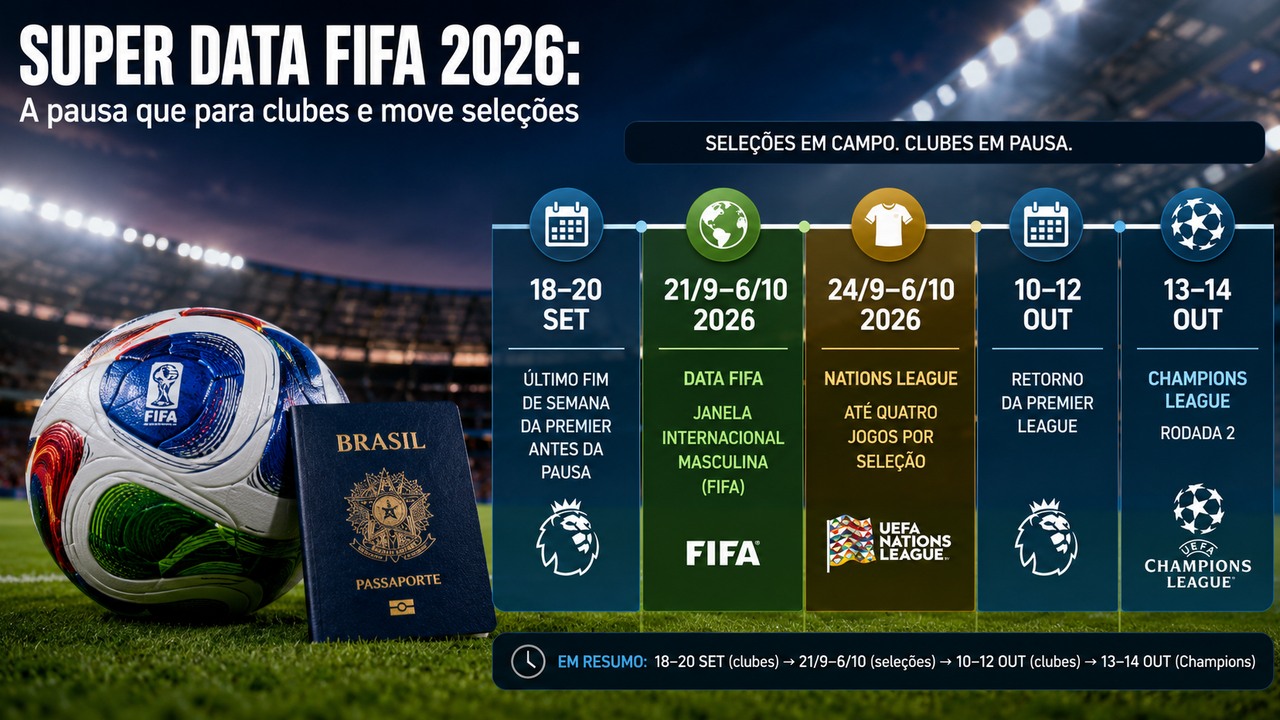
The so-called 2026 FIFA Super Data runs from September 21st to October 6th. This is the official break of the FIFA men's international window for the end of September and the beginning of October. The main new feature is the size: there are 16 days reserved for the teams, with space for up to four matches, instead of two separate breaks as occurred in September and October 2025.
For those who follow European football in Brazil, the consequence appears clearly on the calendar. The Premier League plays its last round before the break between September 18th and 20th, has no league games during the international window and returns between October 10th and 12th. The Champions League, in turn, will only return after this weekend, with the second round of the league phase on October 13th and 14th.
The FIFA 2026 Super Data timeline
September 18th to 20th: last weekend of the Premier League
The official Premier League schedule places the round immediately before the break from Friday 18 September to Sunday 20 September. The last game scheduled for this block is Fulham x Manchester United on Sunday. After that, the English championship has no matches scheduled until October 10th.
This means that the expression “September break” can be confusing in 2026. It starts in September, but runs through the beginning of October and replaces the pattern of two close breaks that fans were used to seeing in many previous calendars.
September 21: FIFA international window begins
FIFA sets September 21 as the first day of the window and October 6 as the last. The window is valid for all confederations and was designed to accommodate up to four national team games.
The name “Super Data FIFA” is a popular way to describe this longer block. In official documents, FIFA treats the period as a 16-day, four-match international window. The change was approved to take effect from 2026.
September 24 to October 6: four rounds of the Nations League
In Europe, UEFA fits the first four rounds of the 2026/27 Nations League within this period. The first round is scheduled for September 24th to 26th, the second for September 27th to 29th, the third for September 30th to October 3rd and the fourth for October 4th to 6th.
Therefore, there is no contradiction between the FIFA Date starting on September 21st and the Nations League starting on September 24th. The FIFA window is the global interval reserved for national team football; the Nations League is a UEFA competition that occupies part of this range with its own dates.
UEFA advises that participating teams will generally play four Nations League matches in succession in this first block. This helps explain why the European calendar shows four rounds packed into less than two weeks.
October 10th to 12th: the Premier League returns
The Premier League resumes the season on Saturday, October 10th, continues on Sunday, 11th, and closes the round on Monday, 12th, with Coventry City x Newcastle United in the current schedule.
Between the end of the round on September 20th and the beginning of the round on October 10th, there are around three weeks without the Premier League. For some clubs, the distance between one league match and the next will be a little longer or shorter depending on the exact day they play before and after the break.
October 13th and 14th: the Champions League returns
The 2026/27 Champions League takes place in the first round of the league phase on September 8, 9 and 10. The second round is only scheduled for October 13th and 14th, immediately after the first weekend of the Premier League post-FIFA Date.
This design creates an unusual gap between the first two rounds of the Champions League. Instead of a continuous European run during September, the club competition gives way to the international bloc and resumes in mid-October.
Why the 2026 FIFA Date may have four games
The explanation lies in the reform of the international men's calendar. When approving the calendar from 2025 to 2030, the FIFA Council defined that, from 2026, the two short windows of September and October would be replaced by a single window at the end of September and beginning of October.
Before this change, the typical design was a break in September and another in October, each with nine days and space for two matches. In 2026, this stretch will become a 16-day block with up to four games.
The practical effect is to reduce the number of times the club season is interrupted, but make the first international break of the European season much longer. The Premier League summarizes its 2026/27 calendar into three selection windows during the season: September 21 to October 6, November 9 to 17 and March 22 to 30.
Four games, however, do not mean four mandatory matches for every team in the world. FIFA reserves the window and allows up to four dates. Each confederation and each team uses this space according to its competition and schedule. In the case of UEFA, the Nations League was set up to occupy the block with four rounds.
Data FIFA and Nations League are not the same thing
This distinction is important for Brazilian fans. FIFA Data is the global international window. It is this that determines the period in which the club calendar needs to make room for the national teams and in which call-ups can occur in the different confederations.
The Nations League, on the other hand, is a UEFA competition. Brazil does not compete in the European Nations League. When the calendar shows “September 24 to October 6” for the Nations League, it is talking about European teams and a specific competition within the wider FIFA window.
This is also why different pages can show slightly different dates without necessarily being wrong. One may be reporting the start of the FIFA window on September 21st; another, the start of Nations League games on September 24; another, the final weekend of the Premier League on September 18-20.
How the break affects the Premier League in practice
The English season does not stop on the first day of September or at the start of the Nations League. It stops after the September 18th to 20th round. From then on, the league calendar leaves the period free for the selections and reschedules games on October 10, 11 and 12.
For clubs, the interruption has different effects. Summoned players travel and play matches for their national teams, while those not called up remain with their clubs. When everyone returns, some teams may have little time to prepare before their next match, especially those that also play in UEFA competitions.
The Premier League itself considers the dates of FIFA and European competitions when putting together the table. The championship also warns that match times and even match days may be subject to adjustments due to television, domestic cups and UEFA commitments. Therefore, the design of the break is stable, but the schedule of a specific club should be checked closer to the round.
Effect on the Champions League
The Champions League does not have its own “break” between September 21st and October 6th. What happens is that your calendar respects the international window and leaves the second round of the league phase for after it.
The first round takes place from September 8th to 10th. Then there are still domestic commitments and, for some teams, games from other European competitions before the FIFA Date. Round 2 of the Champions League only comes on October 13th and 14th.
For English clubs competing in the Champions League, the return can be tight. The Premier League returns between October 10th and 12th and the Champions League begins its next round on the 13th. Scheduling principles try to preserve recovery time, but the combination of the national league, international travel and European competition means the return will be different for each team.
The calendar in a sentence
To follow without confusion, think about the complete sequence: the Premier League plays for the last time before the break between September 18th and 20th; the FIFA window runs from September 21 to October 6; the European Nations League features four rounds from September 24th to October 6th; Premier returns from October 10th to 12th; and Champions returns on October 13th and 14th.
The difference between these dates is not a calendar error. Each marks a different layer of football: the global national team window, the European national team competition, the English championship and the European club competition. In 2026, they all fit together around a single longer international break at the start of the season.