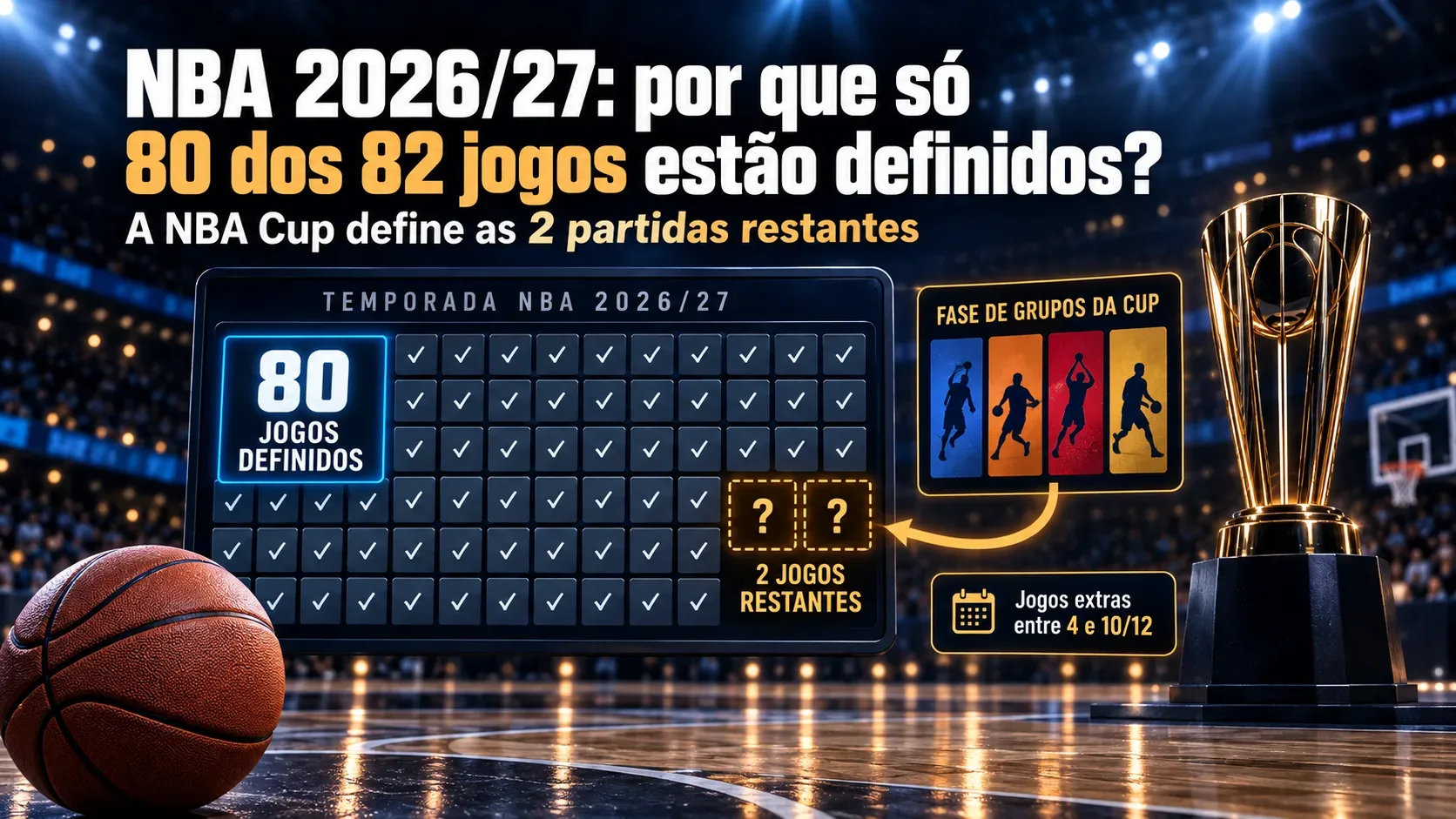
The 2026-27 NBA schedule is not “missing” two games because of an error. The league released dates and opponents for 80 of each team’s 82 regular-season games and deliberately left two slots open. Those matchups will be determined by the results of the Emirates NBA Cup 2026 Group Play stage and placed in the Dec. 4-10 window.
The key distinction is this: the four NBA Cup Group Play games are already part of the regular season and are already included in the 80 announced games. They are not four extra games. What remains unknown are two later games whose opponents and dates depend on which teams advance — or do not advance — to the Cup Knockout Rounds.
Why does the schedule show 80 games instead of 82?
Every team will still play an 82-game regular season. According to the official 2026-27 schedule announcement, the NBA published 80 matchups with defined dates and opponents and reserved two games per team to be determined after NBA Cup Group Play.
This happens because the in-season competition is integrated into the normal schedule. In Group Play, the 30 teams are divided into six groups of five, three per conference. Each team plays four games — one against every other team in its group, with two at home and two on the road. Those four games count normally in the regular-season standings.
So the correct reading is not “80 normal games + 4 Cup games + 2 games to be determined.” The total remains 82. The four Group Play games are already embedded in the 80 known games; only the two games in the Knockout-Round window remain open until the Cup standings are known.
How Group Play turns the two TBD slots into actual games
Group Play runs from Oct. 30 through Nov. 27. At the end of that stage, eight teams advance: the six group winners and one wild card from each conference. From there, each team’s path determines how the two remaining slots on its schedule are filled.
| Status after Group Play | How the two remaining games are filled |
|---|---|
| Team advances and reaches the Semifinals | The Quarterfinal and Semifinal count as two regular-season games. If the team also reaches the NBA Cup Championship, the Dec. 11 title game is an extra competition game and does not count among the 82 regular-season games. |
| Team advances but loses in the Quarterfinals | The Quarterfinal counts as one of the two pending games. The four Quarterfinal losers receive one additional regular-season game, scheduled for Dec. 7, 9 or 10. |
| Team does not advance to the Knockout Rounds | The 22 non-qualifiers play two regular-season games on days without Cup games, mainly Dec. 6-7 and Dec. 9-10. Matchups are built through a formula based on Group Play standings plus scheduling and travel constraints. |
This mechanism allows the NBA to wait until the Cup establishes which teams are occupied by Quarterfinals and Semifinals before finalizing the rest of the schedule. The detailed rules are in the official Emirates NBA Cup 2026 guide.
Which dates matter for completing the schedule?
- Oct. 30 through Nov. 27: Group Play, with four games per team.
- Dec. 4-5: Quarterfinals.
- Dec. 6-7: window for regular-season games involving teams that did not advance; Dec. 7 may also host the additional game for Quarterfinal losers.
- Dec. 8 and/or 9: Semifinals.
- Dec. 9-10: another window for regular-season fill-in games.
- Dec. 11: NBA Cup Championship in Indianapolis; this game does not count toward the regular season.
The official NBA Cup calendar sets the Quarterfinals, Semifinals and Championship dates. The regular-season schedule announcement states that the two initially unassigned games will be played in the Dec. 4-10 window.
How are opponents chosen for teams that miss the Knockout Rounds?
For the 22 teams that do not reach the Quarterfinals, the NBA uses Group Play standings as the basis for creating the additional games. The priority is to schedule same-conference matchups between teams that were otherwise set to meet three times during the original schedule whenever possible.
Because there are 11 non-qualifiers in each conference, not every team can be paired only within the East or only within the West. Therefore, two of the 22 fill-in games will be cross-conference matchups involving lower-finishing Group Play teams, subject to travel constraints. No team will play more than one of those cross-conference games.
What does this mean for fans looking at the schedule now?
Until Group Play ends, the two open slots should be treated as real regular-season commitments that simply do not yet have a final opponent and, in some cases, a final date. They do not indicate a cancellation, a shorter season or an expansion to 84 games.
After Nov. 27, NBA Cup results establish the Quarterfinal field and, as a result, which teams need fill-in games. The league can then complete opponents, home/away assignments and dates so that every team reaches the same 82-game regular-season total.
The main takeaway
The NBA left two slots open because the NBA Cup must affect the schedule without changing the 82-game total. The four Group Play games already count among the 80 published games. After that, Quarterfinals and Semifinals occupy the remaining slots for advancing teams, while teams that fall out of the tournament receive regular-season matchups created to complete their schedules. The schedule only looks incomplete now because part of it depends on results that have not happened yet.