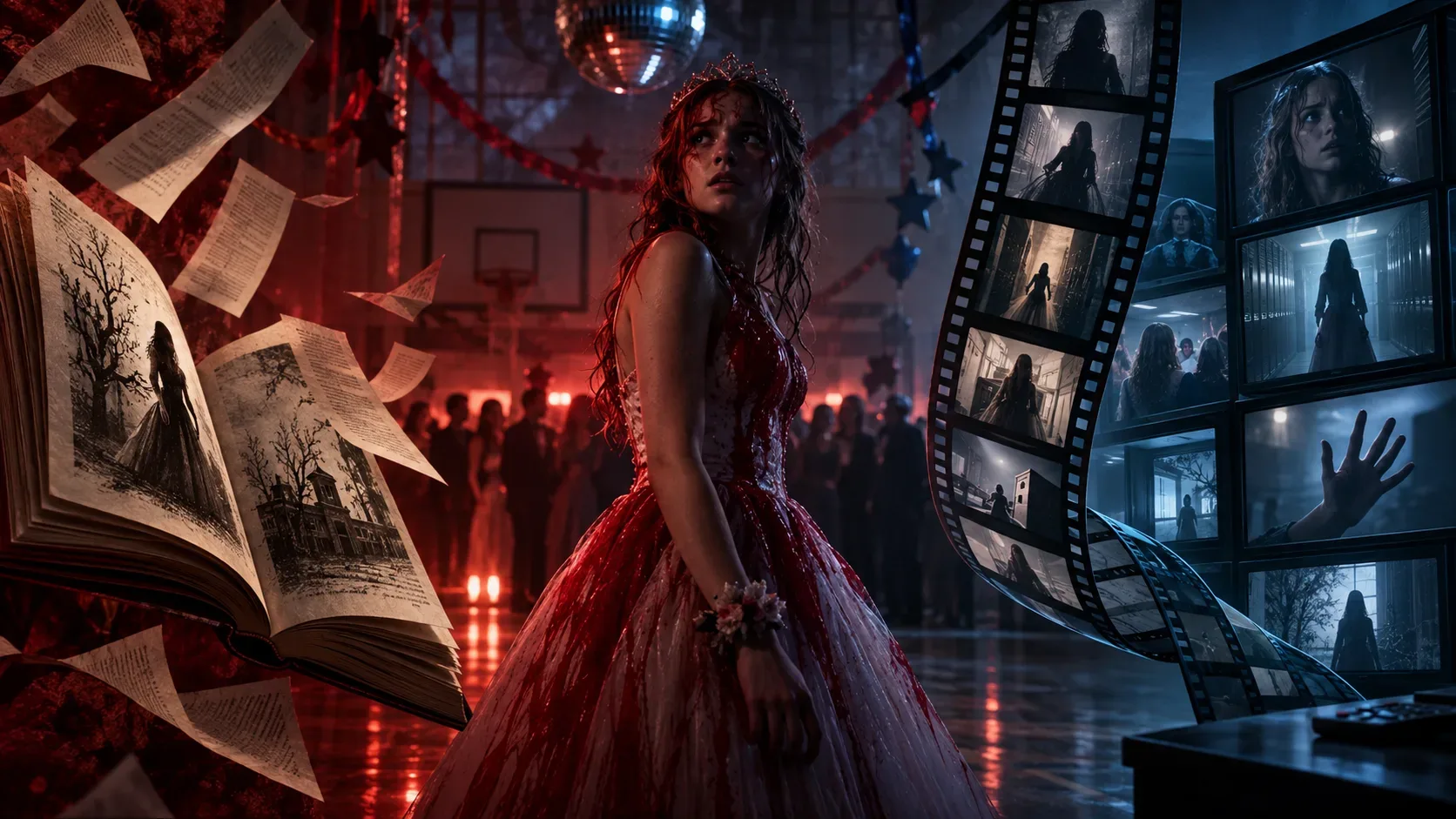
Short answer: the 2026 Carrie has not been announced as a remake of Brian De Palma's film. Amazon presents Mike Flanagan's production as a new adaptation of Stephen King's debut novel and, more specifically, as the first adaptation of the story in series form. That means it returns to the literary work as its source, even though it will naturally share characters, situations, and imagery familiar to viewers of earlier versions.
The distinction matters because a “new adaptation of the same book” and a “remake of a film” are not the same thing. A remake takes an earlier audiovisual work as its direct reference; a new adaptation can return to the literary text and make its own choices about structure, pacing, setting, and characterization. So far, the second definition is the one that best matches how Prime Video describes Carrie 2026.
What is officially confirmed about Carrie 2026
According to Amazon's official page, all eight episodes arrive on Prime Video on October 7, 2026. Mike Flanagan serves as showrunner, writer, and executive producer and directs four episodes. Stephen King is also an executive producer. The series is produced by Amazon MGM Studios.
The official synopsis also makes clear that the adaptation is not simply trying to reproduce an earlier film version. The new Carrie White, played by Summer H. Howell, faces bullying that becomes viral and the pressures of the social-media age. The story also incorporates the sudden death of Carrie's father as part of the circumstances that push her into public high school. These are elements officially presented as part of this contemporary reinvention.
Stephen King's official website likewise classifies the 2026 production as a television work for Prime Video, reinforcing that this is a new serialized project tied to the novel, not a continuation of the 1976 film.
So how does it relate to the 1976 film?
Brian De Palma's 1976 feature was the first screen adaptation of a Stephen King work and became the most influential version of Carrie. The author's official archive lists the De Palma film, while the BFI identifies it as King's first screen adaptation.
The 2026 series will inevitably revisit events the movies made famous because they belong to the novel: Carrie White, her oppressive relationship with Margaret, school bullying, the discovery of her telekinetic powers, and the prom. Repeating those story points does not make the series a remake. Calling the new production a remake of De Palma's film would require evidence that it is specifically recreating the 1976 film's audiovisual construction, and that is not how the official material currently describes it.
What about the other versions of Carrie?
Carrie has returned to the screen more than once. In addition to the 1976 film, there was a television movie in 2002; TV Guide describes it as a production based on Stephen King's novel. A new feature-film version followed in 2013, which the BFI refers to as a later remake.
That is why the phrase “first series adaptation” needs to be read precisely: this is not Carrie's first appearance on television, but it is the first time the story has been structured as an episodic series. The 2002 production was a self-contained TV movie; the 2026 production spreads the narrative across eight chapters.
What eight episodes change in practice
The main confirmed change is not a single plot event but the amount of narrative space. Amazon says the eight episodes expand the novel's world, deepen its characters and tensions, and follow the small choices that lead toward the story's major breaking point. That design differs from the compression required by a feature film.
In format terms, a series can devote full episodes or longer blocks to relationships that a movie has to condense: Carrie and Margaret's dynamic, Sue Snell's guilt and decisions, the roles of Chris Hargensen and Billy Nolan, school life, and the escalation of humiliation. That is a structural possibility created by the format, not a guarantee that every element of the book will be used. What is confirmed is the intention to deepen characters and tensions.
The social-media update also changes the mechanics of bullying. The official description refers to a viral scandal that tears through the community. The series therefore does not appear to be pursuing a period reconstruction of the 1974 novel or the 1976 film; it relocates the story to a contemporary environment where school cruelty can spread well beyond the school corridors.
What is known and what would still be speculation
| Question | Status as of September 2026 |
|---|---|
| Is it a remake of the 1976 film? | That is not how it was announced; the official source defines it as an adaptation/reinvention of the novel. |
| Is it based on Stephen King's book? | Yes. Amazon explicitly confirms this. |
| Is it the first TV version of Carrie? | No. There was a TV movie in 2002. |
| Is it the first adaptation in series form? | Yes, according to Amazon. |
| Does it have eight episodes? | Yes, with all eight scheduled for release on October 7, 2026. |
| Will it include more book scenes than the films? | The series has more room and promises greater depth, but specific scenes can only be verified after release. |
| Will it copy De Palma's shots or scenes? | There is no official confirmation supporting that conclusion before release. |
Why “adapted from the book” does not mean literal fidelity
Returning to the novel as the source does not require the series to follow the text page by page. The official promotion itself frames the project as a contemporary reinvention and already confirms contextual changes. That suggests the most useful comparison after release will be to examine which elements of the novel were preserved, expanded, condensed, or updated, rather than judging the series only by how closely it resembles the 1976 film.
It is also worth avoiding a common assumption: eight episodes do not automatically mean “more faithful.” Extra running time can be used for material from the book, for expanded supporting characters, or for newly created situations. Fidelity can only be assessed from what actually appears in the episodes.
What to watch for when the series premieres
To distinguish a literary adaptation from a simple reproduction of earlier versions, several points will be especially revealing: how the series uses the novel's structure and points of view; how much time it gives Margaret, Sue, Chris, and the other characters; how it turns bullying into a digital phenomenon; and whether the prom climax is built with its own choices of editing, perspective, and consequence.
Until release, the most precise formulation is this: Carrie 2026 is a new television adaptation of Stephen King's novel, designed as an eight-episode series, not an officially declared remake of the 1976 film. The change in format creates room for greater depth and modernization, but detailed claims about fidelity, restored book scenes, or direct references to earlier films should wait until the full episodes are available.