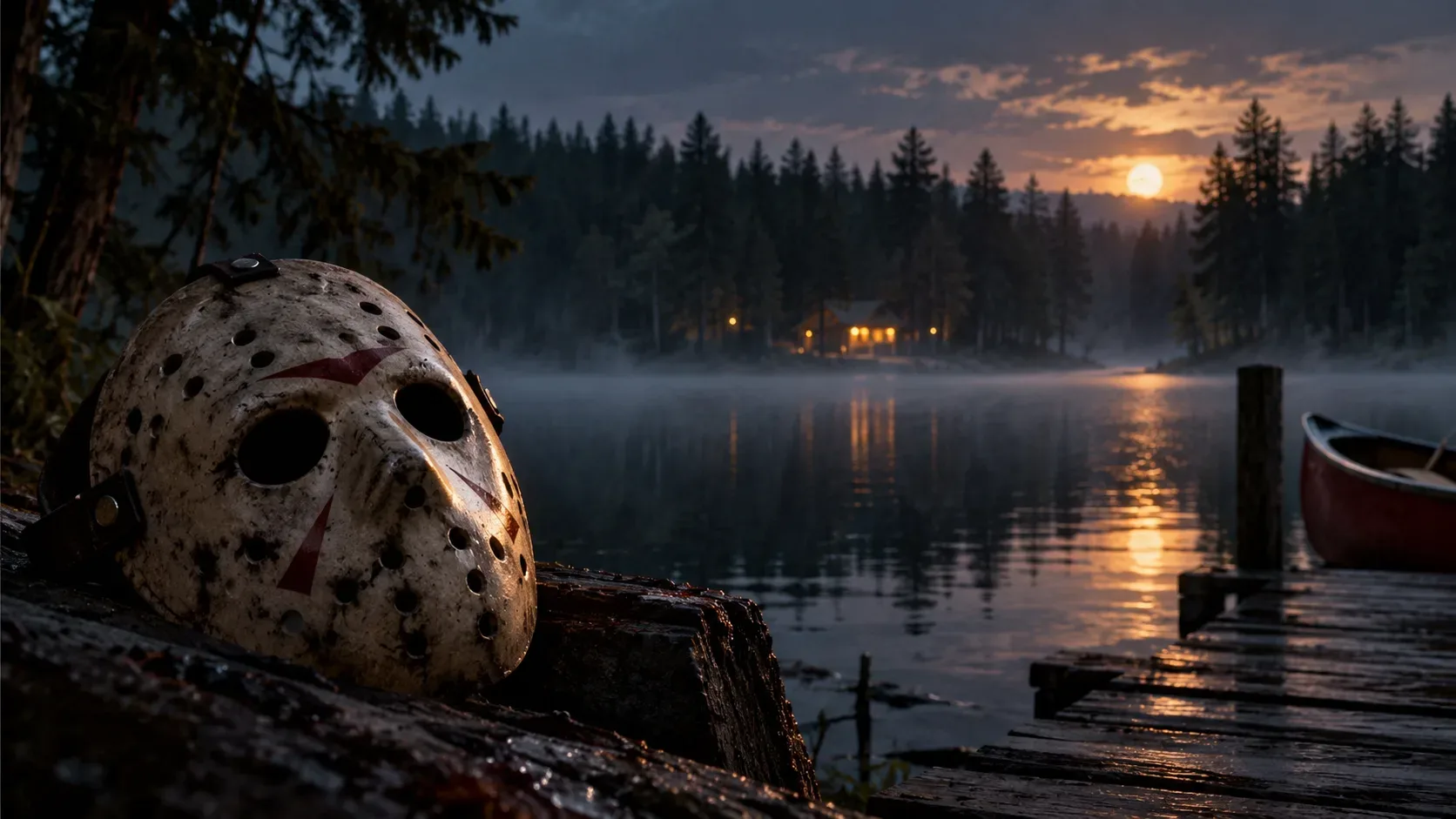
Short answer: Crystal Lake takes place before Friday the 13th (1980) and works as a prequel centered on Pamela Voorhees and Jason's childhood. But it should not be read as a literal, date-for-date insertion into the old timeline: showrunner Brad Caleb Kane confirmed that he took creative liberty by setting the series in the 1970s, even though the classic story places Jason's drowning in 1957. The trailer, meanwhile, confirms that we will see Pamela working at the camp, Jason as a child, and the incident in the lake that sets his mother's transformation in motion.
Where Crystal Lake fits in the Friday the 13th timeline
Peacock defines Crystal Lake as an “expanded prequel” to Friday the 13th and says the series is set before the 1980 film. The production has eight episodes, premiering on October 15, 2026, with all episodes released the same day. The simplest placement is therefore: Pamela and Jason's origin → Crystal Lake → the events of the first Friday the 13th.
That placement comes with an important caveat. In the original film, Pamela's account establishes that Jason drowned in Crystal Lake in 1957 while counselors were not paying attention. The movie's opening also shows two counselors, Barry and Claudette, being murdered in 1958. Kane told Entertainment Weekly that a strict reading of that timeline would place the series in the 1950s, but he chose to move the setting to the 1970s so the show could explore the culture and genres that preceded the franchise's cinematic birth.
| Point | Continuity presented by the 1980 film | What Crystal Lake does |
|---|---|---|
| Jason's drowning | It is described as having happened in 1957. | The series dramatizes the circumstances of the drowning but uses a 1970s setting. |
| Pamela Voorhees | She is revealed at the end as the killer who blames the counselors for her son's death. | She becomes the protagonist, with a story about her relationship with Jason and her deterioration after the loss. |
| Camp Crystal Lake | The 1980 film reaches the camp after decades of tragedy and failed attempts to reopen it. | The show depicts an earlier period, with residents, employees, and familiar characters still active. |
What you need to remember from the 1980 film
You do not need to rewatch the entire franchise to understand the prequel. The essential material is in the first movie. The American Film Institute catalog records that Pamela Voorhees was a former camp cook and that she was working there on the day a boy named Jason drowned. In the climax, she tells Alice that she blames the counselors for the tragedy and reveals herself as the person behind the murders meant to stop the camp from reopening.
That is why Crystal Lake changes the franchise's point of view: instead of beginning with Pamela already transformed into the threat seen in the first movie, the series wants to show the person and mother who existed before that stage. The prequel also brings back figures that the 1980 film used only briefly, turning fragments of exposition and minor characters into serialized material.
What the trailer confirms about Pamela Voorhees
The material published by Peacock on September 14, 2026 visually confirms several important details. Pamela, played by Linda Cardellini, appears working as a cook while the camp begins what seems to be a normal season. The mood changes when Jason gets into trouble in the water, and Pamela is shown reacting in horror.
This confirms that the series will not treat the drowning only as a story recounted after the fact. The event will be dramatized and will form a central part of Pamela's arc. Peacock itself describes the incident as the trigger for a sequence of events that causes her to unravel and, within the horizon of the familiar story, become the killer who seeks revenge against Crystal Lake's counselors.
The premise released before the trailer expands that idea: the main story follows Pamela while she is still reeling from the loss of her son, as two strangers arrive at her door and investigate her past. That suggests the season will combine Pamela's post-loss present with earlier scenes featuring Jason rather than tell everything as one simple, continuous timeline.
What is already confirmed about young Jason
Jason will physically appear in the series as a child. Entertainment Weekly identifies Callum Vinson as young Jason, and an earlier Peacock overview also lists Vinson in the role. Early publicity shows that the production gives the character distinctive physical features through makeup and prosthetics.
The trailer adds a narrative confirmation: Jason is at the camp, and his accident in the lake is presented as an event Pamela experiences directly rather than something remembered only by other people. That ties the series closely to the emotional core of the first film, but it does not settle every canon question. Promotional material still does not explain how the series will handle Jason's fate after the drowning or how closely it will follow the logic established by later movies.
Cast note: Peacock's September 14 article contains an internal inconsistency, calling Cameron Scoggins young Jason in one passage and correctly identifying him later as Officer Dorf. Peacock's cast overview and EW identify Callum Vinson as young Jason, making Vinson the most consistently supported credit.
Which legacy characters return and why that matters for the timeline
The series is not limited to the Voorhees family. Kane confirmed the return of Barry and Claudette, the two counselors associated with the opening of the 1980 movie, now played by Phoenix Parnevik and Danielle Kotch. Officer Dorf and Crazy Ralph also appear in expanded versions, while new characters such as police officer Levon Brooks and his journalist sister Brianna broaden the Crystal Lake community.
Those returns clarify the approach: Crystal Lake is building a more detailed version of the past that the 1980 movie summarized through dialogue, a prologue, and local legends. At the same time, the move to the 1970s shows that the series is not simply filling every gap without changing anything. It preserves recognizable events and relationships while reorganizing their historical context into an expanded origin story.
What the trailer still does not confirm
- Whether the series will keep 1957 as the canonical year of Jason's drowning or replace that date with the new setting.
- Whether Season 1 will reach the murders of Barry and Claudette or remain focused on the period immediately after the drowning.
- How the show will explain Jason's status between the lake incident and his later role in the franchise.
- Whether the season will end directly on the doorstep of the 1980 film.
- Who, besides Pamela, represents the danger hinted at by the trailer and the promotional campaign.
Those unknowns matter because they prevent an overconfident reading of the trailer. It confirms the emotional starting point and several characters, but it does not yet provide a definitive answer for every continuity issue in the franchise.
What viewing order makes the most sense
For viewers already familiar with Friday the 13th, the most intuitive chronological order becomes Crystal Lake → Friday the 13th (1980). The prequel is designed to explain background material that the original movie left as mystery or exposition.
For someone who has never seen the first film, release order still has an advantage: watching the 1980 movie first preserves the reveal of Pamela as the killer and lets the viewer later see how the series turns short clues into a larger story. In other words, Crystal Lake comes before the movie in event chronology, but it was created to speak to an audience that already knows the original's legacy.
Bottom line: Crystal Lake is clearly a prequel to the first Friday the 13th, centered on Pamela and Jason's relationship and the consequences of the drowning. The trailer confirms both characters at the camp and dramatizes the tragedy that propels Pamela's arc. The key timeline point is that the series deliberately relocates this origin to a 1970s setting, so it is best understood as an expansion and reinterpretation of the franchise's past rather than a literal reproduction of every date established in 1980.