
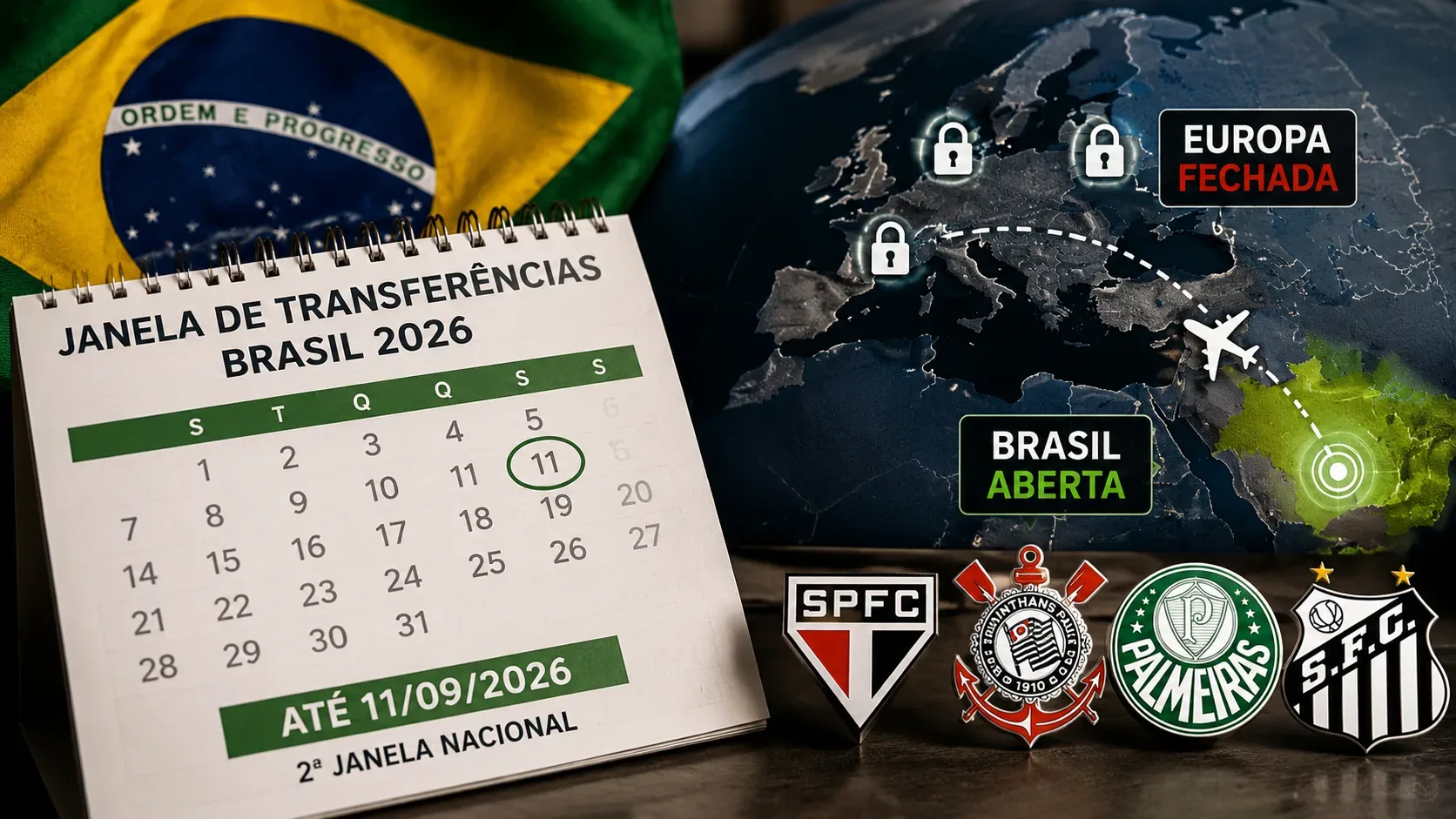
Brazil's second registration window for professional players in 2026 closes on September 11. The period opened on July 20, according to the calendar published by the CBF and recorded by FIFA. That is why Corinthians, Palmeiras, Santos and São Paulo can still add players even after major European markets close in early September.
The key point is simple: there is no single “global transfer window.” Each national association reports its own registration periods to FIFA. In 2026, for example, FIFA lists Brazil with a first window from January 5 to March 3 and a second from July 20 to September 11. The CBF also published the July 20 to September 11 period when detailing registration rules for 2026.
When does Brazil's 2026 transfer window close?
For men's professional football, Brazil's 2026 calendar has two main registration periods. The second one is the relevant deadline for the late-season market:
| Association/market | Opens | Closes | Why it matters to São Paulo's big four |
|---|---|---|---|
| Brazil (CBF) | 20 Jul 2026 | 11 Sep 2026 | This is the deadline for the second window to register new arrivals in Brazil. |
| England (Premier League) | 15 Jun 2026 | 1 Sep 2026, 23:00 BST | After the deadline, an English club normally can no longer register a new signing for that window. |
| Spain (LALIGA) | 1 Jul 2026 | 1 Sep 2026 | Spain's summer market closes before Brazil's. |
England's and Spain's dates are confirmed by the Premier League and LALIGA, respectively. The comparison shows why saying “Europe is closed” can be misleading: European countries do not necessarily share the same deadline, and one association's calendar does not replace another's.
Why do Corinthians, Palmeiras, Santos and São Paulo still have time after Europe closes?
Because all four operate under the Brazilian registration system and, for a signing that will be registered in Brazil, the relevant calendar is the CBF's. In other words, a European country's deadline does not automatically close Brazil's window.
International transfers are processed through FIFA's Transfer Matching System (TMS) and, when applicable, an International Transfer Certificate (ITC). In its international player transfer guide, FIFA explains that registration periods differ between associations and that TMS is compulsory for international transfers.
In practice, this creates an asymmetry that can benefit Brazilian clubs in early September: a player may be leaving a league whose incoming-registration period has already ended while Brazil still has an open window for incoming registrations until September 11. The destination-side registration process must be initiated within the applicable deadline, together with the required documentation and regulatory steps.
What can still happen between the European deadlines and September 11?
- A signing from abroad: a São Paulo club can negotiate the arrival of a player from another country while the Brazilian window is open. The source country's closed window should not be confused with Brazil's deadline to register an incoming player.
- A transfer between Brazilian clubs: domestic deals can also be registered during the Brazilian window, subject to registration rules and the specific competition rules governing the player's use.
- Loans and returns: these also depend on the correct regulatory framework and registration. For international moves, the relevant information must be entered and matched in TMS.
- Deals for a future window: clubs can negotiate agreements that take effect later. Reaching a commercial agreement and being able to register the player immediately are not the same thing.
What changes for a sale from Brazil to Europe after a European window closes?
The logic reverses. If a European club has already closed its incoming-registration period, it normally cannot immediately register a player arriving from Brazil in that same window, even if the Brazilian club is still inside the CBF deadline. The destination must have a valid regulatory basis to register the player.
That does not necessarily prevent clubs from negotiating a fee or signing documents for a future move. But a commercially agreed transfer is not, by itself, the same as a player being eligible to play immediately. Registration by the new club remains decisive.
For Corinthians, Palmeiras, Santos and São Paulo, the extra days through September 11 are therefore generally more useful for bringing players into Brazil than for sending players to European leagues that have already shut their incoming-registration windows.
Negotiation, transfer, registration and competition eligibility are different things
Much of the confusion around an “open window” comes from treating four separate stages as if they were identical:
- Negotiation: clubs and the player discuss price, wages, contract length, loan terms, bonuses and other conditions.
- Transfer: the change between clubs is formalised; for international moves, the TMS process and, when required, the ITC become part of the operation.
- National registration: the player must be registered by the new club's association under the applicable rules. For São Paulo's big four, that association is the CBF.
- Competition eligibility: beyond registration, the player must satisfy the tournament's specific regulations. A competition may have its own squad lists, deadlines or restrictions.
So saying “Brazil's window closes on September 11” does not mean that every player registered that day is automatically eligible for every match or competition. The tournament regulations still matter.
Why is Brazil's 2026 window longer than major European windows?
Brazil reorganised its 2026 domestic calendar around a long national season. The CBF scheduled Série A from January 28 to December 2, with a pause during the World Cup. Registration windows are part of that national calendar and do not need to match European leagues, which follow different seasons and scheduling constraints.
FIFA maintains a global transfer-window tool based on dates submitted by its 211 member associations. This decentralised structure is why Brazil, England, Spain and other countries can have different deadlines.
What São Paulo's big four need to watch through September 11
- check whether the destination association's window is open for the intended move;
- complete contracts and documentation with enough time for regulatory processing;
- for international transfers, comply with TMS and ITC procedures when required;
- check the specific rules of the Brasileirão and any other competition in which the player is expected to appear;
- do not confuse a signing announcement with completed registration and eligibility to play.
For supporters following Corinthians, Palmeiras, Santos and São Paulo, the key date is therefore September 11, 2026 for Brazil's second registration window. European deadlines around September 1 reduce some options — especially outgoing moves that would require immediate registration in those destinations — but they do not end the São Paulo clubs' ability to register reinforcements in Brazil while the CBF window remains open.