
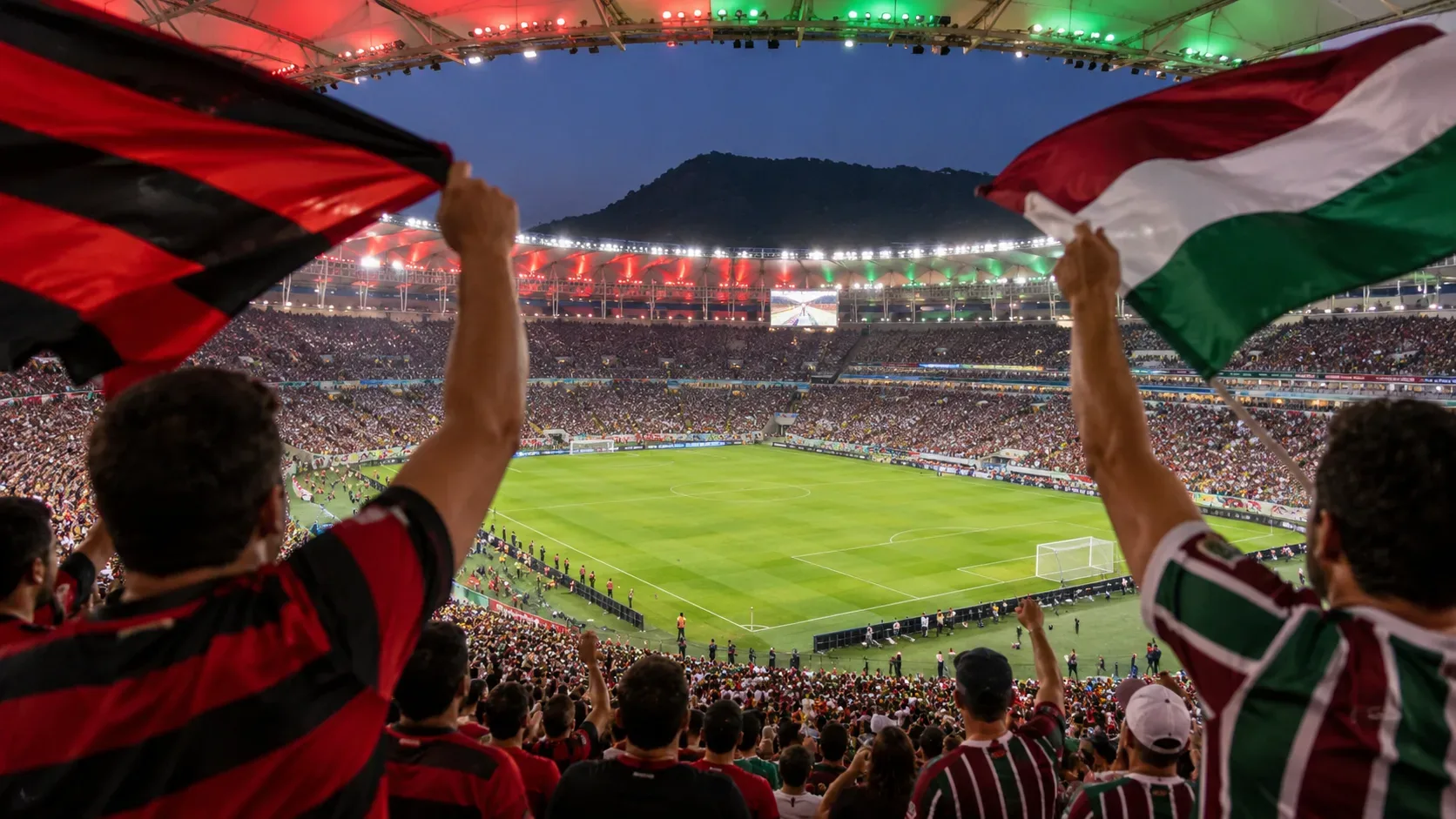
When Flamengo or Fluminense is listed as the home team in a Fla-Flu at Maracanã, more changes than the order of the club names on the fixture list. Home status affects who structures the main ticket sale, which membership programs get priority, which benefits apply, how supporter sections are allocated and which commercial services are offered. At the same time, this does not mean the home club is solely responsible for the stadium: the Maracanã Complex is managed by Fla-Flu Serviços S.A., a company formed by both clubs under the concession agreement signed with the Rio de Janeiro state government.
The key point: home-team status and stadium management are different things
Maracanã has a permanent operating structure, currently under Fla-Flu Serviços S.A., but each match has a sporting organizer defined by the competition. In Flamengo x Fluminense, Flamengo is the home team. In Fluminense x Flamengo, Fluminense is the home team. That role normally concentrates the practical definition of the event's commercial policy, always within the competition regulations, security rules and stadium obligations.
| Aspect | Flamengo as home team | Fluminense as home team | What supporters should check |
|---|---|---|---|
| Main ticket sale | Structured around Flamengo's channels, sales waves and benefits | Structured around Fluminense's channels, check-ins and benefits | The home club's official website and the specific match notice |
| Membership program | Nação plans may receive home-match priority and discounts | Sócio Futebol plans may receive their own priority, check-in and discounts | Away benefits may be smaller or follow a different rule |
| Supporter sections | In a 2026 Brasileirão example, North was for Flamengo and South for Fluminense | In a 2026 Brasileirão example, South was for Fluminense and North for Flamengo | The configuration can change by competition or operational decision |
| Services and hospitality | May include home-club products such as Espaço Fla+ and specific Maracanã Mais rules | May include services, parking and conditions announced by Fluminense | Do not assume a home-match benefit also applies away |
| Match revenue | Prices, discounts and products set by the home organizer affect event income | The same logic applies when Fluminense organizes the match | Gross gate receipts are not the same as net profit or exclusive home-club revenue |
When Flamengo is the home team
The most current example is Flamengo x Fluminense scheduled for October 11, 2026 in the Brazilian Championship. In the official notice published on September 23, Flamengo opened sales first to its membership categories, set prices by section and stated that the South section would be allocated to Fluminense. North was associated with Flamengo supporters, while Upper East, Lower East and Lower West were presented as mixed sections under the policy announced for the match.
Home status also appears in commercial benefits. Flamengo applied the Nação sales waves, kept conditions specific to its plans and offered services such as Espaço Fla+ and Maracanã Mais. For Fluminense supporters, sales followed the channels indicated in the home club's notice. In practice, buyers should start with Flamengo's match announcement and, if they support Fluminense, follow the link and conditions assigned to the away side.
When Fluminense is the home team
In the Fluminense x Flamengo Brasileirão match of April 2026, the logic was reversed. Fluminense opened member check-ins, set its own timetable and presented the South section as the Fluminense area. North and its second level were assigned to Flamengo supporters, while East and West sections appeared with mixed access according to the official announcement.
Flamengo itself highlighted the consequence of away status: the 2026 Maracanã Package did not apply, the club did not offer the same purchase priority as in home matches and Espaço Fla+ was not available. Even so, Flamengo supporters could buy through a Flamengo channel, showing that being the away team does not necessarily mean purchasing only through the home club's system. The specific method depends on the operational arrangement and the regulations for that match.
What CBF rules limit even for the home team
In Brazilian national football, the home team does not have unlimited discretion. The 2026 CBF Competition Manual introduced, among other provisions, a cap on the price charged in the away section: the maximum price cannot exceed twice the cheapest full-price ticket charged to home supporters, excluding half-price tickets. The manual also gives the away club the right to acquire in advance up to 50% of the ticket allotment available in its section from the home club, without reselling those tickets above the purchase price.
These rules help explain why home status organizes the event but does not remove the away club's rights. In addition to the general manual, each competition may have specific regulations, and public-security or operational decisions can change access procedures, ticket allotments and sections.
Who operates Maracanã when both clubs are concession partners?
Since the agreement signed on September 27, 2024, management, operation and maintenance of the Maracanã Complex have been under Fla-Flu Serviços S.A. for a 20-year term. This joint company explains why infrastructure, maintenance and economic exploitation of the complex are separate from the sporting home status of an individual match.
In other words, being the home team does not turn Flamengo or Fluminense into the stadium's exclusive operator for that day. The home club organizes the sporting event and its commercial policy within the applicable rules, while Maracanã's structure remains tied to the concessionaire's operation and the complex's protocols.
And who gets the revenue from a Fla-Flu?
Home status has a direct impact on ticket revenue formation because the organizer sets prices, discounts, priorities and part of the hospitality offer. But the expression "match revenue" needs to be read carefully. Gross ticket sales are not the same as the event's net result.
Operating expenses, taxes, fees and other match costs may be deducted from the gross amount. In addition, the Maracanã concession has its own revenues and obligations under Fla-Flu Serviços S.A. It is therefore incorrect to conclude that every real generated inside the stadium belongs entirely to the club listed as the home team.
The exact economic allocation can vary by competition, contracts and specific arrangements. When the goal is to know how much each club actually received from a particular Fla-Flu, the proper sources are the official match financial statement, the competition's accounting disclosure or the clubs' financial reports, not the home-team label alone.
Important exceptions: finals and specific regulations can change the logic
The 2026 Campeonato Carioca final is a good example. Fluminense officially stated that, under the competition regulations, each finalist would be responsible for selling 50% of the total ticket allotment, with simultaneous sales deadlines and each fan base purchasing through its own club's website. In that type of situation, formal home status does not create the same commercial concentration seen in a standard league fixture.
There is therefore no universal rule such as "the home team always gets North" or "the away supporter always buys on the opponent's website." The 2026 Brasileirão examples help show the operating pattern, but the specific match notice remains the final reference.
Quick checklist before buying a Fla-Flu ticket
- Confirm the home team in the competition's official fixture list.
- Read the home club's ticket notice first.
- Check which section is assigned to your supporters and which sections are mixed.
- Verify whether your membership plan keeps priority or discounts when your club is away.
- Confirm the purchase channel, facial-biometric registration and free-ticket rules.
- Do not assume season packages, hospitality or parking work the same way under both home designations.
- For a final or knockout tie, check whether the regulations impose a special ticket split or simultaneous sales.
Official sources consulted
- https://www.rj.gov.br/casacivil/node/650
- https://www.cbf.com.br/a-cbf/noticias/juridico/a/cbf-divulga-manual-de-competicoes-documento-que-substituira-o-regulamento-geral-das-competicoes
- https://www.flamengo.com.br/noticias/ingressos/flamengo-x-fluminense-informacoes-sobre-ingressos-para-o-classico-pelo-campeonato-brasileiro
- https://fluminense.com.br/noticia/brasileirao-2026-informacoes-de-ingressos-para-fluminense-x-flamengo
- https://static.fluminense.com.br/noticia/final-carioca-2026-informacoes-de-ingressos-para-fluminense-x-flamengo