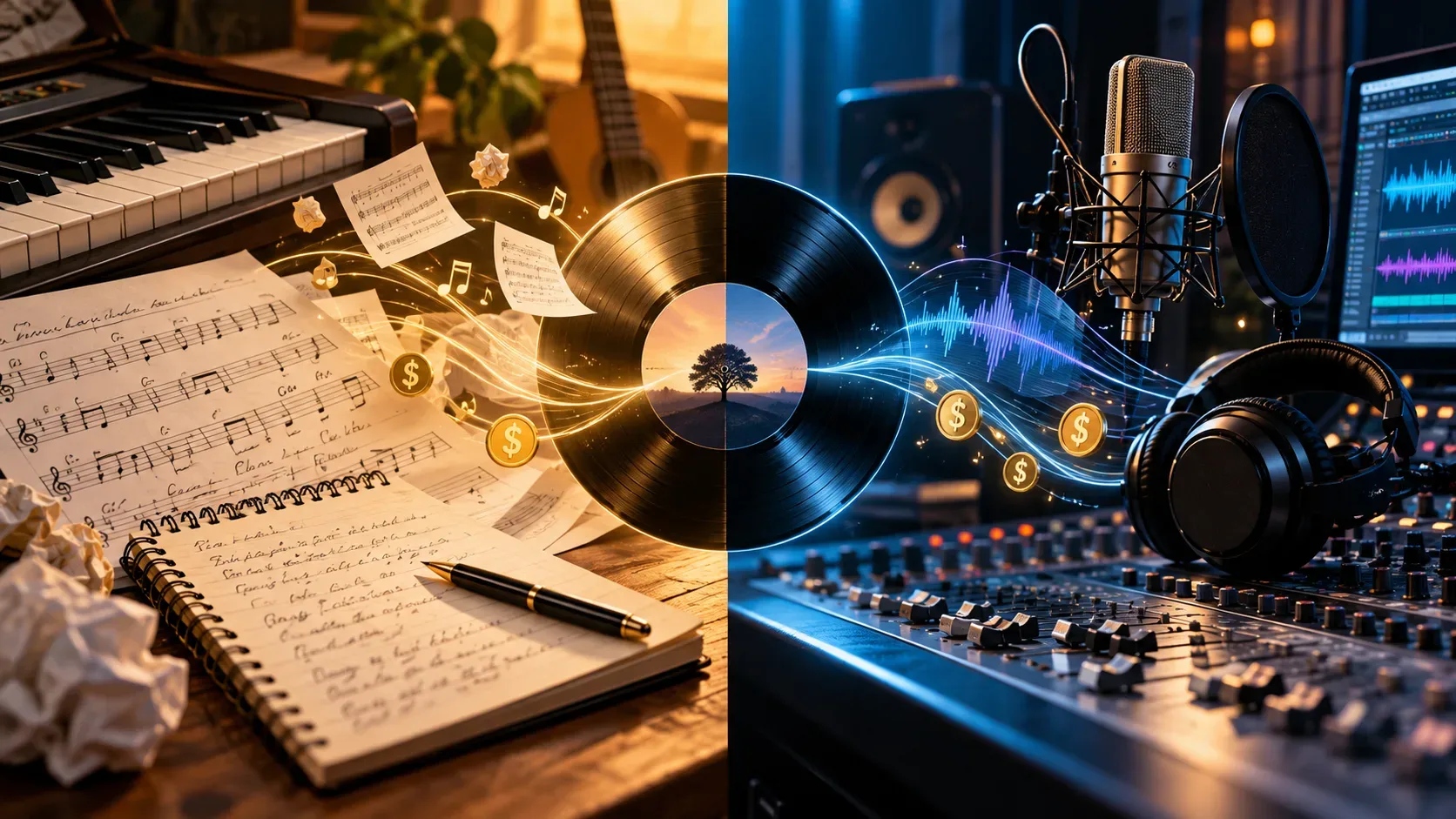
A recorded song may look like a single product to the listener, but in the United States it normally contains at least two copyright-protected works: the musical composition, made up of the music and lyrics, and the sound recording, meaning the specific performance fixed in a file, tape, CD, or other medium. In music-industry vocabulary, that specific recording is commonly called the master.
This separation explains why a contract may say that an artist controls the masters but does not control the entire composition, or the reverse. It also explains why a single stream can generate payments through different channels. The starting point is always the same question: which of the two layers is being used, and who controls that layer?
Master and composition are different rights
| Layer | What it protects | Who may control it | Examples of revenue |
|---|---|---|---|
| Musical composition | Protectable melody, harmony, musical structure, and lyrics | Composer, lyricist, publisher, publishing company, or another owner/assignee | Public performance, mechanical royalties, synchronization, print, and direct licenses |
| Sound recording, or master | The specific recording of the sounds and performance | Artist, record label, producer, company, or another owner/assignee, depending on authorship and contract | Recording licenses, master-side streaming revenue, sale/distribution of the recording, master use, and certain digital performances |
The U.S. Copyright Office expressly explains that a musical composition and a sound recording are separate works, subject to different rules and often owned and licensed separately. Owning a share of the composition therefore does not mean owning the master, and owning the master does not mean controlling the music and lyrics.
Who controls the musical composition?
In general, the composition originates with the composer and lyricist. Initial ownership can later change through contracts, assignments, work-made-for-hire situations, or other legal arrangements. In commercial practice, many songwriters work with music publishers or publishing administrators.
A publisher's role is not always the same. Under a traditional publishing deal, a songwriter may assign some or all of the copyright interest to the publisher. Under a co-publishing deal, the songwriter may retain part of the economic control. Under an administration agreement, the administrator may register, license, and collect income without necessarily taking ownership of the copyright. The contract determines who may authorize which uses.
For public performance of the composition, performing rights organizations, or PROs, such as ASCAP, BMI, SESAC, and GMR can license repertoires and distribute royalties to songwriters and publishers. These permissions concern the composition, not the master.
For digital uses covered by the section 115 compulsory mechanical license, the Music Modernization Act created the blanket-license system administered by the Mechanical Licensing Collective, or MLC. The MLC receives usage reports and royalties from digital music providers for qualifying uses such as permanent downloads, limited downloads, and interactive streams that are digital phonorecord deliveries, and distributes money to identified musical-work copyright owners. In June 2026, the Copyright Office continued the designation of the entity already serving as the MLC.
Who controls the master?
The master is the specific sound recording. The Copyright Office notes that a sound recording may be created by a performer, producer, record label, or another entity in certain circumstances. Even when an artist helped create the recording, the contract may transfer ownership or grant a label a broad exclusive license to exploit it.
That is why the statement "the artist recorded the song" does not answer the question "who controls the master?" The chain of contracts must be checked. A label may own the sound-recording copyright; an independent artist may keep ownership and use only a distributor; a company may hold an exclusive license for a defined term and territory without becoming the permanent owner.
Distributors and aggregators should not automatically be treated as master owners either. They may simply provide delivery to platforms and revenue-collection services. Their actual authority depends on the distribution agreement.
An interactive stream can pay both layers at the same time
On an interactive service, where a user chooses a track on demand, the same playback can trigger separate income streams. On the composition side, there may be mechanical royalties and public-performance royalties. The digital mechanical component covered by the blanket license is administered by the MLC; public performance of the composition is commonly licensed through PROs or direct deals.
On the master side, interactive platforms normally operate under negotiated licenses with labels, distributors, or other sound-recording rights owners. The money received by the master owner is not automatically the amount that reaches the artist. The ultimate split depends on the artist agreement, recoupment of advances and expenses when applicable, distributor fees, contractual royalty rates, and other terms.
It is important not to use SoundExchange as a synonym for "streaming royalties." SoundExchange's core statutory role in the United States concerns noninteractive digital performances of sound recordings, not the general payment of master royalties from on-demand services.
Noninteractive digital radio and AM/FM radio follow different rules
For certain noninteractive services, such as qualifying webcasting, satellite radio, and some cable digital-radio services, section 114 provides a statutory license for the digital performance of sound recordings. SoundExchange states that, under this structure, 50% of statutory receipts go to the sound-recording copyright owner, 45% to featured artists, and 5% to funds for nonfeatured musicians and vocalists.
This is different from traditional terrestrial radio. In the United States, the federal public-performance right in a sound recording is limited to digital audio transmissions. Traditional AM/FM stations therefore do not pay a federal sound-recording public-performance royalty merely for broadcasting the master. The composition, however, still carries a public-performance right and can generate payments to songwriters and publishers through PROs.
Producers, mixers, and engineers who are not owners of the master are normally paid according to their contracts. In certain cases, a featured artist can direct SoundExchange to pay part of the artist's statutory share to a creative participant through a Letter of Direction.
Cover song: you can use the composition without using the original master
A cover recorded from scratch creates a new master. If the new recording does not copy the sounds fixed in the original recording, it does not use that original master. It still uses the preexisting composition.
Section 115 of the Copyright Act can make a compulsory mechanical license available to make and distribute phonorecords of a nondramatic musical work when the legal conditions are satisfied. Among the important limits, the license does not authorize duplication of someone else's master, and the permitted arrangement cannot change the basic melody or fundamental character of the work. Physical media remain subject to a notice process different from the digital blanket system; for certain digital uses, the MLC administers the blanket license.
The mechanical license is also not universal permission for every exploitation of a cover. If the cover is placed in a film, advertisement, game, or video, synchronization rights come into play. If there is a public performance, performance rights may apply. Each use must be cleared separately.
Sampling and interpolation are not the same thing
A sample reuses sounds actually fixed in an existing recording. It can therefore implicate rights in the master and rights in the composition embodied in that excerpt. An interpolation, by contrast, recreates part of the composition in a new recording without copying the sounds of the original master; in that situation, the central clearance issue is usually the composition, while the new recording has its own master.
There is no general rule that "a few seconds are always allowed." The Copyright Office Fair Use Index emphasizes that fair use is evaluated case by case and that no predetermined number of notes, seconds, or percentage guarantees permission-free use. For commercial uses of preexisting material, clearance analysis should focus on exactly what was copied and which rights are affected.
Synchronization usually requires looking at both layers
When an original recording is used in a film, series, advertisement, video game, or other audiovisual content, there are normally two separate permissions: a synchronization license for the composition and a master-use license for the specific recording.
The Copyright Office guide on how music creators get paid explains that there is no compulsory synchronization or master-use license. These permissions are negotiated in the marketplace. If an audiovisual producer commissions a new recording of the composition instead of using the familiar master, the producer may avoid licensing that original master, but the composition rights and the rights in the new recording still must be addressed.
Who gets paid in each scenario?
| Use | Composition | Master |
|---|---|---|
| Interactive on-demand stream | Digital mechanical royalties, including the MLC route when the blanket license applies, plus public-performance income through PROs or direct licenses | Revenue under the platform's license with a label, distributor, or recording owner; payment to the artist depends on the contract |
| Digital download | Mechanical/reproduction and distribution rights, under section 115 rules or voluntary licenses | The master owner or licensee receives revenue through the distribution and contract chain |
| CD or vinyl | Mechanical license for the composition when applicable | Recording revenue follows ownership/licensing of the master and distribution contracts |
| Qualifying noninteractive digital radio | Public performance of the composition through PROs or other applicable licensing | Statutory digital-performance royalty, distributed through SoundExchange when the statutory license is used |
| Terrestrial AM/FM radio in the U.S. | Public performance of the composition | No federal master public-performance royalty solely for traditional AM/FM broadcast |
| Film, advertisement, or video game using the original recording | Synchronization license | Master-use license |
| Cover recorded from scratch | Composition rights remain relevant; section 115 may cover certain audio uses | A new master is created and controlled according to the contracts for the new recording |
| Sample from the original recording | May require permission for the composition | May require master permission because original fixed sounds were copied |
ISWC and ISRC help keep the work and the recording separate
The distinction also appears in identifiers used by the music business. The ISWC identifies the musical work and its authors. The ISRC identifies a specific recording. One composition can therefore be associated with multiple ISRCs because it may exist in different recordings: studio version, live version, remix, rerecording, or cover. This is why databases and royalty systems must accurately link the musical work to the recording in which it appears.
Contracts determine the economic split after copyright
Copyright identifies certain exclusive rights, but it does not by itself determine how much money each participant takes home. An artist can be a coauthor of the composition while receiving a contractual royalty on a master owned by a label. A producer may not own the master but can still receive points or royalties under a contract. A songwriter may keep the copyright and pay an administration fee, or assign a share to a publisher.
When reading a music contract, it helps to separate at least these questions:
- Which asset is covered? Composition, master, or both.
- Is ownership transferred, or is there only a license? Is the license exclusive or nonexclusive?
- What are the term and territory?
- Which rights are included? Reproduction, distribution, performance, synchronization, master use, derivatives, and others.
- How is compensation calculated? Gross revenue, net revenue, contractual royalty, participation, fee, or another basis.
- Are there recoupment provisions, deductions, reserves, or recoverable costs?
- Who accounts, when is payment due, and is there an audit right?
- Are any payments made directly by collective organizations? That can change the payment route without necessarily changing copyright ownership.
Jurisdictional limit: this map is for the United States
This guide mainly describes U.S. copyright and licensing rules. Other countries may recognize neighboring rights and sound-recording performance rights more broadly, including for uses that do not generate the same master-side payment in the United States. International contracts, subpublishers, collective management organizations, and reciprocal agreements can also change the collection route.
Specific cases can also involve coauthorship, work made for hire, old transfers, termination rights, pre-1972 recordings, split disputes, succession, samples, fair use, and other issues that require case-specific legal analysis. The Copyright Office itself notes that its educational materials are not a substitute for legal advice.
The practical rule for avoiding royalty confusion
For any use of music, ask two questions in order. First: am I using the composition, the master, or both? Second: who controls each right for this use, in this territory, and during this period? Only then does it make sense to ask who gets paid.
That sequence avoids one of the most common music-business mistakes: treating "music royalties" as one single stream. In practice, the composition and the master can have completely different owners, licenses, collecting entities, and contracts.
Main sources
- U.S. Copyright Office: What Musicians Should Know about Copyright
- U.S. Copyright Office: How Songwriters, Composers, and Performers Get Paid
- U.S. Copyright Office: Music Modernization Act
- Copyright Act, Chapter 1, including sections 107, 114 and 115
- SoundExchange: Digital Performance Royalties
- U.S. Copyright Office Fair Use Index