
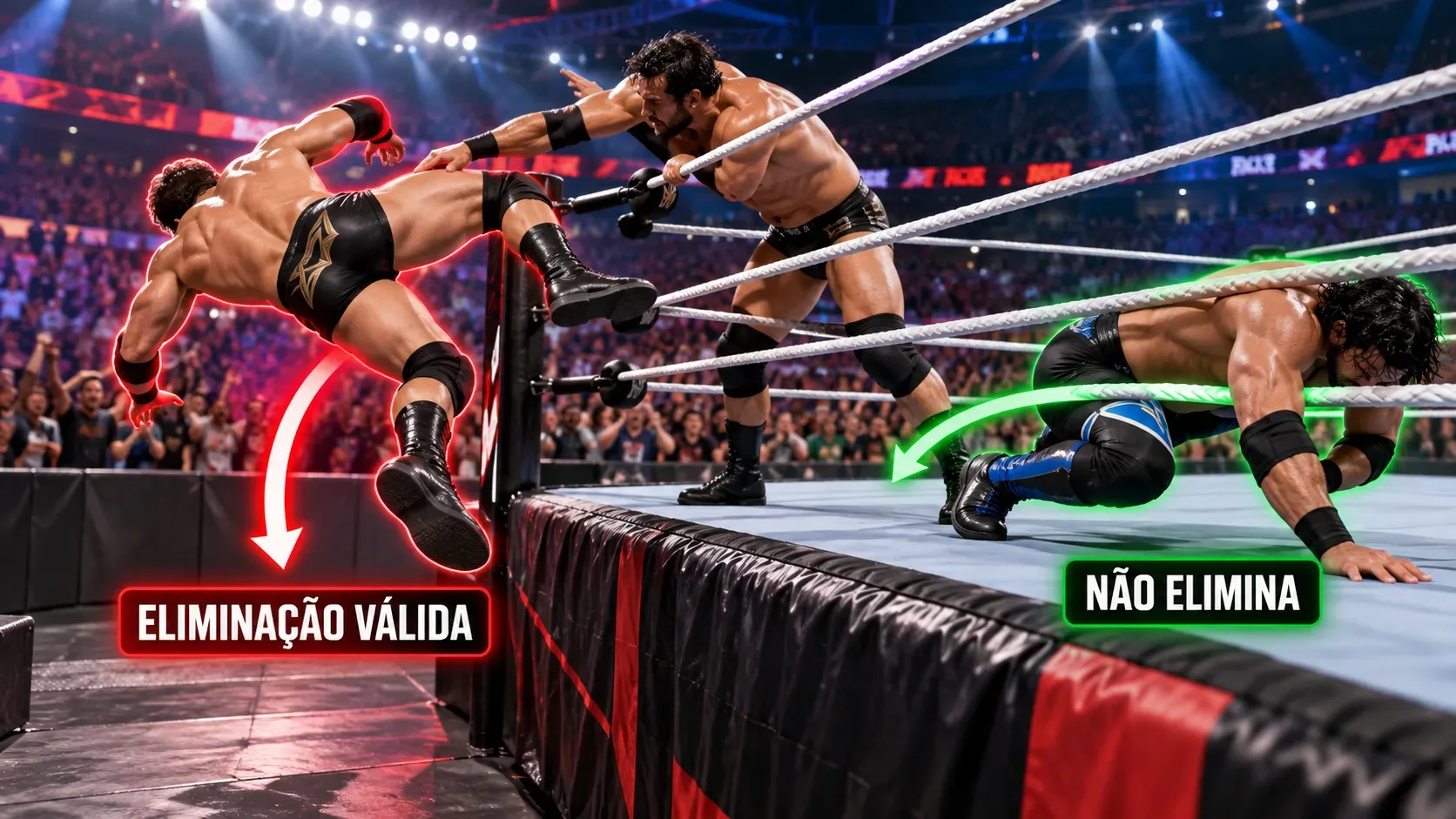
In the Royal Rumble, touching the floor outside the ring is not enough, by itself, to eliminate someone. The rule combines two conditions: the competitor must go over the top rope and both feet must touch the floor. WWE's official description of the 2026 Men's Royal Rumble keeps exactly that logic.
The short answer: two conditions must happen together
To decide whether an elimination is valid, first ask whether the wrestler went over the top rope. Then check whether both feet touched the floor. If either condition did not happen, the elimination is not complete.
| Situation | Does it count as an elimination? | Reason |
|---|---|---|
| Goes over the top rope and both feet touch the floor | Yes | Both conditions of the rule are satisfied. |
| Goes over the top rope, but only one foot touches the floor | No, not yet | The rule requires both feet to make contact with the floor. |
| Exits between the ropes and puts both feet on the floor | No | The competitor did not go over the top rope. |
| Exits under the bottom rope and touches the floor | No | The over-the-top-rope condition is also missing. |
| Is pinned or submits | No | In the standard Royal Rumble format, pinfalls and submissions are not the elimination method. |
Why does going out between the ropes not eliminate a wrestler?
Because the path out of the ring is part of the definition of an elimination. WWE's rules refresher describes the objective as sending an opponent over the top rope and confirms that both feet must touch the floor for the elimination to be official. Therefore, a wrestler can pass through the space between the top and middle ropes, or go under the bottom rope, put both feet on the floor, and still remain legally in the match.
This distinction explains why a visually dramatic exit may not count. The audience sees the competitor outside the ring, but the Royal Rumble does not use the simple idea of being inside or outside. It uses a specific route out of the ring and a specific type of contact with the floor.
What does the both-feet rule mean in practice?
The second filter is just as important as the first. If a competitor went over the top rope but managed to keep one foot off the floor, the elimination is not complete. WWE highlights this detail when revisiting Shawn Michaels' 1995 victory: he was sent over the ropes, one foot touched the floor, but the other stayed suspended, allowing him to return to the ring. The official WWE retrospective of the moment uses the sequence to reinforce that both feet must touch the floor.
That is why so many Royal Rumble saves involve holding the rope, placing hands on the floor, or balancing outside the ring. The decisive question remains the same: after going over the top rope, did both feet touch the floor?
Situations that look like eliminations but are not
- One foot on the floor and one still in the air: the competitor has not met the both-feet condition.
- Exit between the ropes: even with both feet on the floor, the wrestler did not go over the top rope.
- Exit under the bottom rope: the same logic applies because the wrestler did not pass over the top rope.
- Fall, pinfall, or submission: these can happen during the action, but they do not replace the standard Royal Rumble elimination method.
The easiest way to read a confusing sequence is to separate the two questions. First: did the wrestler go over the top rope? Second: did both feet touch the floor? Only when both answers are yes is the elimination complete.
The stipulation from the beginning of the Royal Rumble
The Royal Rumble debuted on January 24, 1988 with 20 participants, according to WWE's official historical page. The following year, the 30-competitor format made its pay-per-view debut, as WWE explains in its history of how the match was created. The participant count has varied in special editions, but the identity of the stipulation has remained tied to over-the-top-rope eliminations.
In an official WWE retrospective, the requirement for both feet to touch the floor is described as part of the stipulation since the inaugural Royal Rumble. That helps explain why the criterion appears again and again in decades of near-elimination moments.
What does this rule change about how you watch the match?
It creates a difference between being outside the ring and being eliminated. A competitor can leave between the ropes to escape pressure, end up outside without following the required path, or survive with only one foot on the floor. At the same time, anyone who has already gone over the top rope is in immediate danger because the moment the second foot touches the floor, the elimination is complete.
This structure also explains why the apron and the ropes matter so much in a Royal Rumble. The goal is not simply to knock an opponent down. It is to put that opponent on the specific trajectory that turns a fall into an elimination.
In summary
A valid Royal Rumble elimination requires going over the top rope and both feet touching the floor. Going out between the ropes does not eliminate a competitor because the first condition is missing. Going over the top rope and touching the floor with only one foot is also not enough because the second condition is missing. With those two questions in mind, most confusing Royal Rumble sequences become much easier to interpret.