
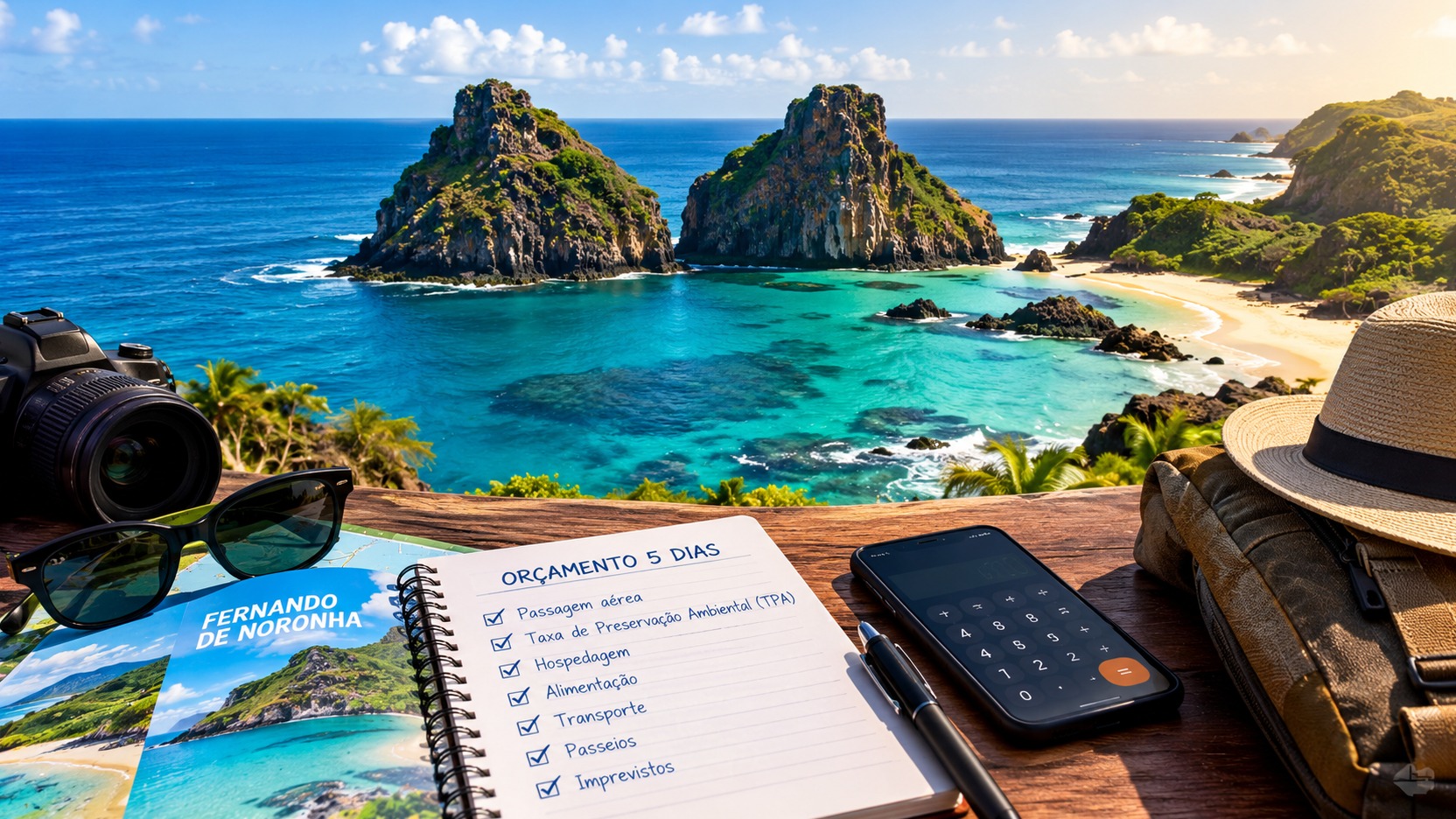
Fernando de Noronha's account becomes much clearer when you separate three things: what is mandatory to stay on the island, what depends on the itinerary and what changes depending on the way of traveling. For a stay of 5 days and 4 nights in 2026, the cost upon arrival could be close to R$4,880 for one person in a structured economic scenario or around R$8,920 in an intermediate scenario. For a couple sharing the same room and taxis, the same models cost around R$6,790 and R$12,020 in total, respectively. The air ticket is not included in these numbers because without the city of origin and exact dates, any value would be a false precision.
These totals are not an official average or price promise. These are auditable models created using current rates, market references consulted in August 2026 and explicit assumptions. The idea is that you can exchange any line for the price of your reservation and recalculate the budget without starting from scratch.
First separate the airfare from the cost on the island
Passage is one of the most volatile lines in the budget. Origin, advance, holiday, baggage, time and connection can change the price within a few hours. Therefore, the most reliable way to plan is to keep two accounts: the cost from landing in Fernando de Noronha and, in a separate line, the actual cost of the round-trip flight for your dates.
The final formula is simple: total trip = cost on the island + group air tickets. This way, you don't mix a promotional rate from one city with the budget of someone traveling from another region of the country.
The only mandatory entry fee is TPA
The Environmental Preservation Fee is charged according to the days of stay. In the official 2026 table of the Administration of Fernando de Noronha, 5 days cost R$ 520.50 per visitor subject to charge. This is the number that should be included in the account for a 5-day trip, even if the accommodation is only 4 nights.
This detail is important because days of stay and hotel rates are not the same unit. Those who arrive on a Monday and leave on Friday normally book four nights, but stay on the island for five calendar days.
The entrance fee to the National Park is another charge
The ticket to the Fernando de Noronha National Marine Park is not the TPA and should not be added as if it were a second mandatory fee to simply disembark on the island. In 2026, the ticket costs R$192 for Brazilians and is valid for ten days. It comes into the budget when the itinerary includes areas of the park that require a ticket.
In practice, those who want to visit emblematic attractions within the National Park usually include this value. Anyone who creates an itinerary only for areas outside of billing can remove it from the spreadsheet. In the scenarios in this article, the ticket was included because it represents the most common first-time itinerary.
Accommodation: use the price of the room, not an invented price per person
Accommodation is the line that most changes the difference between traveling alone and as a couple. To make the calculation reproducible, the economic scenario uses R$650 per night for the room, totaling R$2,600 over four nights. The intermediate scenario uses R$1,200 per night, totaling R$4,800.
These premises are within what appeared in accommodation searches consulted in August 2026, in a market in which rates ranged from simpler offers to average ones exceeding R$1,000 per night. They do not replace the quote for your dates. If you find R$520 per night, exchange 650 for 520. If the room you want costs R$1,600, use 1,600. The model continues to work.
For a single person, the entire room weighs on the individual budget. For a couple, the same room is shared by two. That's why comparing only the price per person can hide the greater structural savings of traveling with a partner.
Food: breakfast included changes the bill a lot
The economic scenario reserves R$160 per person per day for food, or R$800 in five days. The intermediary uses R$300 per person per day, totaling R$1,500. Both premises consider breakfast included in the accommodation.
The 2026 references consulted show simple and executive meals in smaller ranges and tourist dinners capable of easily exceeding R$100 per person. Therefore, R$160 per day requires choices: simple lunch, snack and dinner without transforming every meal into a gastronomic experience. R$ 300 allows you to alternate economical meals with more expensive restaurants without having to eat high-end cuisine every day.
If the accommodation does not include breakfast, add this expense. If you plan to dine at more popular restaurants every night, increase the daily meal rate before making your reservation.
Transportation: bus, taxi and buggy change the calculation logic
The official portal of Fernando de Noronha consulted in August 2026 still reports bus fares of R$5 for tourists. The island also has taxis with regulated fares. An operational reference from 2026 for the scheduled routes shows rides on Flag 1 approximately between R$30 and R$58, with slightly higher values on Flag 2.
In the economic scenario, the bill uses ten bus trips per person and two taxi rides of R$45 per group. This works out to R$140 for those traveling alone and R$190 for a couple, because bus tickets double, but the taxi is shared.
In the intermediate scenario, the premise is R$500 taxi fare per group during the five days. It is a convenience budget, not a mandatory number of races.
Buggy deserves a separate account. In August 2026, rental companies advertised daily rates starting at around R$430, normally without fuel. A single day may be interesting for those who value autonomy, but several days quickly increase the budget. Before booking, compare the total cost of the buggy, fuel and parking with the actual number of taxi rides you intend to take.
Tours: choose before adding
There is no mandatory tour package. The economic scenario includes a paid activity, the Hawaiian canoe, using R$245 per person as a published reference for 2026. The intermediate scenario includes an Island Tour starting at R$342 and a boat trip starting at R$323, totaling R$665 per person.
These values serve to show the mechanics of the budget. Different operators, special dates and promotions change prices. There are also much more expensive experiences. The embarked baptism dive, for example, appeared in August 2026 in the range of approximately R$1,150 per person with local operators. Including a dip like this changes the bill more than small savings on buses or food.
Economic scenario for 5 days and 4 nights
For a person traveling alone, the bill uses R$2,600 for accommodation, R$800 for food, R$140 for transport, R$245 for tours, R$520.50 for TPA and R$192 for the National Park. The subtotal reaches R$4,497.50. Applying a 10% margin on accommodation, food, transport and tours, the recommended reservation is approximately R$4,880, excluding air tickets.
For a couple in the same room, accommodation remains at R$2,600. Food goes up to R$1,600, transport to R$190, tour to R$490, TPA to R$1,041 and National Park to R$384. The subtotal is R$6,305. With a 10% margin on variable expenses, the total is around R$6,790 for the couple, or approximately R$3,400 per person, without tickets.
Intermediate scenario for 5 days and 4 nights
For a single person, the model uses R$4,800 for accommodation, R$1,500 for food, R$500 for transport, R$665 for tours, R$520.50 for TPA and R$192 for the National Park. The subtotal is R$8,177.50. With a 10% margin on variable expenses, the reserve increases to approximately R$8,920, without airfare.
For a couple sharing a room and a taxi, it costs R$4,800 for accommodation, R$3,000 for food, R$500 for transport, R$1,330 for tours, R$1,041 for TPA and R$384 for the park. The subtotal is R$11,055. The 10% margin on variable expenses brings the budget to around R$12,020 in total, or approximately R$6,010 per person, before flights.
How to add the passage without cluttering the spreadsheet
After quoting the actual dates, add up the final price of the ticket including luggage and services that you will actually purchase. If the couple finds round-trip flights for R$1,800 per person, for example, add R$3,600 to the couple's total. The economic scenario would go from approximately R$6,790 to R$10,390. The intermediary would go from R$12,020 to R$15,620.
The example does not say that R$1,800 is the typical fare in 2026. It just shows where the ticket comes in. The correct number is always the quote for your dates.
Why some 2026 accounts don't close
The first divergence appears in the TPA. It is not safe to take the value of one day, R$105.79, and multiply it by five. The official table for 2026 reports R$520.50 for five days. Some pages do simple multiplication and reach R$528.95. For budget and payment, the official table applies.
The second confusion is treating 5 days as 5 days. A trip lasting 5 days and 4 nights usually involves four accommodation charges and five days of stay for TPA.
The third is to add the National Park ticket as if it were mandatory to enter Fernando de Noronha. It is a different charge, linked to access to park areas. If your script needs it, include it. If you don't need it, remove it.
The fourth is to mix price per person with price per room or per vehicle. TPA, food and tours are mostly per person. Accommodation is usually quoted per room. Taxi and buggy are vehicle costs, which can be shared. A quote that doesn't state the unit may appear cheaper or more expensive without actually being wrong.
The fifth is to compare bills with and without air tickets. When one page only presents spending on the island and another includes the flight from São Paulo, Recife or another origin, the totals are not directly comparable.
How much to reserve, after all
For 5 days and 4 nights in 2026, a prudent reference is to think about approximately R$4,880 for a single person in an economic scenario or R$8,920 in an intermediary, always without a ticket. For a couple, around R$6,790 in economy and R$12,020 in intermediate, also without flights.
These numbers already include the five-day TPA, the entrance fee to the National Park, a margin for unforeseen events and the tours defined in each scenario. If you do not enter the park, subtract R$192 per person. If you exchange the economical tour for a boarded dive, add the difference. If you book a cheaper or more expensive room, replace the cost of the four nights. This is what makes the account auditable.
Before paying, review the three most volatile lines with prices for your dates: airfare, accommodation and tours. Official rates must be checked again on the Fernando de Noronha Administration and ICMBio channels, especially if the trip takes place months after reading this article.