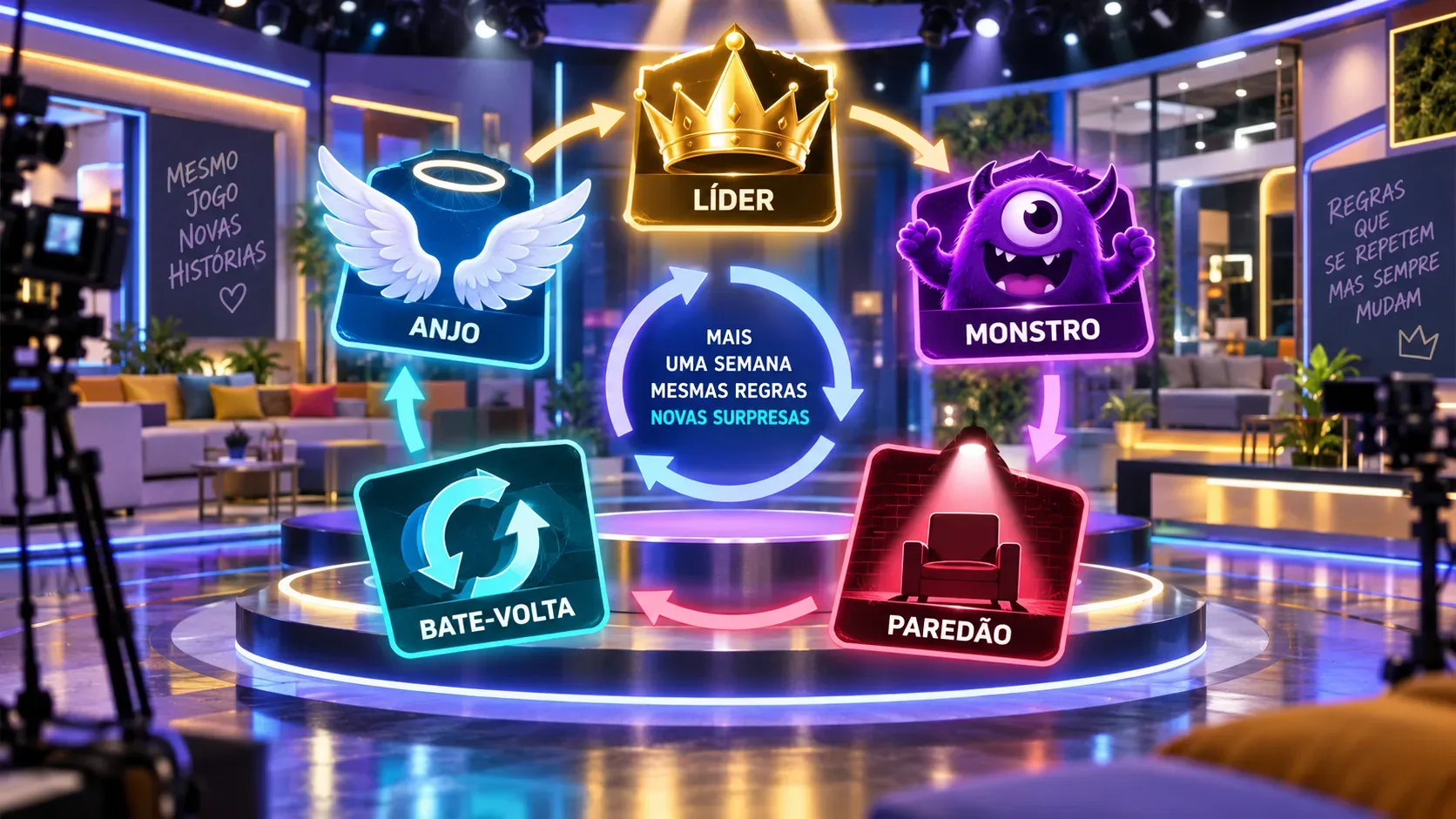
BBB has a set of game mechanics that returns from season to season, but that does not mean every week works the same way. Líder, Anjo, Monstro, Paredão and Bate-Volta form a kind of game skeleton. What changes are the details: who is immune, how many people go to the Paredão, which nominations are direct, who can compete for a chance to save themselves and which extra powers are added to the cycle.
The safest way to understand the show is to separate two layers. The first is the basic function of each mechanic. The second is the Dinâmica da Semana, or weekly game plan announced by production, which defines the exceptions and combinations for that cycle.
BBB's weekly cycle in one line
Typical flow: Prova do Líder → Prova do Anjo and Monstro assignment → Paredão formation → Prova Bate-Volta, when scheduled → public vote and elimination.
This flow is a mental map, not an unchangeable rulebook. The show itself publishes the order and consequences of the stages each week. In April 2026, for example, gshow detailed a BBB 26 week in which the Anjo was self-immune, the Líder nominated one person and the house vote completed the Paredão formation.
What the Líder does
The Líder is the participant, or in special situations the group of participants, who wins the Prova do Líder and receives strategic power over the cycle. The most recurring function is the direct nomination of someone to the Paredão. Around that core, production can add other privileges, restrictions or responsibilities.
This is where variation comes in. Leadership can be individual or shared. In BBB 26, one week featured two Líderes who had to make decisions by consensus, including the Paredão nomination. In other weeks, there may be preselected targets, vetoes, party-related advantages or powers linked to special twists.
In short, becoming Líder means gaining a privileged position on the week's game board, but the exact package of powers depends on the season and the cycle.
What the Anjo does
The Anjo comes from the Prova do Anjo and is tied to immunity. The classic version has the winner protect another participant during Paredão formation. However, that is not an absolute rule. Some weeks feature a self-immune Anjo, meaning the winner cannot be nominated or voted for under the conditions announced for that cycle.
Seasons can also add extra choices. In BBB 26, for example, some Anjo rounds allowed the winner to exchange a personal benefit for an additional immunity. This is why the word "Anjo" identifies a recurring role without guaranteeing exactly the same practical effect every time.
Beyond immunity, the Anjo usually has another well-known role: choosing who will receive the Castigo do Monstro.
What Monstro means
Monstro is a punishment assigned to one or more participants, usually by the Anjo. The selected person must perform a recurring task at set times under specific rules. The activity, costume, duration and consequences can change significantly.
In March 2026, for example, the "Cara & Coroa" Castigo do Monstro paired two participants and also brought a loss of estalecas and a move from VIP to Xepa for the punished players. Other weeks used different tasks and penalties.
The key point is not to confuse Monstro with an automatic Paredão nomination. Monstro can remain only a punishment, but production can also connect it to strategic decisions. In one BBB 26 twist, for example, Anjo and Monstro had to reach a consensus to send someone to the Paredão. Any additional effect therefore has to be confirmed in that week's rules.
What the Paredão is
The Paredão is the stage in which a group of participants is placed at risk of elimination and sent to the public decision. The basic idea is stable, but the path into the Paredão is one of BBB's most variable components.
A formation can combine a Líder nomination, house votes, Big Fone calls, Contragolpe, special powers, competition consequences and surprise twists. The number of people initially nominated can also change, as can who is allowed to try to save themselves before the public vote opens.
This means phrases such as "the Líder's nominee", "the most-voted housemate" or "the person chosen by Big Fone" describe possible routes, not a universal formula. The official weekly plan determines which routes are active.
What the Prova Bate-Volta does
The Prova Bate-Volta is a chance to escape the Paredão before the final lineup is completed. Only the nominated participants allowed by that week's rules take part. Whoever wins, or finishes within the number of available save spots, leaves the danger zone.
The format can vary a lot. In BBB 26, one week had three people playing for one save, while another could have four playing for two saves, according to the official Duelo de Risco weekly plan. The competition can also be absent from a cycle. In BBB 25, one turbo week was announced with a triple Paredão without Bate-Volta.
So it is not enough to know that the competition exists. Three points matter: whether Bate-Volta will happen, who is allowed to play and how many people can save themselves.
What repeats and what can change
| Mechanic | Recurring function | What can vary |
|---|---|---|
| Líder | Concentrates strategic power and normally makes a direct Paredão nomination. | Leadership can be shared, with preset targets, vetoes, extra powers and consensus rules. |
| Anjo | Is tied to immunity and usually chooses the Monstro. | Can be self-immune, protect someone else, grant extra immunities or carry additional benefits. |
| Monstro | Imposes a recurring punishment task on the selected participant. | The task, number of punished players, penalties and possible strategic effects can change. |
| Paredão | Places participants at risk and sends the decision to the public. | The number of nominees, nomination routes, powers, counter-nominations and special rules can change. |
| Bate-Volta | Gives some nominated players a chance to escape before the final public vote. | It may not happen, and eligibility, player count and number of saves can change. |
Why the Dinâmica da Semana matters more than memory of the previous season
BBB uses repetition so viewers can recognize the game, but it also uses variation so participants cannot rely only on habit. That is why two weeks in the same season can produce different Paredão formations, and why a rule remembered from a previous year may not apply to the current cycle.
In practice, the Dinâmica da Semana explanation works as the operating rulebook for that period. It states the order of competitions, immunities, direct nominations, powers, possible counter-nominations and whether Bate-Volta will happen. BBB 26's official gshow pages show this pattern by detailing different combinations of the same core elements week after week.
How to follow the game without mixing fixed rules with exceptions
- Identify the basic function. Líder nominates, Anjo deals with immunity, Monstro punishes, Paredão puts players at risk and Bate-Volta can save.
- Read the Dinâmica da Semana. It shows which extra powers or limitations are active.
- Check who is immune before voting. A self-immune Anjo, powers and special competitions can change the available options.
- Track where each nominated player comes from. Not everyone reaches the Paredão through the same route.
- Check Bate-Volta. The existence of the competition, its participants and the number of saves are defined by the cycle.
In short
BBB does not completely reinvent its game every season. It reuses recognizable pieces and changes how they fit together. Líder, Anjo, Monstro, Paredão and Bate-Volta are the names that help viewers understand the structure. The rule that really determines how those pieces work together, however, is the weekly plan announced for that specific cycle.