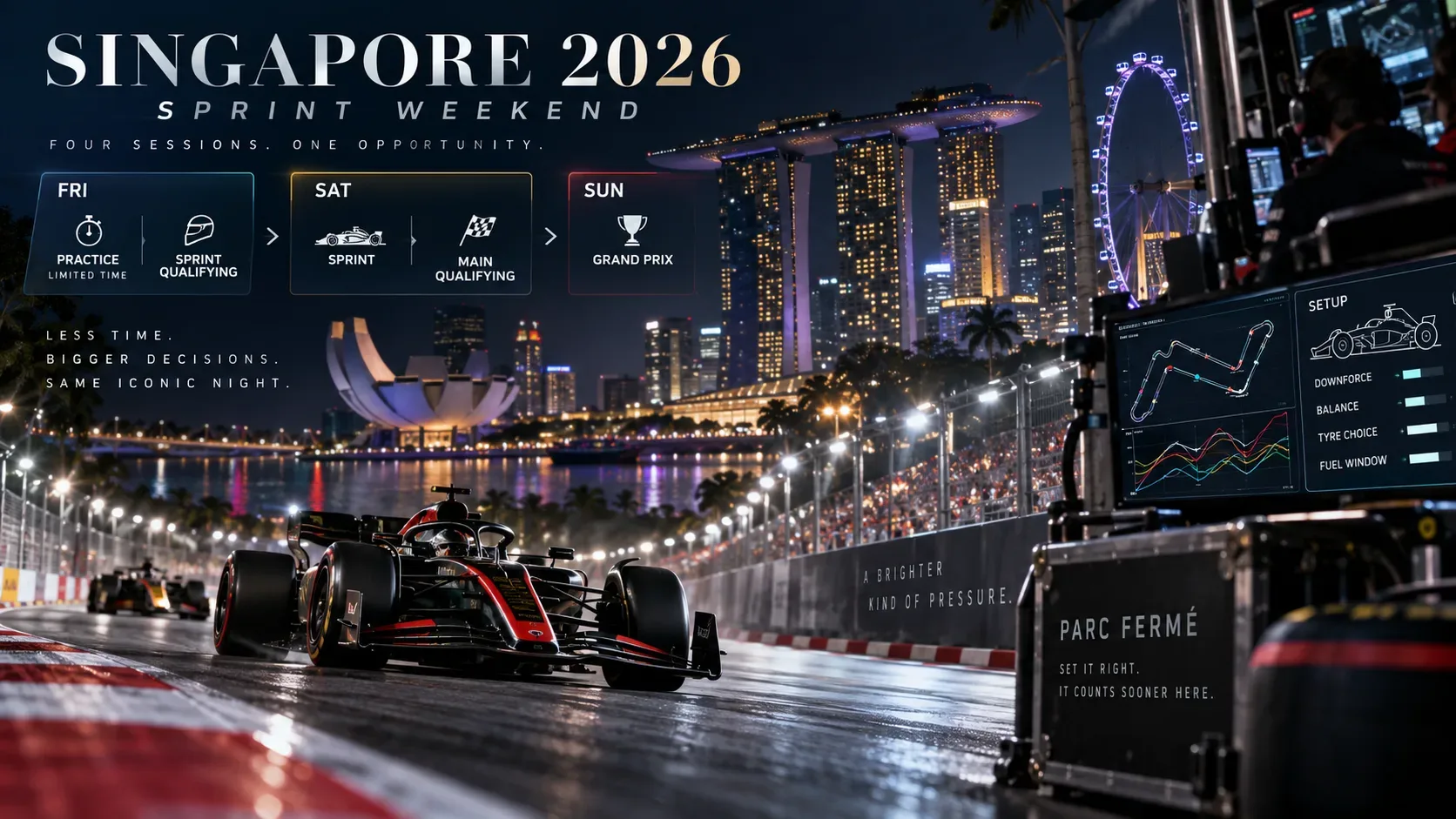
The 2026 Singapore Grand Prix, scheduled for October 9 to 11 at Marina Bay, will use the Sprint format. That changes more than the number of sessions: teams will have only one hour of free practice before Sprint Qualifying, will race the Sprint on Saturday, and will then still need to prepare the car for main Qualifying and Sunday's Grand Prix. The central strategic issue is the reduced learning time and the existence of two separate parc ferme periods.
According to the official Formula 1 timetable, Friday features Free Practice 1 and Sprint Qualifying, Saturday features the Sprint and Qualifying, and Sunday hosts the Grand Prix. The 2026 FIA Sporting Regulations, Issue 08, state that an Alternative Format Competition has only one one-hour free practice session before Sprint Qualifying.
How the 2026 Singapore Grand Prix weekend is structured
| Day | Session | Local time in Singapore | Strategic meaning |
|---|---|---|---|
| Friday, Oct. 9 | Free Practice 1 | 16:30 to 17:30 | The only practice window to validate the baseline setup before Sprint Qualifying. |
| Friday, Oct. 9 | Sprint Qualifying | 20:30 to 21:14 | Sets the Sprint grid and starts the first parc ferme period when the car leaves the pits for the first time. |
| Saturday, Oct. 10 | Sprint | 17:00 | A 21-lap short race, with points for the top eight, that also produces race-condition data. |
| Saturday, Oct. 10 | Qualifying | 21:00 to 22:00 | Sets the Grand Prix grid and starts the second parc ferme period when the car leaves the pits for the first time. |
| Sunday, Oct. 11 | Grand Prix | 20:00 | A 62-lap race on the 4.927 km Marina Bay Street Circuit. |
The times above are those published by F1 for Singapore local time and are subject to change. The official event page lists 62 laps and a 305.337 km race distance at the Marina Bay Street Circuit.
Why a single practice session makes every lap more valuable
On a conventional weekend, teams spread their learning across three practice sessions. Under the 2026 Sprint format, the FIA provides only Free Practice 1, lasting one hour, on the first day of track running. Sprint Qualifying must begin between two and a half and three and a half hours after the end of that session.
In practical terms, a team has to compress into 60 minutes tasks that could normally be distributed: checking the car's basic behaviour, comparing adjustments, understanding tyre response, observing balance at different fuel levels and choosing a setup robust enough for the first competitive session. That pressure is particularly relevant at Marina Bay, which F1 itself describes as a street circuit with a bumpy surface and humid, physically demanding conditions.
Free Practice 1 results therefore should not be read as a definitive pecking order. Fuel loads, tyres and programme priorities can differ between teams, and the session's main value is reducing uncertainty before Sprint Qualifying.
Parc ferme is split into two periods on a Sprint weekend
The 2026 rules create an important distinction from the idea that a car is completely frozen from Friday through Sunday. At an Alternative Format Competition, the first parc ferme period begins when each car leaves the pit lane for the first time in Sprint Qualifying and lasts until the start of the Sprint. The second begins when the car leaves the pit lane for the first time in main Qualifying and lasts until the start of the Race.
Before each of those first exits, the team must provide the Technical Delegate with a suspension setup sheet. While under parc ferme, configuration changes are limited to work permitted by the regulations or approved by the Technical Delegate.
Friday: the setup must be ready before Sprint Qualifying
After Free Practice 1, there is still a window to work on the car. The stronger regulatory commitment begins when the car leaves the garage for Sprint Qualifying. From that point, the setup is protected by the first parc ferme period until the Sprint starts.
That increases the value of decisions made immediately after the only practice session. A change that appears positive over a few laps also has to be suitable for a short qualifying session and for the next day's Sprint.
Saturday: the Sprint is also a data source before Qualifying
The first parc ferme period ends at the start of the Sprint. After the short race, there is an opportunity to revise the configuration before main Qualifying starts the second parc ferme period. That interval is one of the most important features of the current format.
The Sprint is not a free practice session because it awards championship points and has its own sporting consequences. Even so, it provides a 21-lap competitive sample of tyre behaviour, car balance, starts, traffic and sustained pace. Teams can use that information to correct choices before Qualifying, within the available time and the other technical and sporting rules.
Tyre rules make Sprint Qualifying even more specific
The 2026 regulations also prescribe compounds for dry Sprint Qualifying. In SQ1 and SQ2, each driver may use up to one new set of medium tyres in each segment. In SQ3, each driver may use up to one set of soft tyres.
In addition, at an Alternative Format Competition, one set must be electronically returned after Free Practice 1, another after the Sprint and three after main Qualifying. That makes tyre stock management part of the weekend plan, not just the Grand Prix strategy.
The official F1 explanation of the Sprint format also confirms that the top eight Sprint finishers score points, from 8 for the winner to 1 for eighth place. Using the Sprint only as a laboratory therefore carries a potential sporting cost.
What the Sprint can reveal for the 62-lap Grand Prix
The Sprint provides data at competitive pace, but it does not reproduce the full Sunday challenge. The Sprint is 21 laps, while the Grand Prix is 62. That difference changes the importance of degradation, tyre management, pit-stop windows and exposure to track changes over the course of the race.
The most useful strategic approach is to treat Sprint data as additional evidence. It can reveal trends, such as a car losing balance over a run or a tyre behaving differently from expectations, but it does not remove the need to plan for a race that is roughly three times longer.
What to watch in each session without trying to predict the result
- Free Practice 1: look for consistency and lap count, not only the fastest time. It is the only open session for experimentation before the first qualifying session.
- Sprint Qualifying: account for the short format and mandatory compounds. A single lap matters greatly, but it does not summarize race performance.
- Sprint: watch sustained behaviour, apparent wear and car stability. The data can influence changes before main Qualifying.
- Qualifying: leaving the pits begins the second parc ferme, so this represents the last major setup commitment before the Grand Prix.
- Grand Prix: strategy must be built for 62 laps, not as a simple extension of the Sprint.
What is the main strategic change in Singapore
The Sprint format compresses learning at Marina Bay, but it does not eliminate the ability to react. Friday requires teams to reach a workable setup quickly because there is only one hour of practice before Sprint Qualifying. Saturday creates a second opportunity: the Sprint supplies real competition data and, after it, the setup can be revised before main Qualifying opens the new parc ferme.
That structure turns the weekend into two setup decisions rather than one final choice on Friday. To follow the 2026 Singapore Grand Prix through a strategy lens, the most informative comparison will be what teams show in the Sprint, how their cars behave differently in main Qualifying, and then how those choices hold up across Sunday's 62 laps.