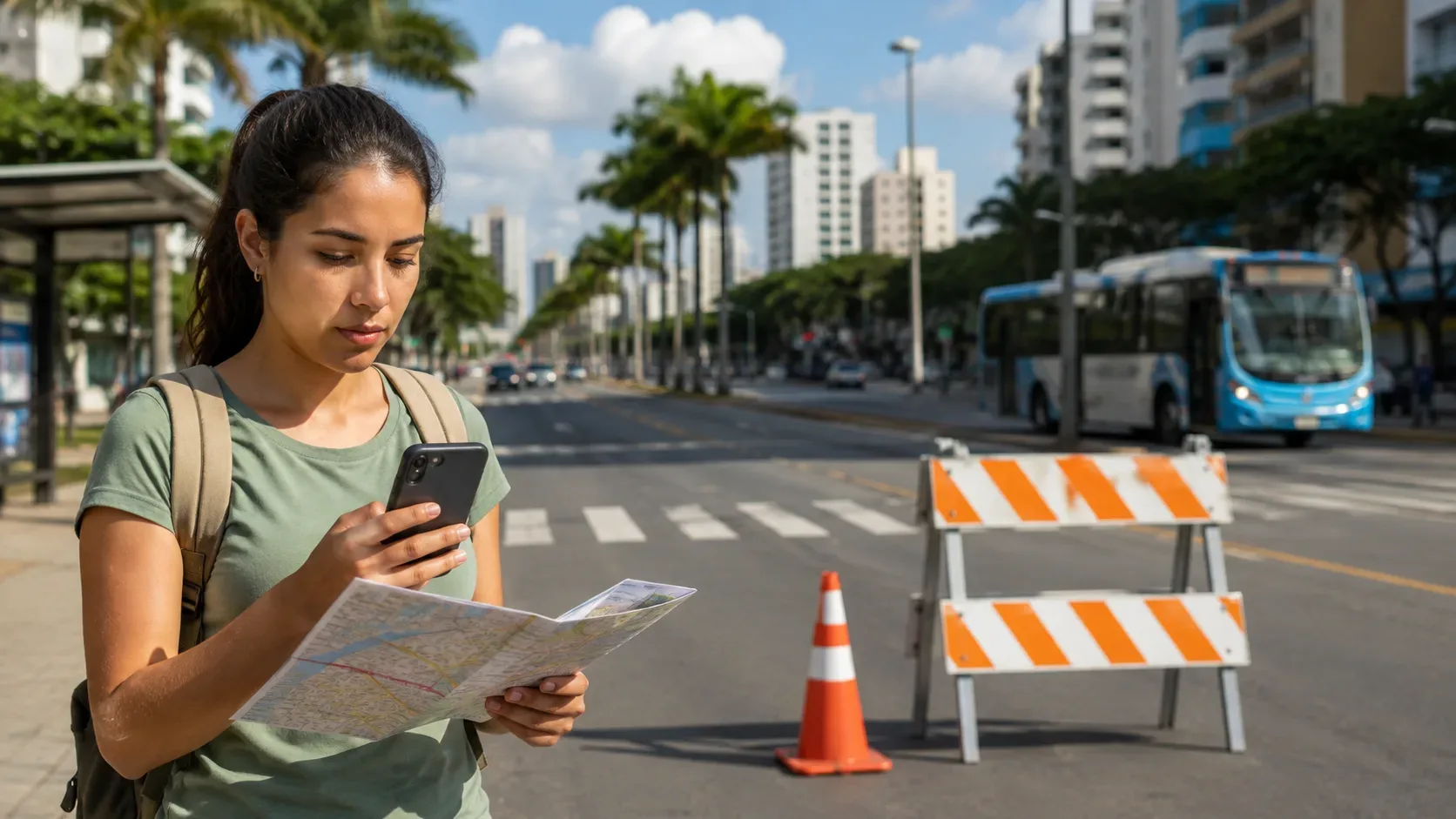
A poster can confirm the name, attraction and announced time of a race, procession, walk or party. It does not alone confirm which particular street will be closed, when the blockade will begin or which bus lines will be diverted.
To plan travel in Aracaju, it is necessary to cross-reference the organizer's publication with operational information from the Municipal Transport and Traffic Superintendence, SMTT. Events capable of interrupting or disrupting traffic depend on prior permission from the traffic authority responsible for the road. The legislation also gives the person responsible for the event the obligation to signpost the location.
The SMTT request page requires the organizer to inform the date, start and end times, location, affected section, complete route, estimated audience, presence of bus lines and the need for closures or agents. The agency itself emphasizes, however, that submitting the application does not guarantee authorization.
Editorial check on August 6, 2026, 12:10 pm: SMTT's front news page displayed posts up to August 4 and did not have a general lockdown bulletin for the weekend of August 8 and 9. This does not prove that there will be no interventions. It just means that the consultation needs to be repeated the day before and on the day of travel.
The poster confirms the event; the operational source confirms the street
The information published by the organizer answers questions such as: will the event take place, what is the meeting place, what is the announced time and how to participate?
SMTT's communication must answer another set of questions: will there be total or partial closure, which direction of the road will be reached, when the operation will begin, which alternative routes will be available and whether there will be a change in public transport.
This separation avoids a common mistake: considering the start time, mass or show time as if it were also the blocking time. The operation can begin before the program and end only after the public has dispersed or structures have been dismantled.
In an operation published in July 2026, for example, changes to buses and blocking began at 2:30 pm, while the race start was scheduled for 4 pm. Normalization was estimated for 7pm. The case shows why the reader needs to record the time of the event and the time of the road intervention separately.
Checklist of six sources before leaving
1. Organizer's official channel
Start with the original event page, not a screenshot forwarded in groups. Check it out:
- full name of organizer;
- date with year;
- concentration and start time;
- address or reference point;
- publicized route;
- changes or cancellations;
- contact channel for questions.
Old posts often reappear when the event is annual. The day and month may match, but the route, time and traffic operation may have changed. Therefore, the year must appear in the check.
2. SMTT Event Authorization Service
The Event Request page shows what data needs to be presented by those who intend to use the route and informs a minimum deadline of 30 days for the request. It serves to understand the process, but does not prove that a specific event was authorized.
The distinction is straightforward: protocol is request; favorable opinion is authorization. When there is no operational information published, ask the organizer for formal confirmation of release or contact SMTT through official channels.
3. SMTT Traffic News
Look for an article that clearly mentions the name of the event, the date, the neighborhood and the affected roads. An operational publication usually reports:
- expected time of intervention;
- section and meaning blocked;
- total, partial or gradual closure;
- route accompanied by agents;
- alternative route;
- guidance for drivers and pedestrians.
In mobile operations, such as races and processions, the closure may advance as participants move through the streets. SMTT has already described operations with temporary blocks, gradual control and real-time monitoring.
The Brazilian Traffic Code establishes that, unless there is an emergency, the community must be notified 48 hours in advance of closures, indicating alternative routes. Still, an update closer to the event may change operational details.
4. Public transport news
Do not assume that the traffic announcement contains all bus changes. SMTT maintains a transport category and may publish a separate article with diverted lines, temporarily used streets and expected normalization.
Compare three points:
- which lines serve the section;
- in which direction there will be a deviation;
- where the embarkation and disembarkation points will be during the operation.
In July 2026, SMTT published specific guidance for buses affected by a race, listing lines, directions and streets used in detours.
5. Check bus routes and timetables
Once you have identified the lines mentioned in the notice, use SMTT's route and timetable query to review the regular route. This helps you understand where the line usually passes and choose another option if the section is blocked.
The page brings together itinerary and timetable information, but regular consultation does not replace a temporary operating announcement. On the day of the event, give priority to the most recent specific notice.
6. Specific accessibility channel
Accessibility should not be deduced solely from the existence of the event or the presence of traffic agents. Confirm directly with the organizer:
- barrier-free entry and accessible route;
- near boarding and disembarking point;
- reserved places and rules for use;
- accessible bathroom;
- area intended for people with disabilities;
- advance registration required;
- possibility of companion;
- communication resources, such as Libras interpreter.
For municipal events, these conditions may be published in a separate publication from the schedule and traffic. In Verão Caju 2026, for example, the accessibility space rules included a limited number of places, registration, documents and the right to a companion.
When the question involves an accessibility barrier or the municipality's actions, Alô SEMDEF receives comments via email, in person and via the AjuInteligente platform. The channel does not replace the organizer's confirmation about the structure of that event.
Confirmation matrix
| Source | What she can confirm | What should not be assumed |
|---|---|---|
| Organizer | Date, schedule, concentration, announced route and participation | Road authorization or official blockade |
| SMTT Event Service | Procedure, documents and required data | Approval of a specific request |
| SMTT Traffic News | Section, direction, blocking, agents and alternative route | Detailed accessibility conditions |
| Transportation news | Deviated lines, direction and period of change | Exact arrival time of each bus |
| Line query | Itinerary and regular schedule | Maintenance of the route during the event |
| Organizer or accessibility channel | Entrance, PcD area, companion, registration and available resources | Road operation or street clearance |
How to cross date, time and section
It is not enough to find two publications with the same name. Before considering the confirmed information, compare:
- Name: Is the title of the event identical or is it another edition?
- Date and year: do both sources refer to the same day in 2026?
- Neighborhood and starting point: was the concentration maintained?
- Excerpt: Do the streets and avenues coincide?
- Road direction: does the blockage affect both directions or just one?
- Times: Are the beginning of the event, the beginning of the blockade and the expected release time separated?
- Update: which source was most recently published or changed?
When there is disagreement, do not automatically choose the most convenient information. For scheduling and access, see the organizer. For blocks, agents, routes and buses, prioritize operational information updated by SMTT.
Service box model
The table below can be filled in whenever there is a confirmed event:
Event: [official name]
Organizer: [entity responsible]
Date and year: [day/month/year]
Concentration: [place and schedule]
Event time: [expected start and end]
Transit operation: [start and expected end]
Affected section: [street or avenue, intersections and direction]
Block type: [full, partial, temporary or gradual]
Alternative route: [routes indicated by SMTT]
Affected buses: [lines, directions and deviations]
Accessibility: [entrance, reserved area, companion and registration]
Last check: [date, time and zone]
Sources: [organizer, SMTT, transport and accessibility]
Status: [committed, updated, canceled or pending]
The time of the last check is essential. Information that was correct on Thursday may be changed on Friday for operational, meteorological or safety reasons.
Check again the day before and on the day
The day before, open the SMTT news page and the organizer's channel again. Check if there has been a change in schedule, route, concentration, bus lines or accessible structure.
Just before exiting, repeat the query. In case of an operational incident or urgent doubt about traffic in the capital, the Traffic Hotline can be reached at number 118. The SMTT Operational Command and Control Center reports that it operates 24 hours a day for emergencies and complaints related to traffic.
The absence of a warning found in the search should not be transformed into “free transit”. Without specific publication, keep the situation as pending, choose a route with a margin of time and confirm directly with the responsible channels.