
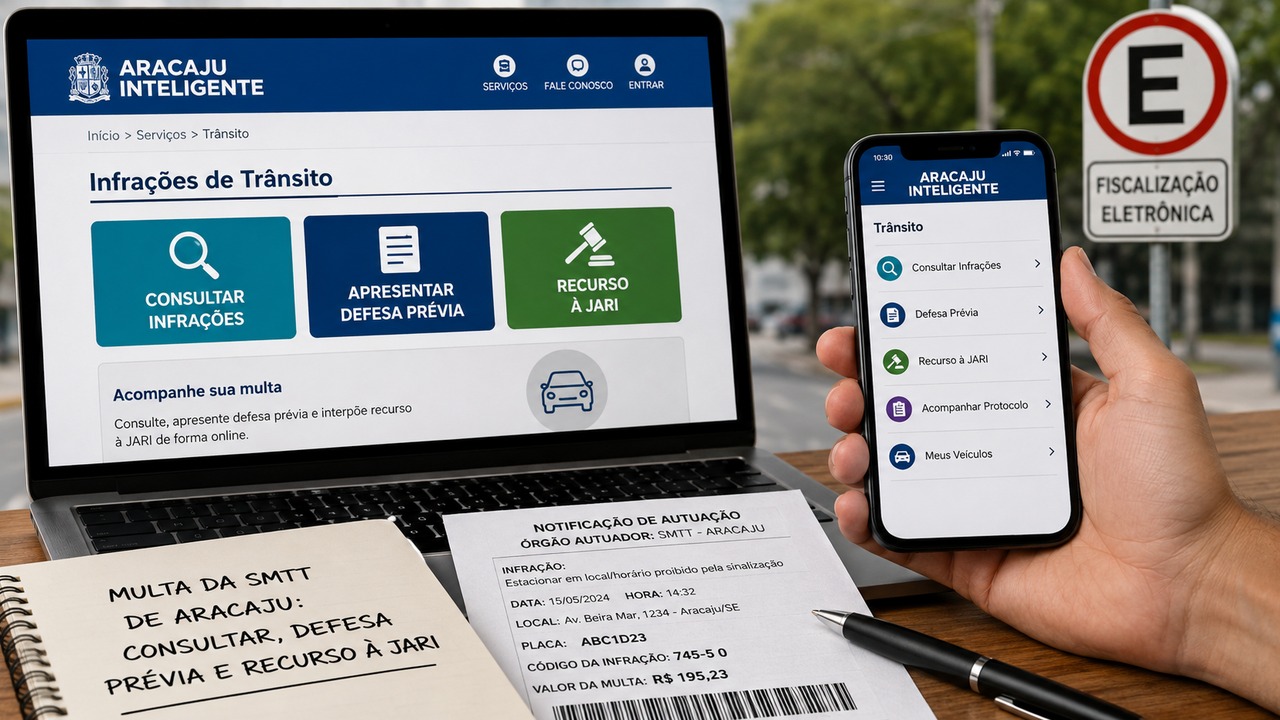
Before filling out any appeal, find out two things: which agency issued the violation notice and what stage the proceeding is in. If the notice identifies SMTT Aracaju as the issuing authority, SMTT's channels and forms are the ones that matter. If the document points to Detran/SE, DER/SE or another agency, the request must follow the procedure of the respective issuing authority, even if the violation appears in a search made through the Detran portal.
SMTT's own traffic-violations page sends fine searches to the Detran/SE Services Portal. This helps locate records linked to the vehicle, but it does not change which agency issued the violation. To challenge it, the decisive information remains the agency shown on the notice and on the Auto de Infração de Trânsito, or AIT, the official traffic violation report.
First: confirm that the fine is actually from SMTT Aracaju
Open the notice and look for the identification of the agency or entity responsible for the violation. Contran Resolution 900/2022 requires a defense or appeal request to identify that agency, as well as the license plate and AIT number. This information prevents a common mistake: sending the defense to the wrong place simply because the vehicle is registered with Detran/SE.
If the issuing authority is SMTT Aracaju, use the service structure maintained by the municipal authority. If it is Detran/SE, Detran itself has defense and appeal procedures for violations within its jurisdiction. If it is DER/SE, the state department maintains its own forms and filing channel for violations issued by DER. The difference is not merely bureaucratic naming: each agency adjudicates the violations that fall within its jurisdiction.
How to check a violation linked to SMTT
The safest starting point is the official domain smtt.aracaju.se.gov.br. In the "Infrações de Trânsito" (Traffic Violations) section, SMTT states that the services related to violations issued by the agency are available there and provides access to searches, duplicate documents and the request form. The "Consultar Multas de Trânsito" (Check Traffic Fines) link directs users to the Detran/SE Services Portal.
On the Detran/SE portal, the traffic and transport violation search allows users to look up a vehicle in the Sergipe fleet by Renavam or chassis number, using the security data required by the system. The page also provides for viewing the violation notice and the result of a challenge. For anyone who has already filed a challenge with SMTT, there is also the "Consulta de Contestação" (Challenge Status Search) page, where progress is checked using the protocol number.
SMTT also maintains a search for public notices concerning violation notices, fine penalties and written warnings. This route can be useful for checking publications when an individual communication was not found. Even so, the specific deadline that applies to your case should be checked in the notice or the corresponding official record.
Violation notice and penalty: the difference that determines the next step
The Notificação de Autuação, or Notice of Violation, informs you that a traffic violation report has been recorded, but the fine penalty has not yet been imposed at that stage. This is when the preliminary defense is submitted. Article 281-A of the Brazilian Traffic Code requires the notice of violation to provide a deadline for this defense of no less than 30 days from the date the notice is issued.
If the preliminary defense is denied, or if it is not submitted within the deadline, the proceeding may advance to the imposition of the penalty. At this stage, a Notificação de Imposição de Penalidade, normally identified as NIP, is issued. The Brazilian Traffic Code requires it to state the final date for an appeal, with a deadline of no less than 30 days from notification of the penalty.
In practical terms, the question is simple. If the document you have is a notice of violation and the fine has not yet been imposed, the proper instrument is the preliminary defense. If there is already a penalty notice, the first-instance instrument is an appeal to JARI.
How to submit a preliminary defense to SMTT
SMTT provides a Formulário de Requerimento Único, or Unified Request Form, which is used, among other purposes, for preliminary defenses and appeals to JARI. On the form, select the option corresponding to the defense against the violation and fill in the applicant's information, vehicle data and the grounds for the request. National rules and the municipal form itself require a separate request for each violation, meaning each AIT must be handled individually.
The defense must be legible, signed and submitted within the deadline. Contran Resolution 900/2022 requires the request to contain the agency responsible for the violation, the applicant's identification and contact details, the license plate, the AIT number, a statement of the facts, the grounds or documents supporting the allegation, the date and the signature. It is not enough to write only that you "disagree" with the fine: it is important to explain what is being challenged and attach what supports the version presented.
In SMTT's current form, for an individual, the minimum documentation listed for a preliminary defense includes a copy of the CNH driver's license or another identification document that allows the signature to be verified, a copy of the CRLV vehicle registration document, the Notificação de Autuação, the AIT or another document containing the license plate and violation-report number, as well as any documents the interested party considers necessary for the analysis. A power of attorney must be attached when there is a representative.
For a legal entity, in addition to the documents applicable to an individual, the form asks for a document proving the authority of the person acting on behalf of the company, such as articles of association, a power of attorney, an administrative order or decree, as applicable, and the personal identification document of the authorized representative.
How to file the defense or appeal with SMTT
The official "Consulta de Contestação" page states that there are two ways to submit the Unified Request Form: in person at SMTT headquarters or through the Aracaju Inteligente platform. The headquarters address given by SMTT is Rua Roberto Fonseca, 200, Inácio Barbosa neighborhood, Aracaju. Because opening hours and service routines may change, check the official page before traveling there.
For electronic filing, use the official address ajuinteligente.aracaju.se.gov.br. The City of Aracaju already provides SMTT services on the platform such as defense against a violation and appeal to JARI. After completing the submission, keep the protocol number and proof that the documents were attached.
Contran Resolution 900/2022 also allows postal submission to the issuing authority and electronic filing when that channel is made available. Because SMTT's current page highlights Aracaju Inteligente and in-person service, anyone intending to use the postal service should first confirm the current address and operational guidance for the specific case.
When an appeal to JARI applies
An appeal to JARI comes into play after the penalty is imposed. This may happen because the preliminary defense was rejected or because no preliminary defense was filed within the deadline. Failure to present a defense at the earlier stage does not, by itself, eliminate the possibility of appealing the penalty when the NIP opens the first-instance appeal period.
Article 285 of the Brazilian Traffic Code establishes that an appeal against a penalty is filed before the authority that imposed the penalty. If it is timely, that authority must forward it to JARI. The same article gives a timely appeal suspensive effect, except in cases of late filing or lack of standing. Article 286 also makes clear that an appeal against a fine may be filed within the legal deadline without requiring the amount to be paid first.
On SMTT's Unified Request Form, select "Recurso à JARI" (Appeal to JARI). For an individual, the listed documentation includes an identification document or CNH that allows the signature to be verified, the CRLV, a copy of the Notificação da Imposição da Penalidade, as well as the Notificação de Autuação, the AIT or a document containing the license plate and violation-report number, and the documents supporting the appeal. A power of attorney must be attached when there is representation.
For a legal entity, the form repeats the requirement to prove who is authorized to act on behalf of the company. SMTT also warns that the form must be filled out legibly, without alterations, with a signature matching the document presented and with the minimum required documentation complete.
What to write as the grounds for the defense or appeal
The form does not require elaborate legal language. The most important thing is to organize an objective, verifiable narrative. Identify the AIT, state which point is being challenged, explain why it would be incorrect or why the penalty should not stand, and attach the available evidence. If the space in the "Motivo" (Reason) field is insufficient, SMTT's own form allows a signed and dated continuation page to be attached.
Avoid generic templates that do not address the information in your notice. A defense based on the license plate, location, time, vehicle, signage, driver identification or any other circumstance only makes sense if that fact is actually present in the case and can be demonstrated. Resolution 900/2022 allows documents proving the allegation to be attached and also authorizes the adjudicating agency to request additional materials when necessary.
How to track the challenge after filing
After filing, keep the protocol number you receive. On SMTT's "Consulta de Contestação" page, progress is searched using that number. The site itself states that, if the request has already been made, the protocol allows you to track its processing.
It is also worth keeping the submitted file, the filing receipt and the version of the attachments. If information later needs to be supplemented, these documents help demonstrate what was submitted and on what date.
SMTT, Detran/SE and DER/SE: do not mix up the channels
The electronic search may give the impression that everything goes through Detran because the state portal brings together information linked to the vehicle. But searching and adjudicating are different things. SMTT's own page points to Detran/SE for fine searches, while SMTT maintains its own form, challenge channels and JARI for SMTT penalties.
Detran/SE has its own procedures for defenses and appeals when the violation falls within its jurisdiction. DER/SE also maintains a specific area for violations, forms and filing for citations issued by the department. Therefore, before attaching any document, confirm which agency appears as the issuing authority. Using the SMTT form for a DER penalty, for example, means starting with the wrong channel.
If JARI denies the appeal, there is still a second administrative instance
JARI is the first appeal instance for the penalty. If the decision is unfavorable, the Brazilian Traffic Code provides for a second-instance appeal within 30 days from publication or notification of the JARI decision. For penalties imposed by a municipal or state agency, the second-instance decision is made by the State Traffic Council, CETRAN.
At that point, follow the instructions that accompany the JARI decision, because they should indicate how and where the new appeal must be submitted. Do not confuse this stage with submitting a new preliminary defense: the proceeding is already in the appeal phase.
What to do based on the document you have
You received a Notificação de Autuação
Confirm that SMTT Aracaju is the issuing authority, check the printed deadline and prepare the preliminary defense. Use one form for each AIT and attach the minimum documentation listed by SMTT, together with the evidence specific to your case.
You received a Notificação de Imposição de Penalidade
The proceeding has already moved beyond the initial violation-notice stage. If you want to challenge it, observe the NIP deadline and file an appeal with SMTT's JARI, using the Unified Request Form and the documents required for this stage.
You only found the violation on the Detran/SE Portal
Open the details before choosing any form. Identify the issuing authority and determine whether the record is still at the violation-notice stage or whether a penalty has already been imposed. The fact that the search is on Detran/SE does not mean the appeal should be sent to Detran.
You have already received the JARI decision
Read the decision and the appeal instructions. If you wish to continue the challenge, the route is the second administrative instance, observing the legal deadline and the channel indicated for forwarding the matter to CETRAN.
Official channels to start with without using the wrong address
For municipal violation services, start at smtt.aracaju.se.gov.br and look for the "Infrações de Trânsito" or "Consulta de Contestação" section. For digital filing of SMTT services, use ajuinteligente.aracaju.se.gov.br. To check vehicle violations, follow SMTT's own link to the Detran/SE Services Portal at detran.se.gov.br.
If the document identifies another issuing authority, leave the SMTT flow and find that agency's official channel. The most useful rule for avoiding wasted time is this: first identify the issuing authority, then identify the stage, and only then choose between a preliminary defense, an appeal to JARI or the second administrative instance.
Because deadlines and administrative procedures have a direct effect on the right of defense, always check the deadline stated on the notice and the current instructions of the responsible agency. In a complex situation, a disputed deadline or uncertainty about the validity of the violation report, individualized guidance from a qualified professional may be necessary.