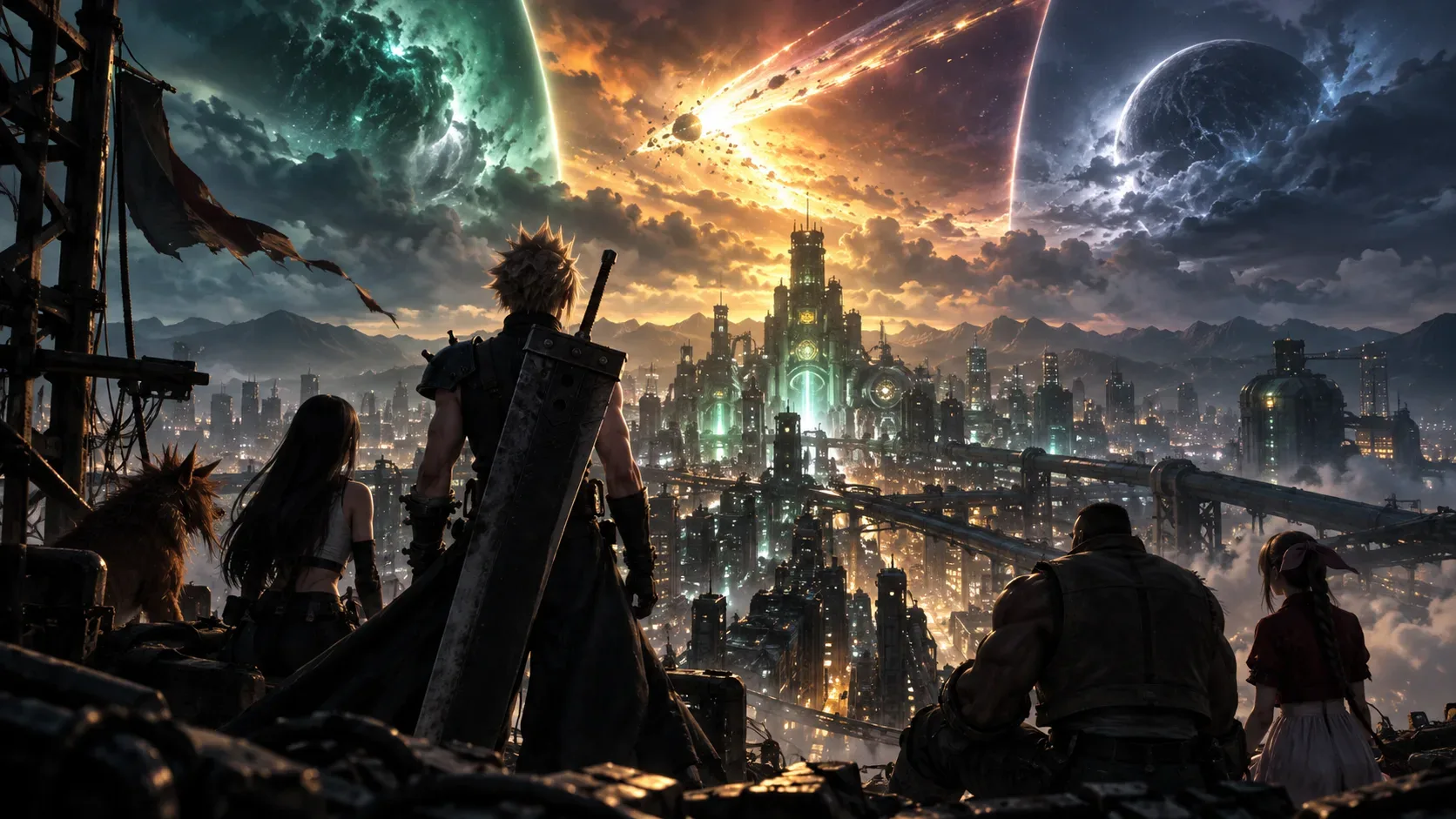
Yes. As of September 14, 2026, official messaging treats Final Fantasy VII Revelation as the third and final entry in the Final Fantasy VII Remake series. This is not just a fan interpretation: Square Enix presents it as the conclusion of the trilogy, PlayStation calls it the “final entry” in the Remake Series, and Nintendo summarized its September 9 Direct appearance by saying the remake series is reaching its conclusion. The point that still needs nuance is different: ending the trilogy does not necessarily mean ending every future project connected to Final Fantasy VII.
Revelation is officially the third and final part
The trilogy structure is now explicit on official pages. Square Enix identifies Final Fantasy VII Remake Intergrade as Part 1, Final Fantasy VII Rebirth as Part 2, and Final Fantasy VII Revelation as Part 3. In addition, the digital product called the Trilogy Edition bundles exactly those three games.
- Part 1: Final Fantasy VII Remake Intergrade.
- Part 2: Final Fantasy VII Rebirth.
- Part 3: Final Fantasy VII Revelation.
The confirmation predates the Nintendo Direct referenced in the brief. On September 3, 2026, Square Enix and PlayStation Blog were already presenting Revelation as the final entry in the Remake Series. On September 9, the official Nintendo Direct page reinforced the same message by framing the announcement as the conclusion of the remake series.
What the “end of the trilogy” actually ends
What is confirmed is the end of the main arc planned as the Remake, Rebirth, and Revelation trilogy. So if the question is “will there be a Part 4 needed to complete this same remake project?”, the available official information points to no: Revelation is Part 3 and the series finale.
That is different from saying Square Enix will never again produce a game, expansion, or project set in the Final Fantasy VII universe. The official pages reviewed do not make that promise. They define the end of the Remake Series, not the permanent end of the broader Final Fantasy VII franchise.
What has already been confirmed about Final Fantasy VII Revelation
| Point | What is confirmed |
|---|---|
| Role in the series | Third and final entry in the Final Fantasy VII Remake trilogy. |
| Release date | April 8, 2027. |
| Announced platforms | PlayStation 5, Nintendo Switch 2, Xbox Series X|S, Xbox on PC, Steam, and Epic Games Store. |
| Exploration | A larger-scale open world and the Highwind airship for traveling across the planet. |
| Continuity | The game concludes the main story that began in Remake and continued in Rebirth. |
| Post-launch content | A Story Expansion Pass has been announced with two narrative DLCs: one tied to Sephiroth and another to Vincent and the Turks. |
These points appear in official materials from Square Enix, the PlayStation Blog, and the Revelation editions page.
Do the DLCs change the answer to “is it the last one”?
They do not change the fact that Revelation is the last game in the trilogy, but they make the answer more precise. Square Enix has already announced two story DLCs for after launch. That means the base game ends the sequence of three main titles, while additional narrative content will still be released within Revelation.
In other words, “last in the trilogy” describes the structure of the main games. It does not mean all story content will end on the base game's release day.
What has not yet been officially detailed
Official sources already define Revelation's role, but they are keeping the answers that could spoil the ending under wraps. At this point, they have not publicly detailed:
- the exact ending and how closely it will follow or depart from the 1997 game's conclusion;
- the full resolution of continuity changes introduced by Remake and Rebirth, including the final fate of characters and story threads left open;
- the scope of the two story DLCs, beyond the announced themes/titles and the statement that more details will come later;
- possible projects set in this same continuity after the trilogy, because the reviewed pages neither announce a “Part 4” nor categorically rule out other Final Fantasy VII products.
That distinction matters: a lack of detail should not be treated as confirmation of a theory. What is official today is Revelation's structural role as the conclusion; the exact content of the ending remains for the game itself and future announcements to reveal.
Why the Trilogy Edition is especially strong confirmation
The Trilogy Edition leaves little room for ambiguity because it is an official product that packages the three games as a single set: Remake Intergrade, Rebirth, and Revelation. Square Enix's own page describes the bundle as the Remake Series trilogy. That reinforces that “trilogy” is not merely an informal label used by the community.
So, is Final Fantasy VII Revelation really the last one?
Yes, as the final main installment of the remake trilogy. Square Enix positions Revelation as Part 3 and the final entry in the Final Fantasy VII Remake Series; Nintendo and PlayStation repeat the conclusion framing. What remains open is how that ending will be told and what may exist after the trilogy in the wider Final Fantasy VII universe.
For anyone trying to separate fact from theory, the practical rule is simple: treat the three-part structure, Revelation's final role, the April 8, 2027 release date, and the announced narrative DLCs as confirmed. Treat alternate endings, character fates, and later projects as speculation until Square Enix publishes something more specific.