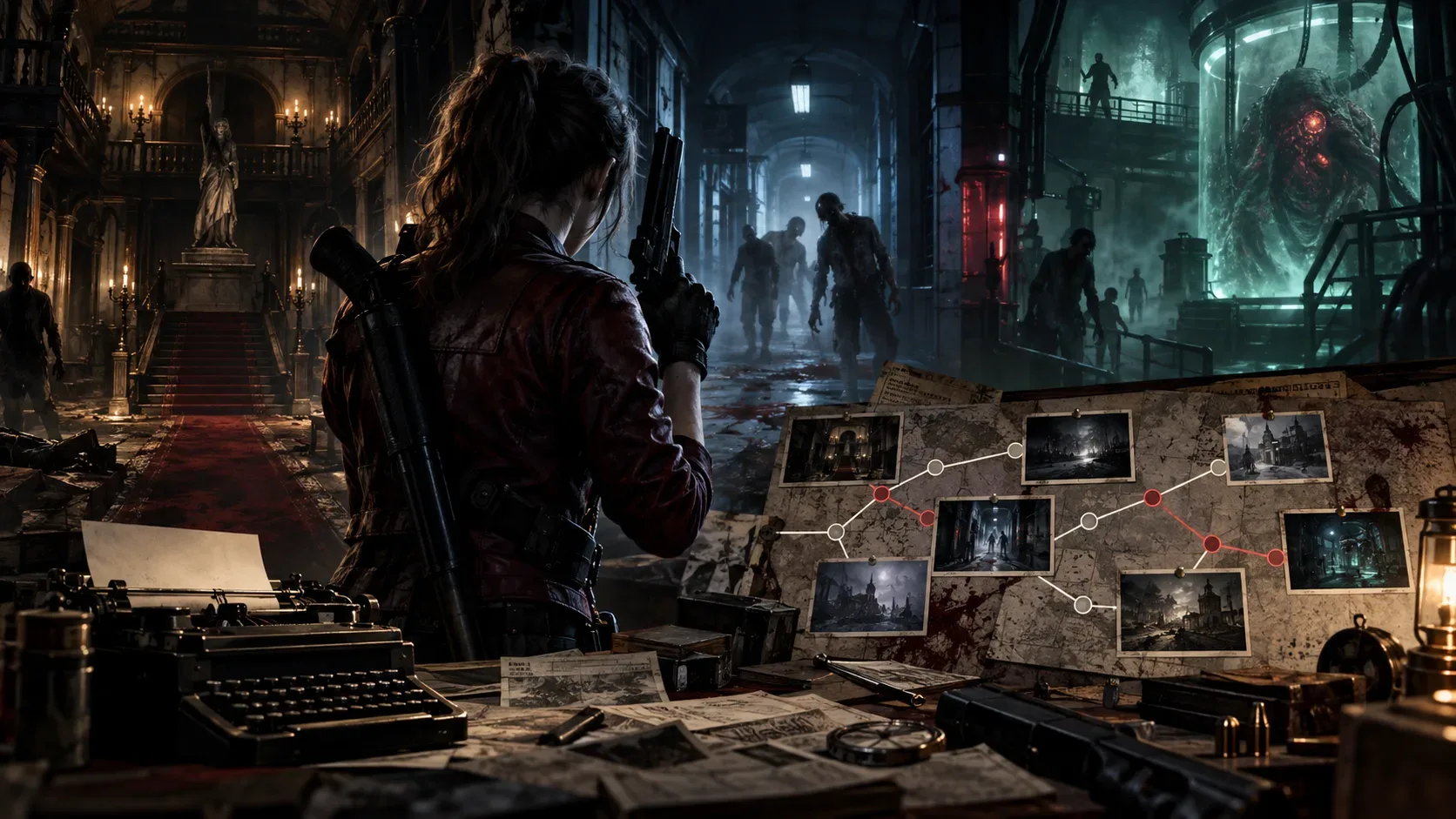
There is no single correct order for playing Resident Evil. The best sequence depends on what you want: enter the franchise through newer games, follow the in-universe chronology, or play only the chapters that carry the main storyline. For most newcomers, a simple modern route is Resident Evil 2 remake → Resident Evil 3 remake → Resident Evil 4 remake → Resident Evil 7 → Resident Evil Village → Resident Evil Requiem. After that, you can go back to the classics and bridge chapters.
Capcom itself organizes the story by in-universe events, and that chronology shows why release date alone does not solve the problem. In the official chronology, Resident Evil 0 takes place before the first game, Resident Evil 3 starts before Resident Evil 2 and ends after it, and Revelations fills gaps between numbered entries. The series also has remakes that now work as more accessible entry points.
Three ways to play Resident Evil
| Route | Suggested order | Who it suits |
|---|---|---|
| Newcomer | RE2 remake → RE3 remake → RE4 remake → RE7 → Village → Requiem | Players who want current controls, pacing, and presentation before exploring older games. |
| Chronological | RE0 → RE1 HD → RE2 and RE3 as an overlapping block → Code: Veronica → RE4 → Revelations → RE5 → Revelations 2 → RE6 → RE7 → Village → Requiem | Players comfortable with different gameplay styles who want to follow events in narrative order. |
| Essential | RE1 HD → RE2 remake → RE3 remake → Code: Veronica → RE4 remake → RE5 → RE6 → RE7 → Village → Requiem | Players who want the backbone of the series without turning the experience into a marathon of every spin-off. |
Why release order is not the only option
Resident Evil mixes numbered sequels, prequels, unnumbered chapters, and remakes. Resident Evil 0 was released after several games, but its story happens immediately before the first Resident Evil. Code: Veronica has no number in its title, yet it appears early in Capcom's official chronology, soon after the Raccoon City disaster. Revelations and Revelations 2 sit between numbered games and act as bridges for characters and organizations that return later.
Remakes add another layer. Capcom's history page separates the original 1996 Resident Evil from the 2002 remake and also lists the modern remakes of Resident Evil 2, Resident Evil 3, and Resident Evil 4. On a first playthrough, you do not need to play an original and its remake back to back. They occupy similar narrative positions, but structure, locations, pacing, and story details can differ.
Newcomer route: the easiest way to enter today
If you have never played the series, starting with Resident Evil 2, the 2019 remake, is a strong summary of what the franchise does best: exploration, limited resources, gradually opening routes, and constant pressure. Resident Evil 3 then keeps the Raccoon City context while showing another perspective on the same disaster.
Resident Evil 4, in its 2023 remake, expands the action without abandoning resource management and tension. Next, Resident Evil 7 moves to a first-person camera and begins the Ethan Winters arc, which continues directly in Resident Evil Village. Ending this route with Resident Evil Requiem puts you at the newest main entry, released on February 27, 2026. Capcom defines it as the ninth main installment, and official 30th anniversary material highlights the return to Raccoon City.
This route is not meant to tell the entire story. It prioritizes accessibility and variety. Afterward, you can go back to the first Resident Evil, Code: Veronica, Resident Evil 5, and Resident Evil 6 with a better sense of which styles of the series interest you most.
Chronological route: the order of events
For players who want to follow the universe, Capcom's official chronology provides clear milestones. The sequence below uses those markers without interrupting campaigns midway:
- Resident Evil 0: July 23, 1998.
- Resident Evil / Resident Evil HD Remaster: July 24, 1998, the Mansion Incident.
- Resident Evil 2 and Resident Evil 3: September 1998. These stories overlap. RE3 begins on September 28, one day before the central events of RE2, and continues through Raccoon City's final days. For better flow, play them as a block instead of alternating chapters.
- Resident Evil Code: Veronica: December 1998.
- Resident Evil 4: autumn 2004.
- Resident Evil Revelations: 2005.
- Resident Evil 5: March 2009.
- Resident Evil Revelations 2: 2011.
- Resident Evil 6: June 2013.
- Resident Evil 7 biohazard: 2017.
- Resident Evil Village: February 2021.
- Resident Evil Requiem: place it last in this practical route. It is the ninth main installment and the newest release. The Capcom chronology page consulted still provides its detailed timeline through Village, so there is no need to invent a specific in-universe date to position Requiem.
The important exception is the RE2 and RE3 block. Capcom explicitly states that their events take place in the same city at roughly the same time. A minute-by-minute order would require leaving one game to open the other, which hurts the experience. For actual play, accepting the overlap is more useful.
Essential route: the main story without every side game
If your goal is the backbone of the series, begin with Resident Evil HD Remaster, which brings the 2002 remake of the first game to modern platforms. Then continue with RE2 remake, RE3 remake, and Code: Veronica. Code: Veronica belongs in this route because it directly continues characters and conflicts from the early era, even without a number in its title.
From there, move through RE4 remake, RE5, and RE6. This trio tracks the series' shift from more enclosed survival horror toward larger campaigns with more action. Next, play RE7 and Village, which form a directly connected arc. Finish with Requiem.
Resident Evil 0 can wait until later on this route. It takes place first chronologically, but it works better once you already know the Mansion Incident and some of its characters. Revelations and Revelations 2 can also be treated as meaningful supplements rather than prerequisites for understanding every numbered game.
Remake or original: which version should you choose?
For a first run, the simplest choice is to use modern versions when they exist: Resident Evil HD Remaster for the first game, Resident Evil 2 remake, Resident Evil 3 remake, and Resident Evil 4 remake. That keeps the route on current platforms and reduces abrupt changes in controls and presentation.
The originals remain valuable if your goal is to understand how the series' design evolved. They should not be treated simply as inferior versions of the remakes. Camera systems, maps, enemies, puzzles, and pacing can change substantially. Players who want to compare eras can play the original after the remake, or the other way around, but they do not need to duplicate every chapter in a first marathon.
What about the optional games?
Capcom's official chronology includes several side chapters. Resident Evil Outbreak and Outbreak File #2 follow ordinary survivors during the Raccoon City crisis. The Umbrella Chronicles and The Darkside Chronicles retell events and add original episodes in an on-rails shooter format. They enrich the universe but do not need to come before the main games.
Revelations sits in a middle category. The first game takes place between RE4 and RE5, while Revelations 2 occurs before RE6 in Capcom's chronology. If you like Jill, Chris, Claire, and the organizations fighting bioterrorism, both add context. If you only want to reach the main chapters, you can save them for later.
Where Resident Evil Requiem fits
Capcom confirms that Resident Evil Requiem launched on February 27, 2026. The company presents it as the ninth main installment, and the official portal lineup already lists it among the available games. For players who want to maximize references, its most practical place is after Village and after learning at least the Raccoon City portion of the series.
If you want to play Requiem soon, you do not need to finish the entire catalog. Resident Evil 2 remake provides a strong foundation for Raccoon City and Leon, while RE7 and Village familiarize you with the series' modern era. Older games can then become context expansion rather than a barrier to entry.
Which route should you choose?
- Want to start without dealing with older controls? Use the newcomer route.
- Want to follow events in sequence? Use the chronological route and treat RE2 and RE3 as an overlapping block.
- Want the main story without playing everything? Use the essential route.
- Want to understand how Resident Evil changed as a videogame series? Then release order is useful, especially if you compare originals and remakes.
The key is not to turn Resident Evil into a mandatory checklist. The franchise was built across decades, with entries that vary greatly in camera, pacing, and focus. Choosing a route based on your goal creates a more coherent experience than simply starting in 1996 and moving through every release.