Short answer: so far, Nintendo has confirmed that Kirby and the World Beyond will feature free exploration across expansive 3D environments, but it has not confirmed that the game is open world. The distinction matters: large areas, multiple routes, and freedom of movement can exist in a game that is still divided into stages, regions, or connected zones. Until the map and progression structure are explained, calling the new Kirby game “open world” would go beyond what has been announced.
What Nintendo has confirmed about exploration
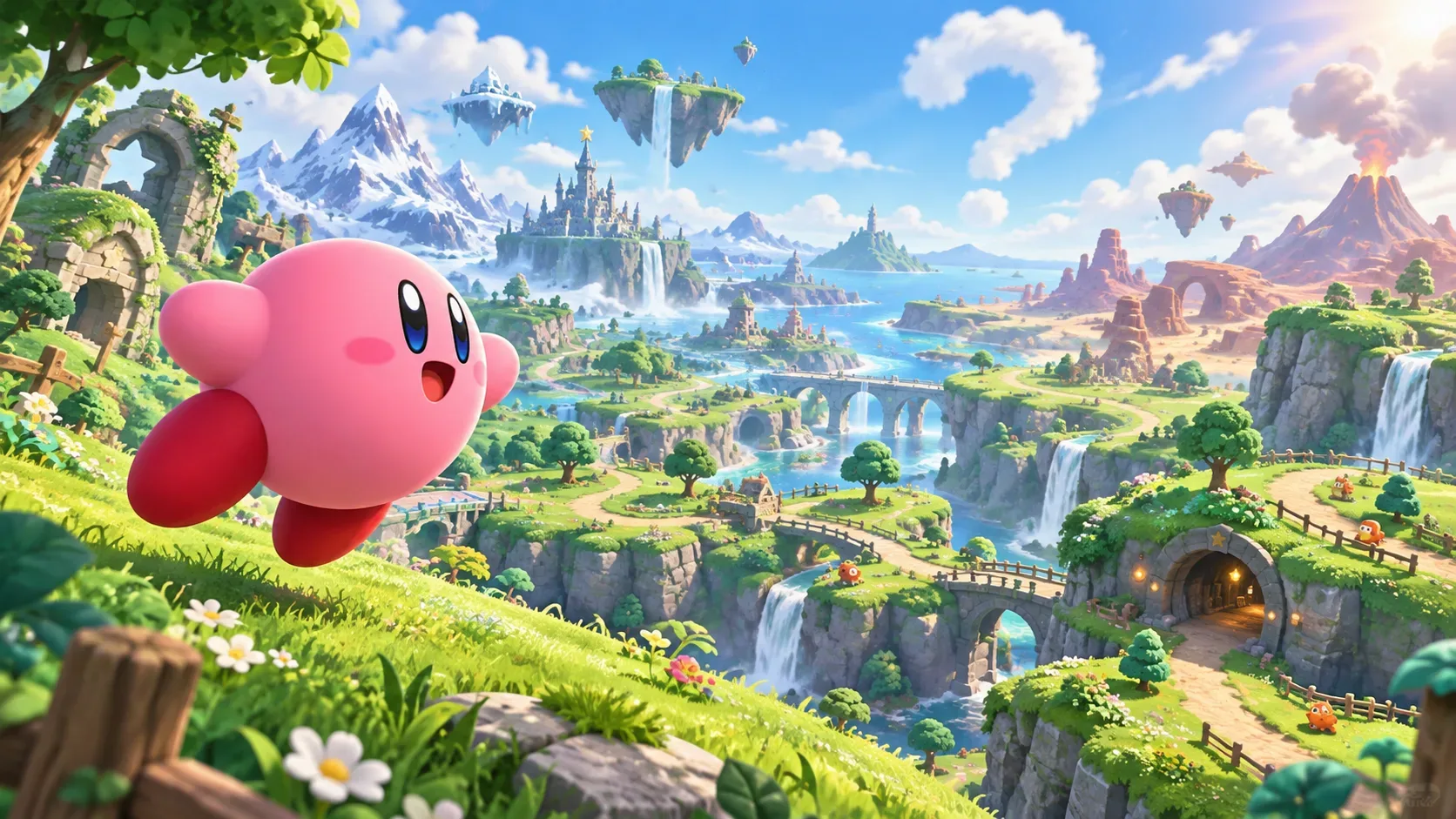
The official Nintendo store page presents the game as an adventure where Kirby can freely explore and traverse an expansive world using powered-up Copy Abilities. Nintendo also details movement-focused actions: bomb jumps to gain height, sticking a sword into trees to climb, and riding at high speed across fields.
In an official Nintendo news post, the company describes it as a new 3D adventure built around expansive environments and free exploration. The game is scheduled for Nintendo Switch 2 in 2027.
| Point | Status | What it means |
|---|---|---|
| Free exploration | Confirmed | Players will have room to move around and investigate environments beyond a strictly linear path. |
| Expansive 3D environments | Confirmed | Scale and openness are central to how Nintendo is presenting the game. |
| Abilities used for traversal | Confirmed | Bomb jumps, sword-assisted climbing, and fast travel across fields point to more active vertical and horizontal exploration. |
| A continuous open world | Not confirmed | Nintendo has not said that the entire map will be one seamless space. |
| No separate stages or areas | Not confirmed | There is not enough official information to know whether the game will use stages, regions, portals, selection screens, or loading transitions. |
| Free objective order | Not confirmed | Nintendo has not explained how much of the campaign can be completed outside a set sequence. |
Why “free exploration” does not automatically mean open world
“Open world” usually describes a structure where large parts of the map are connected and players can move between them with relatively few hard divisions, often choosing routes and activities in a flexible order. “Free exploration,” however, can simply describe freedom within a specific area.
A game can offer a huge forest with branching paths, secrets, and vertical routes while still ending that area as a stage before sending the player somewhere else. In that case, exploration is free inside the environment, but the campaign remains stage-based. That structural question is exactly what Nintendo has not yet answered for World Beyond.
There is another reason to be cautious in Nintendo’s own wording. In the same Nintendo Direct material where Kirby and the World Beyond is described through “free exploration” and an “expansive world,” Nintendo explicitly uses the term “open-world” for other games such as LEGO Batman: Legacy of the Dark Knight, Far Cry 3, and Hela. That does not prove Kirby is not open world, but it does show that, in the official descriptions reviewed, Nintendo has not applied that label to this game.
What appears to change from Kirby and the Forgotten Land
Kirby and the Forgotten Land also gave players considerable freedom inside 3D spaces. The key difference is that Nintendo officially describes that game as an experience built around 3D platforming stages. In an Ask the Developer interview, its structure is explicitly discussed in terms of freely exploring and completing each stage, with a world map and Waddle Dee Town separate from regular stages.
World Beyond, by contrast, is being introduced with broader language: an expansive “world,” fields that can be crossed at high speed, and Copy Abilities that double as traversal tools. That suggests greater ambition for movement and discovery, but it still does not establish that the stage structure is gone.
| Aspect | Forgotten Land | World Beyond |
|---|---|---|
| Exploration base | 3D platforming stages with freedom inside each stage | Expansive environments with free exploration |
| Overall structure | Stages, a world map, and Waddle Dee Town are officially documented | Not yet detailed |
| Traversal | Traditional Kirby movement, Mouthful Mode, and Copy Abilities | Powered-up abilities also support climbing, gaining height, and crossing fields quickly |
| Open world | Not presented as an open-world game | Not confirmed so far |
The signs pointing to more freedom
- Environment scale: Nintendo emphasizes expansive spaces rather than only corridors or arenas.
- Movement as a discovery tool: some abilities appear designed to reach height, cross distance, and find alternate routes.
- Language about traversing the world: the official copy suggests movement through broad spaces rather than only point-to-point progression.
- Open fields: Nintendo’s example of moving at high speed across fields implies areas large enough for that kind of traversal to matter.
These elements strengthen the case that this Kirby game will be more open than Forgotten Land. They are still fully compatible with a structure made of large zones or extended stages.
What still needs to be revealed before we can call it open world
- whether there is one seamless map or multiple separate regions;
- whether players travel directly between biomes or select stages from a map;
- whether loading screens or transitions define the boundaries of each area;
- whether main objectives can be completed in different orders;
- whether areas are gated by story progress, abilities, or specific barriers;
- whether fast travel exists and how it interacts with normal exploration.
The story already includes a huge wall blocking Kirby’s path, according to Nintendo’s official description. It may simply be a narrative device, a progression gate, or part of a regional structure. Without more details, anything beyond that is speculation.
So what is the safest description today?
Based on what has been confirmed, the most precise description is: a new 3D Kirby adventure with free exploration across expansive environments. There are clear signs of greater mobility and potentially more autonomy than in Kirby and the Forgotten Land, but Nintendo has not confirmed a seamless open world.
That makes it useful to separate two statements. “World Beyond appears to offer much more exploration freedom” is supported by official material. “World Beyond is an open-world game” is not supported yet. The definitive answer depends on Nintendo showing the map, the connections between areas, and the campaign structure.