Mega Man: Dual Override is not trying to replace the series’ identity with a build system. What Capcom has shown so far points to a more specific change: preserve side-scrolling action, Robot Masters and the freedom to tackle challenges in different orders, while giving players more than one way to get through the same stage. In that design, Proto Man changes moment-to-moment combat, while Custom Chips change preparation.
As of September 15, 2026, Capcom has confirmed that Proto Man will be a second playable character with his own style, that Mega Man and Proto Man can mix and match Custom Chips, and that both can use the Override system. The announced release window is spring 2027. The key is to separate these three additions: character, customization and temporary power are not the same mechanic.
At a glance: what changes and what stays
| Element | Classic formula | Dual Override | Practical impact |
|---|---|---|---|
| Playable character | Mega Man carries the main shooting-and-platforming style | Proto Man joins as an alternative built around a shield and more close-range combat | Character choice now changes how players approach enemies and spaces |
| Preparation | Progress usually relies mainly on core abilities, items and weapons acquired through the campaign | Custom Chips let players combine upgrades that modify character functions | The same stage can be approached with different priorities for movement, offense or defense |
| Temporary power | Mega Man 11 used Double Gear as its major added mechanic | Dual Override separates Chip customization from the temporary Override state | Equipping upgrades and deciding when to push a character past normal limits become different decisions |
| Core structure | Side-scrolling action, Robot Master stages and pattern-based challenge | Capcom says it wants to preserve the mainline core while expanding player options | The changes are in the tools, not in turning the game into a different genre |
Proto Man is more than a Mega Man variation
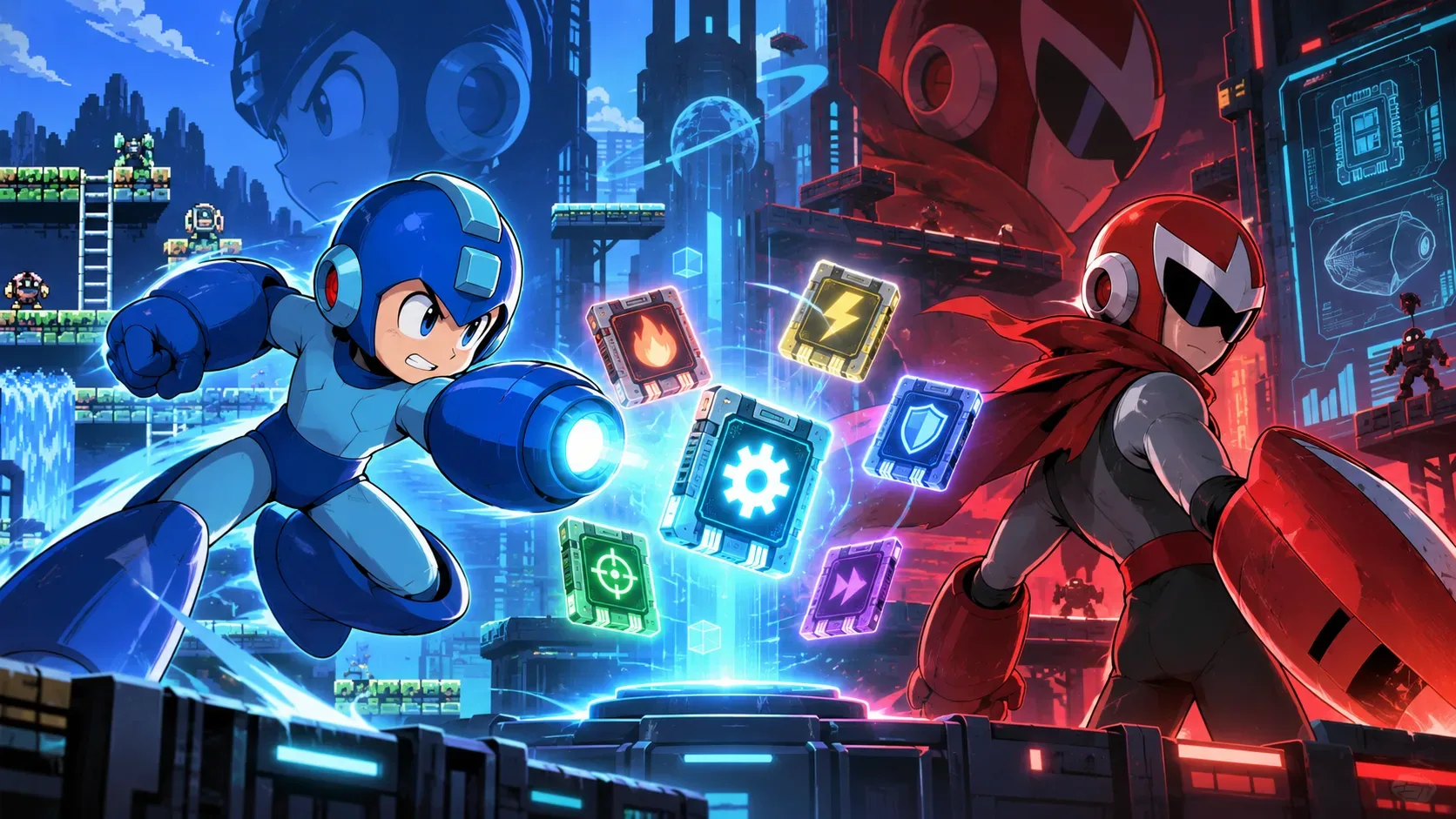
The clearest difference is that Proto Man has not been presented as a cosmetic swap. Nintendo’s September 9 material describes him as having a versatile shield-based fighting style and powerful close-range attacks, in contrast with Mega Man’s ranged firepower. That shifts the center of risk: Mega Man is better positioned to solve many situations while keeping distance; Proto Man is designed to move closer.
The development team told VGC that fans would not be satisfied with “two different characters with different skins and the same play style,” so the team created game elements that differ between the two. Capcom press information reproduced by Gematsu also associates Proto Man with a heat gauge that players need to manage when using his arsenal.
That combination of shield play, shorter range and heat management suggests a more aggressive risk-reward loop. What is confirmed is the distinct identity; what has not yet been fully published is the complete command list, values and shield interactions. It is therefore too early to claim that Proto Man will simply be “harder” overall rather than more technical in specific situations.
Custom Chips change how players prepare for a challenge
Custom Chips are the layer that most clearly changes stage replayability. Capcom has shown upgrades such as rapid-fire shots, a protective shield bubble and a hover ability, and says players will be able to mix and match Chips on both Mega Man and Proto Man to suit their playstyle.
In an interview with CGMagazine, director Shinya Ikuta was more specific: he said the Custom Chip System replaces Mega Man 11’s Double Gear System as Dual Override’s central customization system, and that different combinations can dramatically change the experience of replaying the same stage. He also explained that the Gamescom demo used a limited set prepared for the event, while the final product will include many selectable Chips in a customization menu.
That matters because it prevents a misleading interpretation: Chips do not appear to be only a disguised “easy mode.” Ikuta acknowledged that difficulty can be affected by the selected Chips, but said he would rather players see them as tools that may be more effective or appropriate for certain stages. In the same interview, the team said that collected Bolts can be traded for Custom Chips, connecting exploration with an expanding toolkit.
In practice, the classic formula no longer asks only “which stage should I choose first?” It also asks “what setup do I want for this stage?” That expands preparation rather than replacing execution: jumping, positioning, learning patterns and reacting still matter.
Override is another layer — not the same thing as Chips
The game’s title points to a separate system. According to Capcom, Override temporarily releases a robot’s limiter to provide a surge of power, but it has a cost: after use, multiple abilities become temporarily unavailable or weakened. Both Mega Man and Proto Man can use it.
The result is two complementary decisions. Custom Chips define how the character has been prepared; Override defines when it is worth pushing beyond normal limits during action. That distinction matters compared with Mega Man 11 because it avoids concentrating every new idea in a single acceleration button. Customization exists before and throughout progression, while Override is a tactical timing choice.
What remains classic Mega Man
Despite the additions, the team insists that Dual Override still belongs to the mainline series. In its VGC interview, Ikuta said the goal is not to add things that are not representative of mainline Mega Man, such as turning the game into a 3D experience, but to update the presentation and stages while keeping the familiar core. The interview also reinforces the importance of challenge, the sense of accomplishment and the freedom to choose which stages to tackle first.
Official materials still show side-scrolling action and platforming, Robot Masters and stages built around specific hazards. Capcom has introduced Twinkle Girl as a new Robot Master and shown Astro Man returning. Proto Man and the Chips are therefore best understood as additional ways to solve challenges inside that structure, not as signs that the series has abandoned its foundation.
What has not been confirmed yet
- Full Custom Chip list: Capcom has shown examples, but it has not published the final catalog or every possible combination.
- Final equipment rules: the Gamescom demo used specific configurations; the final menu and limits may still change.
- Proto Man’s complete kit: shield use, close-range combat and heat management are confirmed, but not every command and interaction has been detailed.
- Balance between the two characters: there is not enough evidence to say which one will be stronger, easier or ideal for each stage.
- Exact release date: the announced window is spring 2027; no specific launch day had been confirmed as of September 15, 2026.
So what actually changes in the formula?
The deeper change is that Dual Override adds choice without removing traditional execution. Proto Man creates a second combat language that is closer-range and shield-oriented. Custom Chips make preparation a more explicit part of strategy and allow challenges to be revisited with different setups. Override, meanwhile, adds a burst of power with a later cost.
For players coming from the classic games, the reference point remains familiar: choose challenges, master platforming, read patterns and defeat Robot Masters. What changes is the number of decisions before and during each attempt. Capcom’s promise so far is to make the formula accommodate more playstyles without replacing precision-based challenge with an automatic system.
Sources and information status
This article reflects public information available through September 15, 2026. Its main references are Capcom’s Gamescom 2026 announcement, Nintendo’s official September 9 Direct recap, VGC’s interview with the development team, CGMagazine’s interview on Custom Chips, and Capcom press information reproduced by Gematsu. Because the game is still in development, balancing details, the Chip list and final system behavior may change before release.