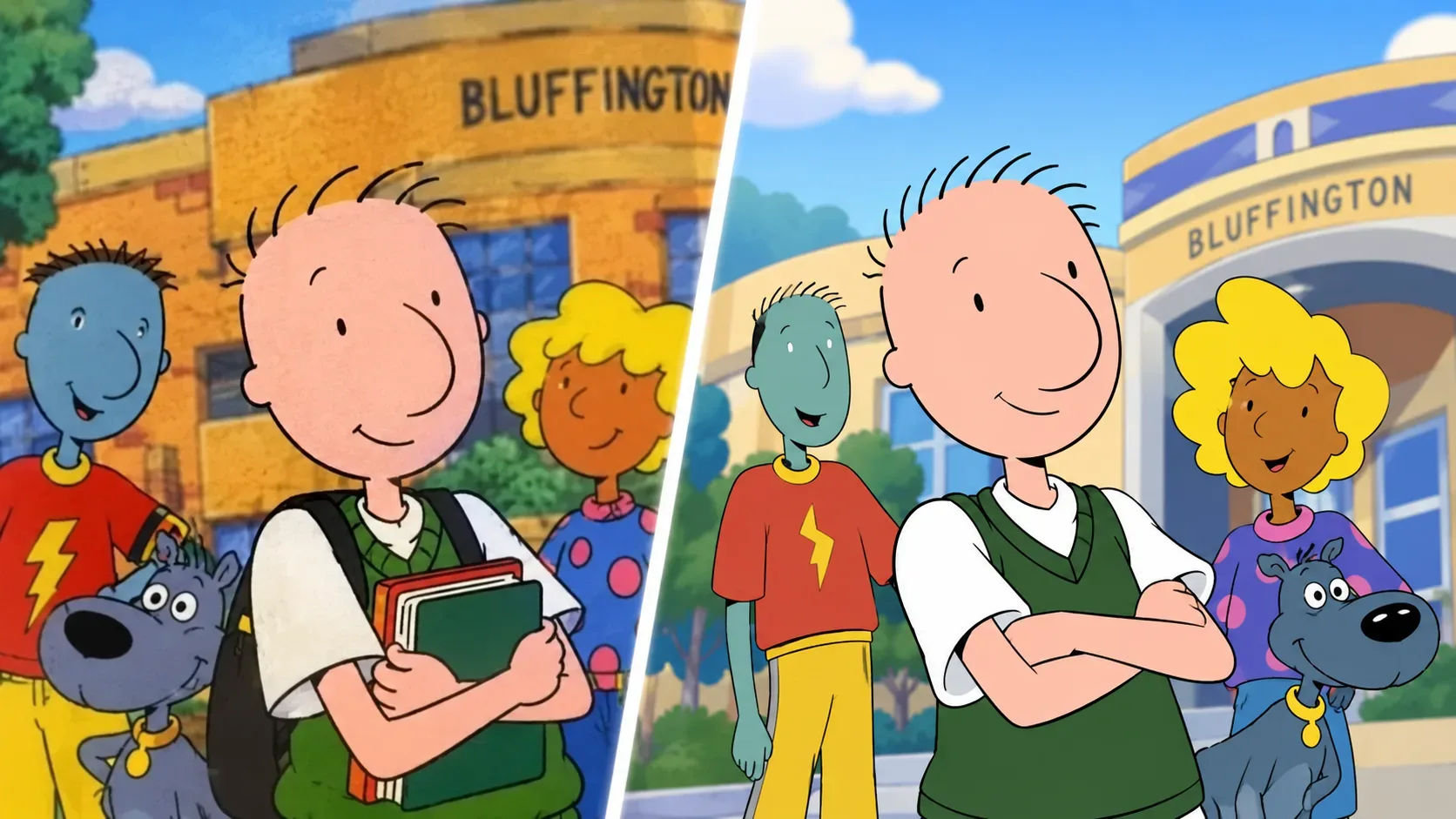
Watching Doug straight through makes the break easy to notice: the episodes produced for Nickelodeon have a different rhythm, look, and everyday feel from the later Disney-produced chapters. That impression is not just nostalgia. The company, network, production setup, voice cast, episode format, and visual direction all changed. At the same time, calling the Disney era “an unrelated new series” is also too simple: it was conceived as a continuation, with Jim Jinkins still connected to the project.
What happened when Doug left Nickelodeon
Doug premiered on Nickelodeon in 1991 and reached 52 episodes produced by Jumbo Pictures. According to a Los Angeles Times retrospective, the original deal allowed for as many as 65 episodes ordered in blocks, but Nickelodeon did not exercise its option for the final 13 after the first 52 had been produced.
In February 1996, Disney acquired Jumbo Pictures, the company founded by Jim Jinkins and David Campbell. The official D23 archive records the purchase and notes that the studio went on to produce Brand Spanking New Doug, later renamed Disney's Doug. The new run premiered on ABC on September 7, 1996; D23 itself describes it as a continuation of the Nickelodeon series.
So the move was more than a different logo in the opening credits. The company making the show changed ownership, the original outlet shifted from Nickelodeon cable to the ABC broadcast network, and the project entered a new creative phase.
The main differences, side by side
| Aspect | Nickelodeon era | Disney era | Why viewers notice it |
|---|---|---|---|
| Production | Jumbo Pictures producing the series for Nickelodeon | Jumbo Pictures owned by Disney, working with Walt Disney Television | The corporate structure, outlet, and part of the staff changed |
| Original outlet | Nickelodeon, beginning in 1991 | ABC, beginning September 7, 1996; later also in syndication | The show became part of a different children's programming strategy |
| Episode format | Mostly two short stories per half-hour | Full-episode-length stories | A single longer story changes pacing and scene structure |
| Doug | A new kid in Bluffington living an elementary-school routine | Older and entering a new stage of school life | The series marks the passage of time instead of pretending nothing changed |
| Voice | Billy West voiced both Doug and Roger in the original English cast | Thomas McHugh takes over Doug; Chris Phillips takes over Roger | A new lead voice immediately changes the show's familiar sound |
| Visuals | Character designs, clothes, and settings associated with the original run | Hair, clothing, proportions, and Bluffington locations are refreshed | Familiar characters can look noticeably “redesigned” |
The Disney era deliberately showed Doug growing up
One of the biggest choices was not to resume the story with everyone visually and socially frozen at the exact point where the Nickelodeon run stopped. D23 describes the new series as a continuation in which Doug is growing up and approaching his 12th birthday. Disney's own catalog presentation now places this version of Doug in middle school, still relying on his journal and imagination to navigate friendship, school, and growing up.
That progression is built into the opening of the Disney run: Doug's birthday, a new school, and changes around Bluffington become part of the story. New outfits, different hairstyles, and updated locations therefore work as more than cosmetic tweaks; they communicate that his world has moved forward.
This matters because many animated series keep characters almost permanently at the same age and status. Doug used the network transition as an opportunity to alter the status quo.
Doug's voice changed — and that matters more than it may seem
During the Nickelodeon era, Billy West performed the original English voices of both Doug and Roger Klotz. In a Vanity Fair video interview, West recalled those roles and said he had nothing to do with the Disney version. For the new run, Thomas McHugh became Doug and Chris Phillips became Roger; D23's cast listing confirms both names.
For viewers who knew the first run, this is one of the fastest ways to sense the change. Even when the scripts, personalities, and relationships remain recognizable, a different voice changes cadence, tone, and the energy of the central character. In animation, that can be as noticeable as a new visual design.
The episode format changed the storytelling rhythm
Another easily overlooked difference is structure. Most Nickelodeon half-hours contained two shorter stories. In the Disney run, the standard became one longer story filling the episode.
That changes the viewing experience even when the subject matter remains grounded in everyday problems. A short segment generally reaches its conflict and resolution faster; a longer story has room for more transitional scenes, secondary threads, and setting changes. The feeling that the later show “moves differently” is therefore not purely subjective: it is built around a different narrative unit.
The changes were not simply “Disney changing everything”
It is common to reduce the second era to “Disney changed Doug.” Disney's acquisition of Jumbo and the new production structure obviously mattered, but Jim Jinkins himself pushed back against the idea that executives imposed every major alteration. In an interview with FLOOD, he said the changes were his decision and that the team wanted a creative restart after having already told a large number of stories.
That does not mean the two eras were produced under identical conditions. The same retrospective notes departures among original staff and Billy West's exit. The more accurate description is a deliberately reworked continuation, not an untouched original that was simply rewritten by a new corporate owner.
What changed in distribution and rights
The transition also created an important catalog split. At the time of the deal, the Los Angeles Times reported that Nickelodeon retained distribution rights to the 52 episodes it had financed, while Disney acquired the Doug trademark and rights to future products across media. That helps explain why the two eras could be packaged separately in reruns, syndication, and later services.
On television, the new production debuted on ABC as Brand Spanking New Doug. D23 records that it entered syndication on August 31, 1998 and changed its title to Disney's Doug, ending in 1999. Today, the Disney+ page presents the 1996-era show as three seasons. Catalog availability varies by country and over time, so a current streaming menu should not be treated as a complete map of historical rights.
So why do the two eras feel like different shows?
Because several changes happened at once. It was not only the artwork or only the network. Viewers encountered familiar characters inside a production with a new owner, a new broadcast home, a new actor voicing Doug, longer stories, slightly older characters, and a visually refreshed Bluffington.
The continuity was still real: Jim Jinkins remained tied to the project, Jumbo Pictures kept producing it, and the Disney era was officially presented as a sequel to the Nickelodeon run. But the decision to make the passage of time visible, combined with the production changes, made the break easy to feel. That is why many viewers remember Doug as two distinct experiences — not because the second was necessarily a reboot, but because the continuation was designed as a new stage.