The most accurate answer to why TV Globinho ended is that the program was removed from free-to-air television in two stages. In June 2012, Globo reorganized its Monday-to-Friday morning schedule and TV Globinho became a Saturday-only program. In August 2015, the children’s block left the schedule for good, and Saturday mornings were taken over by É de Casa. Memória Globo documents these slot replacements; it does not present one isolated cause that explains the entire process.
The launch of Gloob, the children’s channel operated by the then-Globosat, helps explain the strategy of that period, but it needs to be handled carefully. Gloob debuted on pay TV on June 15, 2012, just days before Encontro com Fátima Bernardes premiered on June 25. Memória Globo itself describes the new channel as a way to complement Globosat’s children’s portfolio at a time when free-to-air Globo was reducing that type of programming. This points to a shift in how children’s content was distributed within the group, but it does not justify saying that “Gloob replaced TV Globinho” as if one program had been directly swapped for the other.
2000: TV Globinho begins within Globo’s children’s programming
According to Memória Globo, TV Globinho premiered on July 3, 2000. At first, it operated as a segment within Bambuluá, hosted by Angélica, from Monday to Friday. The format connected the cartoons shown in the block with appearances by child presenters, comedy sketches, and reports.
Over time, the program became a standalone attraction and occupied morning slots from Monday through Saturday. This was the period that cemented the memory of a regular “children’s morning” on Brazilian free-to-air television: the TV Globinho brand worked as an umbrella for cartoons, series, and presenter segments, even as hosts, duration, and times changed over the years.
This detail matters when explaining the ending because TV Globinho was not simply one cartoon that got canceled. It was a children’s programming block, and its survival depended on how much space the broadcaster reserved for that kind of content in its schedule.
2012: the decisive change happens on weekdays
The first major reduction came in June 2012. Memória Globo records that the morning schedule changed and TV Globinho stopped airing Monday through Friday, remaining only on Saturdays. Its weekday space was taken over by Encontro com Fátima Bernardes, which premiered on June 25, 2012 with a mix of entertainment, journalism, lifestyle topics, and service information.
That is why saying “TV Globinho ended in 2012” is imprecise. What ended then was its daily weekday presence. The program stayed on the air on Saturdays for more than three additional years.
| Milestone | What changed | What continued |
|---|---|---|
| Until June 2012 | TV Globinho was part of the regular weekday morning routine. | Globo maintained a recurring children’s block on free-to-air TV. |
| June 2012 | Encontro took over the weekday slot. | TV Globinho remained on Saturdays. |
| August 2015 | TV Globinho left the air permanently. | Saturday mornings shifted to a different programming concept. |
Where Gloob fits into the story
Gloob debuted on June 15, 2012 on pay TV. On the page about the channel’s conception, Memória Globo explains that Globosat saw room for its own children’s channel and connects that decision to the period when free-to-air Globo was starting to reduce programming aimed at children.
The order of the dates helps avoid an oversimplified conclusion: Gloob launched on June 15; Encontro, which took TV Globinho’s weekday space, premiered on June 25. Gloob was a pay-TV channel, while TV Globinho was a block on free-to-air television. So there was a broader shift in how the group distributed children’s content, not a direct substitution on the same channel and time slot.
Editorially, it is reasonable to interpret 2012 as a turning point: children’s programming stopped occupying a major daily block in Globo’s free-to-air morning schedule while the pay-TV operation gained a dedicated children’s channel. What is documented is the strategic overlap and Gloob’s complementary role; attributing the entire end of TV Globinho exclusively to the channel’s launch would go beyond the available evidence.
2015: the final Saturday and the arrival of É de Casa
TV Globinho remained on Saturdays until August 1, 2015, the final date recorded by Memória Globo. The following week, on August 8, 2015, É de Casa premiered, a live program combining service information, journalism, and entertainment on Saturday mornings.
This completes the chronology: first TV Globinho lost its Monday-to-Friday slot; then, three years later, it lost Saturday as well. The 2015 “ending” was therefore the conclusion of a reduction that had already been underway since 2012.
What is documented fact and what is interpretation
| Statement | Status | How to read it |
|---|---|---|
| TV Globinho premiered on July 3, 2000. | Documented | Date recorded by Memória Globo. |
| In June 2012, it became a Saturday-only program. | Documented | The weekday schedule was taken over by Encontro. |
| Gloob debuted on June 15, 2012. | Documented | It was a children’s pay-TV channel. |
| Gloob was created in a context of reduced children’s programming on free-to-air Globo. | Documented as strategic context | Memória Globo connects the channel’s creation to the need to complement Globosat’s children’s portfolio. |
| “Gloob killed TV Globinho.” | Not proven in that form | The sources show overlap and a strategy shift, not a simple direct causal relationship. |
| TV Globinho ended on August 1, 2015 and gave way to É de Casa. | Documented | The new program premiered the following Saturday, August 8. |
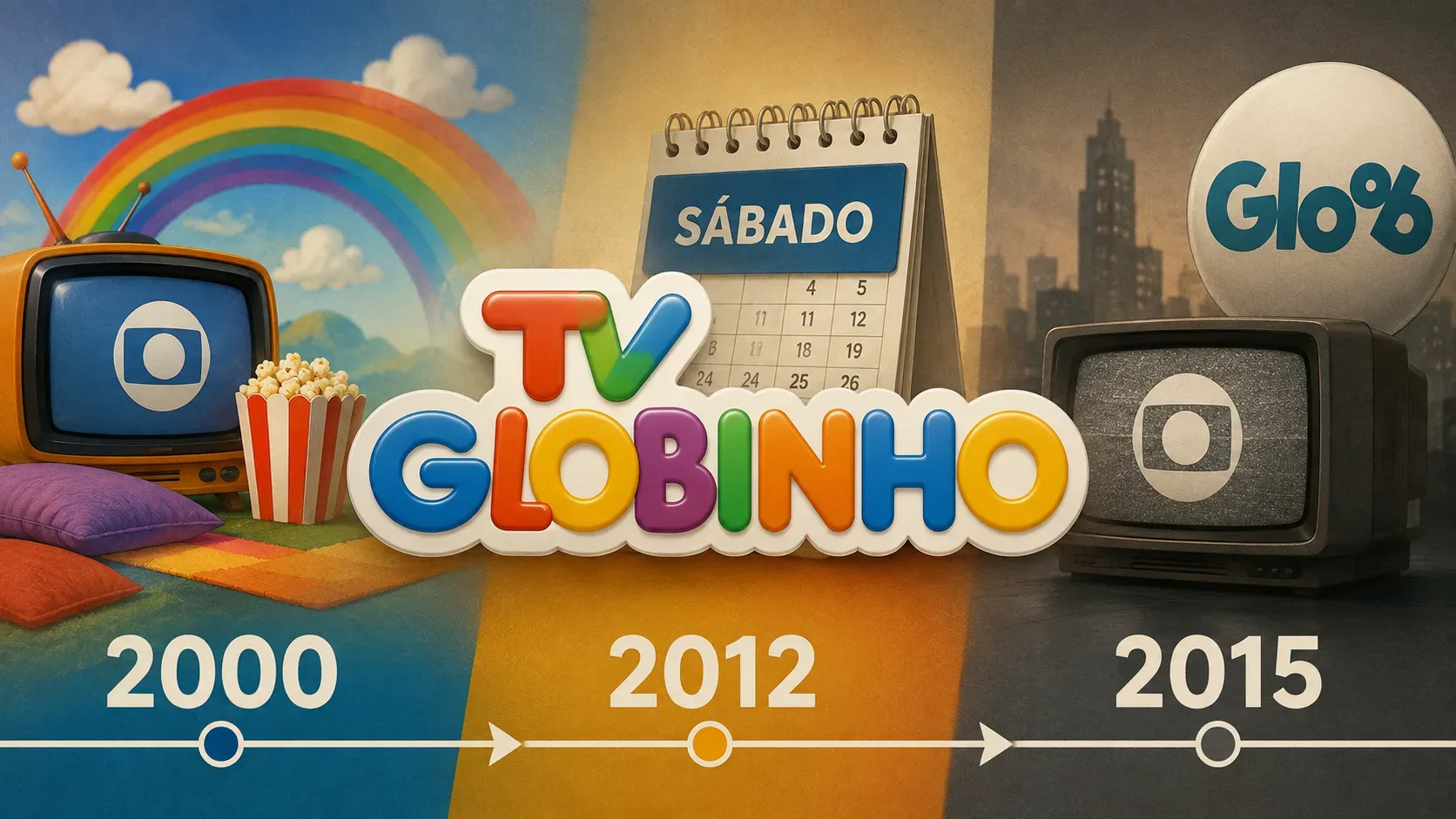
Timeline: 2000 → 2012 → 2015
- July 3, 2000: TV Globinho premieres, initially connected to Bambuluá.
- 2000s: the attraction becomes established as a standalone children’s block and, in different phases, occupies mornings from Monday through Saturday.
- June 15, 2012: Gloob launches on pay TV.
- June 25, 2012: Encontro com Fátima Bernardes premieres; TV Globinho leaves weekdays and remains only on Saturdays.
- August 1, 2015: TV Globinho airs for the last time.
- August 8, 2015: É de Casa premieres on Saturday mornings.
So why did TV Globinho end?
Because Globo progressively reformulated its morning schedule and removed the fixed space devoted to the children’s block: in 2012, weekdays were assigned to Encontro; in 2015, Saturday was assigned to É de Casa. In parallel, the group had launched Gloob on pay TV, a channel designed to strengthen its children’s offering on another platform.
This explanation is more faithful to the sources than looking for a single culprit. The timeline shows a two-stage scheduling decision and a broader distribution strategy change. It also explains why many people remember 2012 as “the end” — that was when the daily routine disappeared — while the program’s official final date is August 1, 2015.