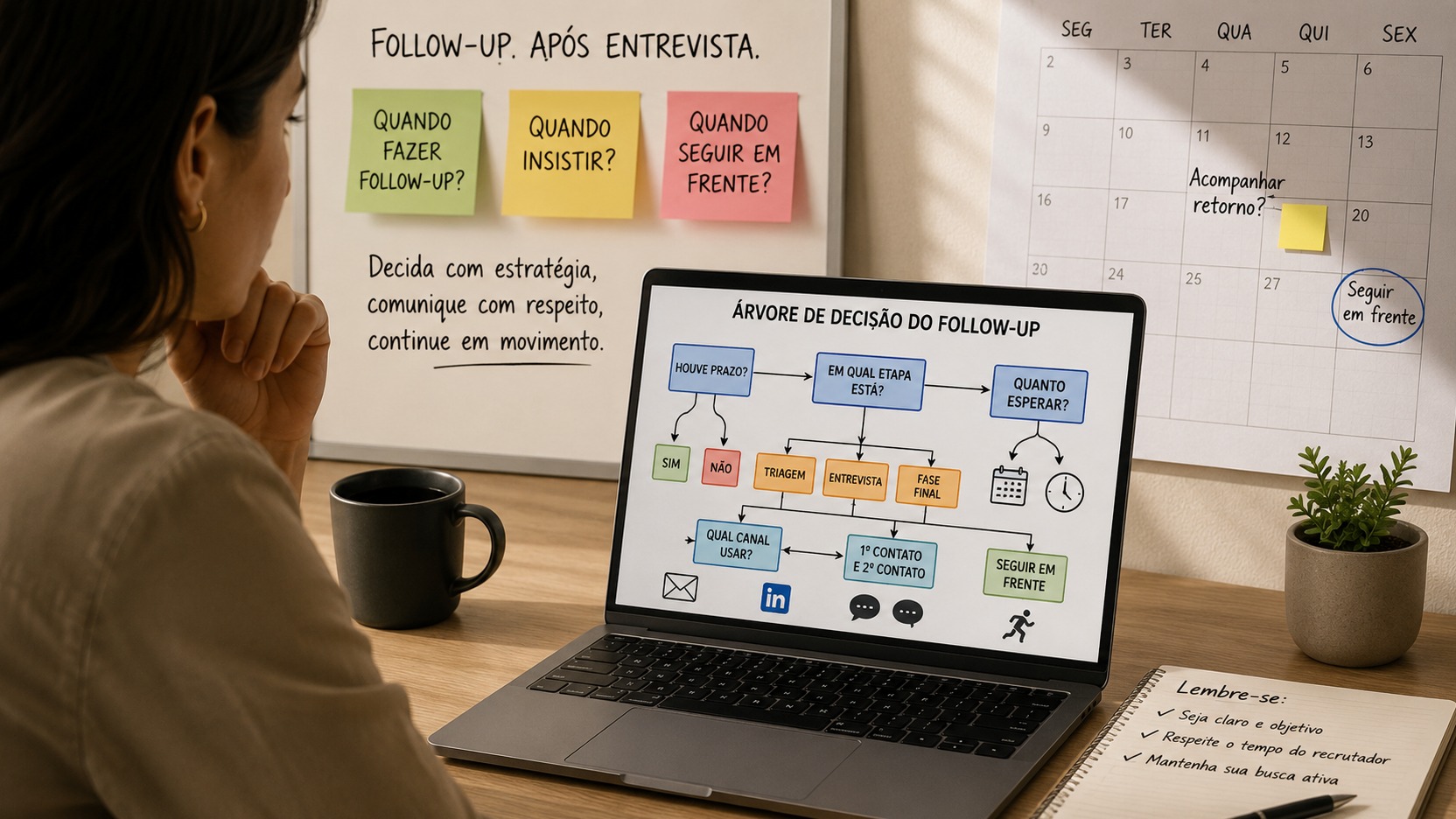
Remaining unanswered after an interview creates a practical problem: the candidate doesn't know whether to wait, demand an update or consider that the opportunity has gone cold. The best solution is not to memorize a number of days or interpret each silence as approval or rejection. It involves deciding based on three pieces of information: the deadline given by the company, the stage you are at and the communication history of that process.
The frustration with this wait is real. In a survey published in April 2026 by Portal Gestão RH, based on a study by Grupo Hub with 200 professionals from different regions of Brazil, 94.7% said they noticed a delay in returning selection processes and 66.3% reported not receiving feedback throughout the selection process. This helps explain the anxiety, but it doesn't turn a specific company's silence into a reliable signal about the outcome of your interview.
The most useful rule is to separate monitoring from passive waiting. You can respect the company's deadline and, at the same time, continue applying. A vacancy should only take the place of a concrete opportunity when there is concrete communication. Until there is a formal proposal or confirmed progress, it remains a possibility.
First: was there a return deadline?
If the recruiter gave you a date or a window, that deadline should drive your decision. If they said “by Friday”, “next week” or “in ten days”, there is no advantage in asking for an update before the end of that period, unless there is truly urgent information, such as another proposal with a deadline for response.
When the promised date passes without news, it is worth giving a small operating margin. Delays may occur because there are still interviews, internal approvals, management schedules or changes to the schedule. As a practical reference, recent guidance from Indeed suggests respecting the deadline given and adding approximately one or two business days before contact. The important point is not to treat this margin as a law, but to avoid turning a few hours of delay into a charge.
If no one has provided a deadline, use a conservative reference. Five business days to a week after the interview is usually a reasonable time frame for the first update request. Current career guidance materials also place approximately one week as a safe window when there is no set timeline.
A thank you message is not the same as a status follow-up
There are two different contacts that many people mix. The first is to thank you for the interview. It can be sent on the same day or within 24 hours, in a short form, just to thank, reaffirm interest and possibly complement important information that was missing. Guidance from CareerOneStop and materials from the US Department of Labor recommend this contact shortly after the interview.
The second contact is the request for an update on the process. This must respect the agreed deadline or, failing that, a window of a few working days. Sending a “thank you for chatting” a few hours after the interview doesn’t mean that, two days later, you already need to ask if you were approved.
This distinction helps to avoid excessive messages. Thank you is courtesy and reinforcement of interest. Status follow-up is an objective question about next steps or anticipated decision.
Which stage of the process are you in?
The phase changes the weight of silence. After an initial conversation with recruitment, there may still be many candidates, technical interviews and internal alignments. At this stage, a week without news usually says little about the result. If there was no deadline, wait five business days to a week and make a simple first contact.
After an interview with a manager or team, the same principle applies, but the update request may mention the step taken. This helps the recruiter quickly locate your process and respond with context.
In the final phase, silence tends to be more sensitive because the candidate has already invested more time and may be organizing other decisions. Still, proximity to the decision does not authorize daily contacts. If there was a deadline, wait for the deadline and a small margin. If there wasn't, a week remains a good reference point. If there is another real proposal with a deadline, the urgency becomes concrete and must be communicated immediately, without bluffing.
How to make the first follow-up
The first contact should facilitate a response, not require a justification. Remind them of the vacancy, the stage or the date of the interview, say that you are still interested and ask if there is an update or forecast of the next steps. There is no need to explain anxiety, say how many days you have been waiting in a demanding tone or try to convince the recruiter again with an entire resume summary.
A short example would be: "Hello, [name]. How are you? I participated in the interview for [position] on [date] and I'm still interested in the opportunity. Can you update me on the progress or the next steps? I'm at your disposal. Thank you."
If the promised deadline has already passed, adapt the sentence: “As the forecast mentioned was until [date], I wanted to know if there was any update to the schedule.” This formulation registers the agreement without sounding accusatory.
Which channel to use
The most coherent channel is usually the same one the company has already used with you. If invitations, confirmations, and materials arrived via email, email is the safest option because it is asynchronous, organized, and easy to find. If the recruiter initiated and conducted the communication via WhatsApp, a brief follow-up on the same channel makes sense. If the conversation started on LinkedIn and there was no migration to another medium, the platform itself can be used.
The Hub Group survey found that candidates preferred WhatsApp in 59.9% of responses and email in 37.4%. This shows the strength of direct channels in Brazil, but it doesn't mean you should switch channels on your own. The candidate's preference does not outweigh the context of the process.
Telephone is best reserved for situations in which the company has indicated this contact, in which there have been previous calls or in which there is an objective urgency. Calling repeatedly to try to jump the queue tends to produce more pressure than clarity.
When is it worth making a second contact
If you made the first follow-up at the appropriate time and did not receive a response, wait again. A week is a good reference for the second contact. Updated guidance from Indeed treats the second follow-up as acceptable when silence continues and recommends spacing out attempts rather than insisting on sequence.
The second contact should be even simpler. You don't need to repeat the entire history. You can write: "Hello, [name]. I'm back in touch about the [position] vacancy. As I haven't had an update yet, I wanted to confirm if the process is still ongoing and if there is a new return date. I'm still interested and remain at your disposal. Thank you."
This second contact has a different function than the first. It does not exist to artificially increase your chances, but to try to obtain information that allows you to organize your search. If the company responds that the process continues and offers a new date, respect the new deadline again. If you respond without a deadline, keep the vacancy as uncertain and continue with other applications.
When insisting before the deadline makes sense
There are situations in which waiting silently can undermine a real decision. The main thing is to receive another offer with a response deadline. In this case, report the fact transparently and ask if the company can share its forecast. Don't invent a proposal, don't increase your salary and don't create a false deadline to pressure the recruiter.
A possible message is: "I received another proposal with a response deadline of [date], but I am still very interested in this opportunity. If possible, can you tell me if a decision is expected by then?"
It also makes sense to get in touch when the company has requested a document, test, reference or additional information and you need to confirm receipt, or when there has been a technical problem that may have prevented delivery. In these cases, contact is not anxiety: it resolves an objective pending issue in the process.
When to stop insisting
After two reasonably spaced contacts without any response, insisting routinely rarely adds information. From there, the most efficient approach is to treat the vacancy as uncertain or inactive for planning purposes. This does not require sending a goodbye message or withdrawing your candidacy. It just means stop organizing your life as if that answer were imminent.
“Moving on” also doesn’t need to wait for the second silence. The search for other vacancies must continue from the beginning. A 2026 guide from the United States Department of Labor, when exemplifying a weekly job search plan, combines interview, thank you, new applications and preparation for other opportunities in the same sequence. The logic is simple: monitoring a selection and maintaining the application funnel are parallel activities.
If the company reappears two or three weeks later, you can evaluate the opportunity normally. Stopping waiting does not mean closing the door; means giving control of the schedule back to you.
Don’t try to read “signs of approval” in the silence
A long interview, a friendly recruiter, questions about availability, a conversation about salary or compliments on your CV may be positive, but they are not equivalent to a decision. Likewise, delay does not automatically mean failure. Processes can be delayed because the company still interviews people, depends on internal approvals, reorganizes the budget or simply communicates poorly.
The reliable signal is explicit communication: invitation to the next step, request for documentation related to hiring, proposal, rejection or formal update of the schedule. Everything else should be treated as context, not result.
This protects the candidate from two common mistakes. The first is to suspend other applications because “it seemed like it had already worked”. The second is to interpret a few days of silence as definitive rejection and react with an emotional or confrontational message.
The quality of communication also informs about the company
The candidate does not control the process, but can observe how the organization manages expectations. An isolated delay is normal. A schedule that changes and is communicated is also manageable. The problem becomes more evident when deadlines are repeatedly broken without warning, simple questions go unanswered, and the candidate has to chase down basic information at every step.
The Hub Group study helps to measure this discomfort: in addition to the perception of delay and lack of feedback, 80.2% of participants who received feedback considered the responses to be generic or not very useful. For those who are choosing where to work, the experience of the selection process is just one piece of data, not a sentence about the entire company, but it is legitimate data to consider.
A decision tree so you don't get stuck waiting
If there is a deadline, wait until the end of it and give yourself a small margin. If there was no deadline, count approximately five business days to a week. After that, do a first short follow-up through the channel already used in the process.
If there is a response with a new deadline, follow the new deadline. If there is a vague answer with no prediction, keep the opportunity open, but don't narrow your search. If there is no response to the first contact, wait approximately another week and send a second objective contact.
If the second contact also goes unanswered, stop routinely insisting and treat the vacancy as uncertain. Continue your applications, interviews and negotiations. If the company returns later, decide based on the situation at that time.
If a real proposal from another company comes up with a deadline, the tree changes: communicate the urgency immediately, inform the true date and ask if there is a possibility of a decision. The company can accelerate, it can say it can't, or it can remain silent. In either case, you'll have more useful information to help you decide than trying to guess what the recruiter is thinking.
The best follow-up is the one that produces clarity without paralyzing your search
Following up is not “charging” the recruiter in the sense of demanding a decision. It is asking for an update when the agreed deadline has passed or when there has been a reasonable wait. A well-placed first contact is normal. A second, after another break, can also be useful. Repeated contacts without new facts tend to have diminishing returns.
The central point is not to transform a company's response into a condition for continuing your search. Respect deadlines, use the appropriate channel, record what was agreed and keep other applications moving. Thus, silence stops being an enigma that controls your agenda and becomes just another piece of imperfect information within a process that has not yet ended.