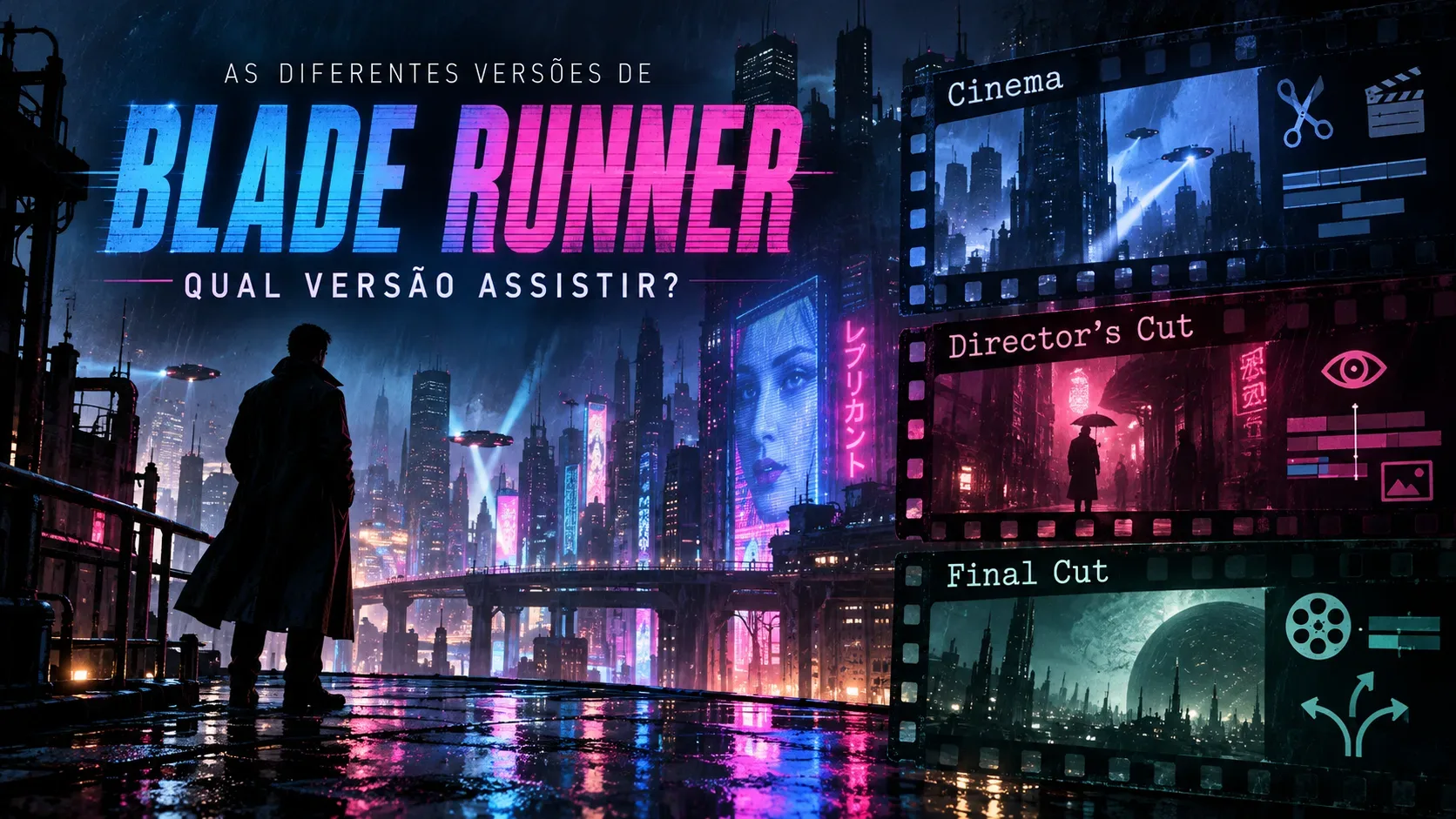
Short answer: for a first viewing, the 2007 Final Cut is the simplest starting point if you want the version over which Ridley Scott had direct editorial control, with restored picture and sound and without the explanatory narration used in the 1982 release. The 1992 Director’s Cut tells essentially the same story and already makes the decisive narrative changes, but it is an earlier, technically less refined stage. The 1982 theatrical version is especially valuable if you want to understand how audiences originally encountered Blade Runner, with voice-over narration and a more explicit ending.
Quick choice, spoiler-free
| Version | Deckard voice-over | Unicorn dream | Ending | Other key changes | When to choose it |
|---|---|---|---|---|---|
| Theatrical, 1982 | Yes | No | Longer and more explanatory | Original release structure; the international cut adds several more graphic moments compared with the U.S. cut | To experience the historical release and compare its more guided noir tone |
| Director’s Cut, 1992 | No | Yes | More abrupt and ambiguous | Removes the narration and extended ending, adds the unicorn | To see the interpretive shift that helped redefine the film in the 1990s |
| Final Cut, 2007 | No | Yes, in a refined version | More abrupt and ambiguous | Restoration, revised picture and sound, effects fixes, small editing changes and more graphic material | For Scott’s most fully realized version and the most consistent technical presentation |
There is an important complication in the label “theatrical version.” In 1982 there was a U.S. theatrical cut and an international theatrical cut. They share the narrative choices that most clearly separate the original release from later cuts, especially the narration and extended ending. The international cut, however, includes several more explicit violent shots. IMDb’s alternate versions page details those differences, while the BFI provides context on how the original release was reshaped after test screenings.
What the narration changes in the theatrical cut
Deckard’s voice-over was incorporated into the 1982 commercial release to make the story easier to follow. In practice, it pushes the film closer to classic detective noir: the protagonist comments on people, clues and situations, guiding the audience through a world that requires more visual inference when the voice is removed.
This is not simply a difference in dialogue count. Without the narration, scenes that once received a verbal interpretation depend more heavily on acting, editing, production design and music. The result is less explanatory and more open to interpretation. Ridley Scott told Wired that the 1992 cut removed the voice-over and the ending he disliked, choices retained in the Final Cut.
Director’s Cut: the major change is meaning, not plot
The 1992 Director’s Cut removes the narration, eliminates the extended ending from the theatrical release and includes the brief vision of a unicorn while Deckard is at the piano. Those three points significantly alter how the character can be interpreted without rewriting the film’s main storyline.
The label “Director’s Cut” can suggest that Scott freely rebuilt the film at that time, but the director later explained that the version was still not his final word. In 2007 he told Wired that the 1992 cut had solved central issues but remained limited by technical quality and by what could be done at the time. The Director’s Cut is therefore best understood as a decisive bridge between the 1982 release and the 2007 revision.
Final Cut: what 2007 actually adds
The Final Cut keeps the Director’s Cut’s fundamental narrative choices: Deckard’s narration is absent, the unicorn remains, and the film does not restore the theatrical cut’s extended ending. The difference is mainly in execution. Scott was able to revise picture, sound, effects and small editing details with resources that were not available when the 1992 cut was prepared.
- restored image from original elements and a remastered presentation;
- remixed and revised sound;
- removal or correction of wires, matte lines and other visual-effects problems;
- small continuity, dubbing and shot-length adjustments;
- reintroduction of some more graphic moments associated with international material;
- more complete or refined versions of certain passages, including the unicorn moment.
Warner’s 2007 release materials presented the Final Cut as a restoration and remaster with added or extended scenes, revised effects and new audio treatment. A historical copy of that announcement is available through The Digital Bits. Scott also explained to Wired that the revision let him correct technical details he could not properly address earlier.
With spoilers: why the unicorn changes the reading of Deckard
From this point on, there are spoilers about the ending and Deckard’s identity.
In the theatrical cut, the origami figure Gaff leaves near the end can be read mainly as a sign that he has been in the apartment and chose to spare Rachael. When the Director’s Cut and Final Cut add the unicorn vision, another connection appears: Gaff seems to know a private image from Deckard’s mind. That strengthens the possibility that Deckard’s memories were implanted and that he is therefore a replicant.
This interpretation has a clear authorial source, but it should not be presented as a universal agreement among everyone involved. Scott told Wired that he had always conceived Deckard as a replicant. Harrison Ford, by contrast, historically argued for Deckard as human. For the purpose of comparing the cuts, the key point is that the unicorn makes the replicant reading much more active within the film itself.
With spoilers: the two endings create different effects
The 1982 release continues after Deckard and Rachael leave the apartment. The sequence expands their escape into an open landscape, and the narration supplies additional information that reduces immediate uncertainty about Rachael’s fate. This is why it is often called the “happy ending,” even though the rest of the film remains deeply concerned with mortality and pursuit.
In the Director’s Cut and Final Cut, the film ends when the elevator doors close. Removing the continuation changes the emotional effect: the audience is not given the same sense of a completed escape or the same verbal explanation. Instead, the edit preserves questions about Deckard, Rachael and what Gaff knows.
So which version should you watch?
If it is your first time: the Final Cut is usually the most direct choice. It is the version Scott described as finally complete, and the BFI recommends it as an entry point into his work.
If you have already seen the Final Cut: the theatrical cut is the most revealing comparison, because its narration and ending make it easy to see how editing can change meaning without replacing the basic story. The Director’s Cut then works as a historical bridge between the two approaches.
If you want to study the versions: compare them in this order: 1982 theatrical cut, 1992 Director’s Cut and 2007 Final Cut. Focus on four axes: narration, the unicorn, the exact point where the film ends and the technical finish. This makes clear that Blade Runner is not simply a case of scenes being added or removed. Each cut reorganizes how much the film explains and how much it leaves the viewer to decide.
What not to confuse when looking for an edition
- U.S. Theatrical Cut and International Cut: two 1982 variants. Their best-known differences involve extra violence in the international version, not a change on the scale of the Director’s Cut.
- Workprint: a working version associated with test screenings. It is historically important, but it is not another name for the Director’s Cut.
- Director’s Cut: the 1992 revision, without narration, without the extended ending and with the unicorn.
- Final Cut: the 2007 revision, prepared with greater Scott control plus extensive restoration and technical corrections.
If a disc or streaming service does not clearly identify the cut, check the full title and description before watching. “Blade Runner” by itself may point to different versions depending on the catalog, country and edition.