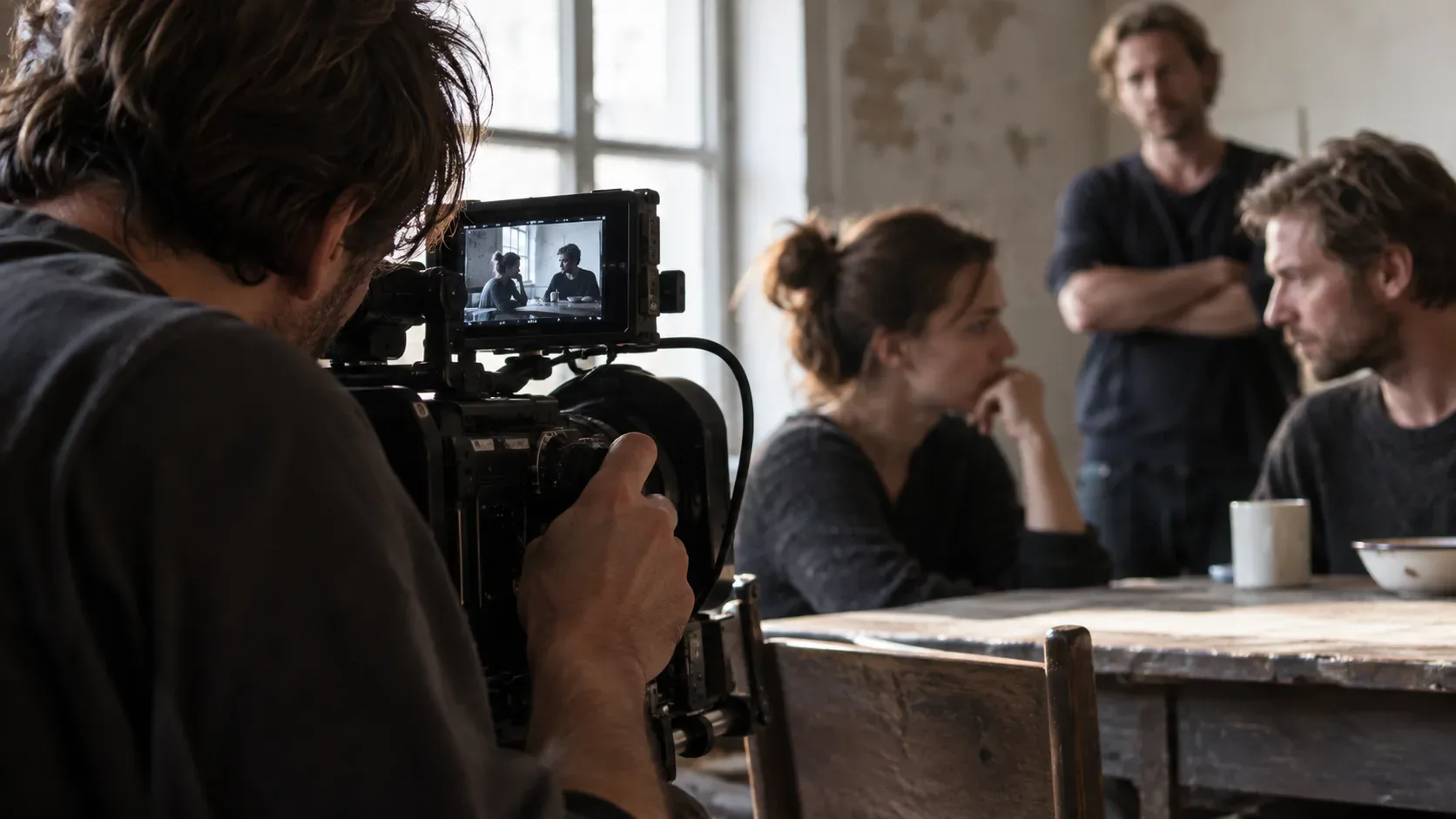
Dogme 95 began as a provocation against a kind of cinema that Lars von Trier and Thomas Vinterberg saw as overly dependent on polish, effects, and technical control. The manifesto, dated March 13, 1995 and presented publicly that month in Paris, proposed a Vow of Chastity with ten rules. The goal was not simply to make production cheaper. It was to remove tools that normally let a director organize, beautify, or correct the filmed world, forcing the camera, sound, actors, and staging to respond more directly to what happened in front of them.
That is why the importance of Dogme 95 is not best measured by asking whether every film obeyed every commandment perfectly. The films associated with the movement exposed contradictions and departures of their own. Its more durable achievement was to turn production restrictions into film language: unstable camerawork, available light, diegetic sound, real locations, less visual control, and greater dependence on performance. Thomas Vinterberg's Festen and Lars von Trier's The Idiots, both released in 1998, carried that program onto the international circuit and showed that austerity could create an instantly recognizable aesthetic.
What was the Dogme 95 Vow of Chastity?
The original text, signed by von Trier and Vinterberg on behalf of DOGME 95, argued that cinema should fight the "illusion" created by technical cosmetics and submit to rules that restored priority to the moment, the characters, and the locations. After the ten rules, the director also swore to give up personal taste and the idea of creating a "work" as an individual expression. That passage helps explain why the manifesto was more than a technical manual: it also attacked the idea of authorship as total control.
The manifesto can be read in a reproduction preserved by the Danish Film Institute. The table below summarizes each rule and, more importantly, the kind of effect it could have on the image, sound, or organization of a shoot.
The 10 rules and what each one changed in practice
| Rule | Production and stylistic consequence | How it appears in the films |
|---|---|---|
| 1. Shoot on location without bringing in sets or props. | The script and mise-en-scène have to adapt to existing spaces. This reduces control over architecture, decoration, and the placement of objects, allowing the real environment to participate in the drama. | In Festen, the house and celebration spaces operate as concrete social spaces, with corridors, rooms, and tables shaping entrances, exits, and confrontations. |
| 2. Never produce sound separately from the images; music can exist only if it is playing in the scene. | The soundtrack can no longer tell viewers what to feel from outside the scene. Voices, room noise, diegetic music, and sonic accidents gain weight, while editing loses one of its most direct emotional tools. | Room tone, conversation, singing, and incidental noise in Festen contribute to a sense of presence. When music appears, it belongs to the characters' environment. |
| 3. Use a hand-held camera. | Framing no longer depends on perfectly designed camera moves. The camera can react to actors, move closer abruptly, correct the frame during action, and accept instability. | This is one of the most visible traits of Festen and The Idiots: faces enter and leave the frame, distance changes quickly, and the image seems to chase events rather than dominate them. |
| 4. Shoot in color and without special lighting. | Cinematography has to live with available light even when it creates deep shadows, low exposure, blown highlights, or abrupt changes between spaces. The rule limits the ability to idealize faces and locations. | The grainy appearance and natural light of Festen reinforce its raw quality. The BFI specifically highlights natural lighting and the video aesthetic as part of the film's force. |
| 5. Forbid optical work and filters. | The material should not receive a visual layer that artificially transforms color, texture, or perception. The image tends to look less polished and less protected by a controlled authorial finish. | In the early Dogme films, the rough video texture and exposure imperfections remain visible instead of being transformed into a visually uniform surface. |
| 6. Avoid "superficial action," including murders and weapons. | Conflict has to emerge less from spectacle and more from behavior, dialogue, power relations, and embarrassment. Tension shifts from physical events to human situations. | Festen turns a family gathering into a battleground through speeches, reactions, silences, and ruptures of etiquette rather than genre action. |
| 7. Forbid temporal and geographical alienation; the film takes place here and now. | Production stops relying on historical reconstruction or simulated places. This pushes the narrative toward the present and favors stories built around recognizable environments and behavior. | The conflicts in the first Dogme films unfold in contemporary spaces, with clothes, objects, and social relations belonging to the immediate world of the shoot. |
| 8. Do not accept genre movies. | The manifesto tried to prevent ready-made conventions from horror, action, crime, or melodrama from becoming the template. In practice, no film is neutral toward genre, but the rule pressured filmmakers to avoid adopting a formula as a package. | Festen can echo melodrama, black comedy, and family drama, yet its construction does not depend on presenting itself as a conventional genre product. |
| 9. Use the Academy 35 mm format. | This became Dogme 95's most famous historical contradiction. The manifesto prescribed the 35 mm format, but Festen and The Idiots were made with digital video cameras. The breach showed how quickly practice became more important than a literal reading of the rules. | The BFI notes that the two films helped place consumer digital cameras at the center of an aesthetic transformation, precisely as Dogme emerged with a rule tied to 35 mm. |
| 10. Do not credit the director. | The rule tries to reduce the authorial signature and shift attention from the filmmaker's prestige to the filmed situation. It directly echoes the closing oath, in which the director claims to give up personal taste. | In practice, the films' authorship was known and formed part of the movement's public circulation. The rule works better as a gesture against the cult of the auteur than as a real erasure of filmmakers' identities. |
Why did these rules change the image even when they were broken?
The most important effect of Dogme 95 came from the combination of restrictions. Hand-held camerawork alone does not make a Dogme film. Natural light alone does not either. But when a filmmaker cannot build a set, redesign the lighting, add an external score, stabilize every movement, and correct the image with filters, production loses several layers of protection. That changes the relationship between planning and chance.
Instead of building an ideal frame and asking actors to fit inside it, the camera tends to adapt to the actor's body and the logic of the space. Instead of using music to intensify a revelation, a scene has to create tension through voice, silence, noise, and duration. Instead of hiding imperfections, technical texture becomes part of the experience. The result is not automatically more "truthful," but it can feel more immediate because it preserves signs that conventional filmmaking often controls or removes.
This distinction matters. The manifesto spoke of "forcing the truth" out of characters and settings, but that was an aesthetic position taken by its authors, not an objective guarantee of authenticity. A film is still written, performed, edited, and selected. Dogme 95 did not abolish cinematic construction; it shifted where that construction could happen.
Festen: when restriction becomes dramatic tension
Festen is the clearest example because its form suits its dramatic situation. A family gathers for a celebration and the social order of the event begins to collapse. The film has to follow crowded tables, corridors, speeches, interruptions, rapid movement, and simultaneous reactions. The portable camera does not feel like a decorative visual effect. It becomes a way to move through a space where emotional stability is also disappearing.
The Criterion Collection highlights the film's dynamic hand-held camerawork, grainy natural lighting, diegetic sound, and intense performances. The BFI also links its Handycam look to the sense of messy truth that runs through the film. These traits did not arise simply because the production had limited resources. They resulted from turning limitation into method.
There is also a crucial irony: the small digital camera used by Vinterberg and cinematographer Anthony Dod Mantle enabled exactly the mobility the movement wanted. The Criterion notes that camera tests led the crew to a very compact Sony PC7. A manifesto that set out to react against dependence on technology therefore helped demonstrate how lighter technology could expand the physical freedom of filmmaking.
The Idiots: Dogme as provocation and discomfort
In The Idiots, Lars von Trier pushed the principle of instability into an even more confrontational territory. The film follows a group of adults who perform behaviors associated with intellectual disability as a way of challenging social norms, a premise that became controversial because of its representation of disability and other choices in the film. Formally, the close camera, irregular recording, and sense of improvisation make the viewer less comfortable inside the situations.
For understanding Dogme 95, the key is that the rules did not produce a "clean" or restrained aesthetic. They could create visual aggression, exposure, embarrassment, and a sense of intrusion. The lack of polish does not function as an absence of style. On the contrary, roughness becomes a recognizable style even while the manifesto declares war on style as an individual signature.
Was Dogme 95 really followed to the letter?
No. The movement's history is also a history of exceptions, confessions, and interpretations. The 35 mm rule was contradicted by two of its founding films, which relied on digital video. Other filmmakers admitted specific departures. The BFI reports, for example, that Søren Kragh-Jacobsen submitted a "confession" about elements of Mifune's Last Song that did not fully comply with the rules.
This flexibility helps explain why Dogme 95 had a greater impact as a creative device than as a seal of purity. The restrictions worked as problems to be solved. When they collided with the practical needs of making a film, that collision also revealed which parts of the process a filmmaker considered indispensable.
The movement issued certificates and, according to the BFI, 31 films were officially recognized. Dogme 95 was formally disbanded in 2005, by which time the expansion of digital technology had made the cheap, lightweight, technically flexible production model that the group helped make visible much more common.
The legacy: less a look than a way of imposing limits
The legacy of Dogme 95 is not to copy shaky camerawork or remove the soundtrack. Applied in isolation, those choices become mere appearance. The movement's more useful contribution is to show that a production rule can alter a film's language because it changes the decisions available to the crew.
- Restricting locations changes mise-en-scène and forces drama to negotiate with real spaces.
- Restricting lighting changes exposure, texture, shooting rhythm, and the relationship with chance.
- Restricting non-diegetic music transfers emotional weight to performance, silence, noise, and editing.
- Restricting stabilization changes the distance between camera and body and makes framing more reactive.
- Restricting genre and spectacle pushes conflict toward relationships, behavior, and social situations.
That logic remained relevant long after the movement formally ended. The rise of lightweight digital cameras, the spread of low-budget independent filmmaking, and the acceptance of less polished textures made many Dogme-associated solutions seem less radical over time. The BFI notes that the movement helped reenergize low-budget filmmaking in Denmark and beyond.
So what did Dogme 95 change in film language?
Dogme 95 did not invent hand-held camerawork, natural light, location shooting, or cinematic realism. Those tools already existed in documentary traditions, neorealism, cinéma vérité, new waves, and many forms of independent cinema. Its novelty was to combine them in a short, public, deliberately provocative manifesto, turning familiar limitations into a recognizable production program.
In practice, the ten rules shifted the film's center of gravity. Less energy could be spent building a perfect surface; more had to be solved through presence, space, performance, direct sound, and adaptation. Festen showed how that could intensify a drama. The Idiots showed how the same logic could generate friction and discomfort. And the films that followed proved that Dogme 95 was not a single formula but a persistent question: what happens to film language when a filmmaker deliberately gives up part of their control?