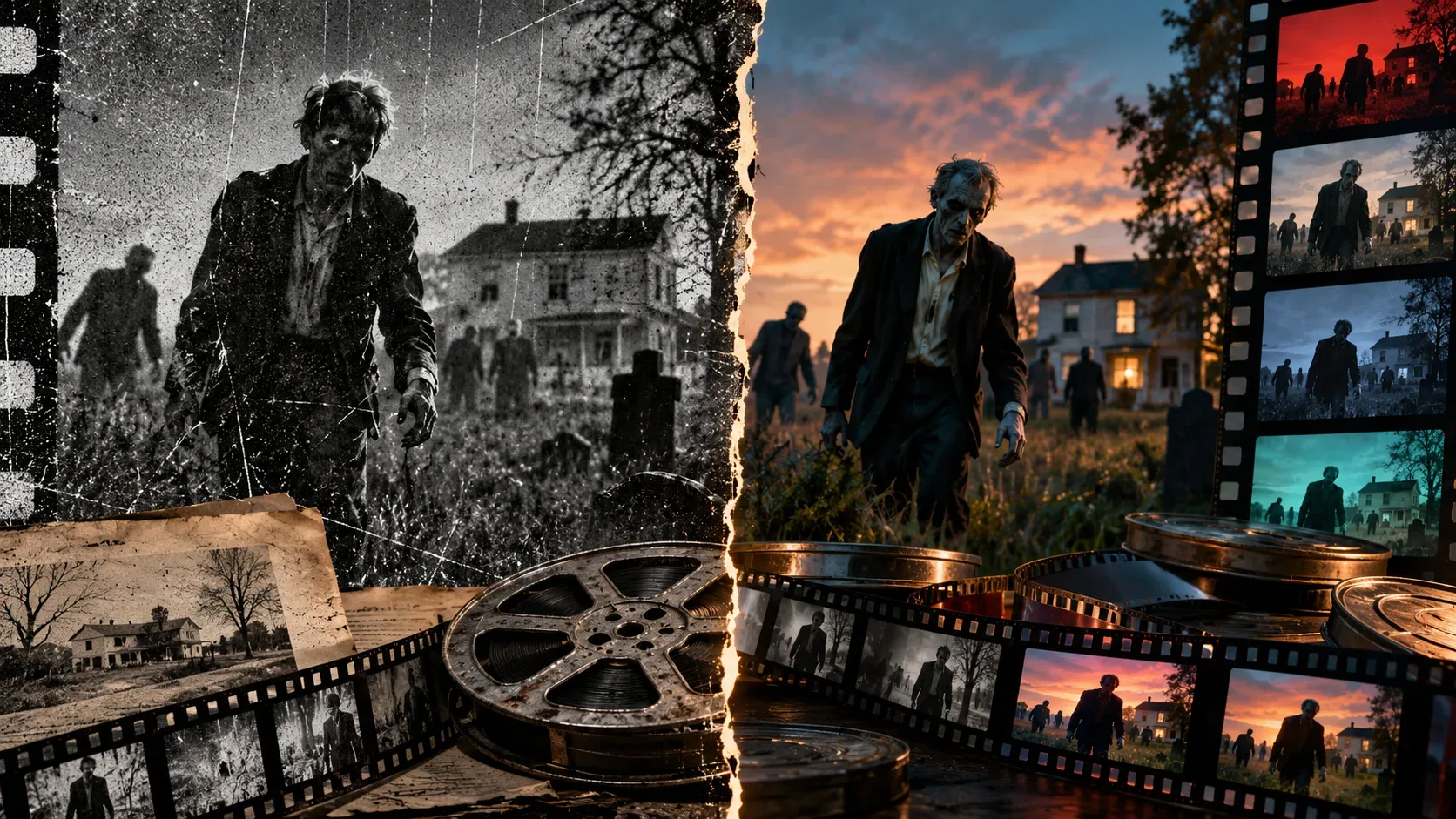
Short answer: in the United States, the original black-and-white film Night of the Living Dead (1968) is in the public domain. That does not mean every later version is also public domain. Colorizations, new scores, subtitles, commentaries, re-edits, restorations with creative contributions, and remakes may contain their own copyright-protected material. The practical rule is to separate what was already in the 1968 film from what was added later.
Why is the 1968 film in the public domain in the U.S.?
The Library of Congress catalogs the film as a 1968 U.S. production and states that the registration for the original black-and-white version, PA46-101, was cancelled because the work had been published before 1978 without a copyright notice. In another institutional source, the Library of Congress copyright blog explains that the project had been titled Night of the Flesh Eaters and that, when the title was changed to Night of the Living Dead, the new opening title card omitted the notice required by U.S. law at the time.
That detail was decisive under the earlier U.S. copyright regime. The Library of Congress summarizes that the film went directly into the public domain because of the missing notice. For present-day use, the key point is straightforward: the expressive material embodied in the original 1968 release does not regain exclusivity merely because later copies are restored, digitized, or reissued.
What the public domain lets you use
Under U.S. copyright law, public-domain material may be reproduced, distributed, publicly performed, and adapted without permission from a copyright owner. That includes the 1968 motion picture as published, including the images, editing, performances, and other expression embodied in the film, subject to situations in which a separate element has its own legal status.
That qualification matters. The film's public-domain status does not automatically place every related item in the public domain. A separately issued screenplay, a promotional photograph, a new music recording, a home-video edition, a commentary track, or a later restoration must be evaluated according to its own source and content.
The original, a colorization, a restoration, and a remake are not the same thing
| Material | U.S. status | Practical effect |
|---|---|---|
| Original 1968 black-and-white film | Public domain | Material from the original release may be reproduced and adapted under U.S. copyright law. |
| Later colorization | May be copyrighted as to the added color work | The underlying film remains public domain, while creative selection and application of colors may be protected. |
| Technical restoration or remaster | Depends on what was added | Cleaning, digitization, or purely technical correction should not automatically be treated as a new protected work, but sufficiently creative choices may create protectable new material. |
| New score, dubbing, subtitles, or commentary | Usually separate contributions | Those later elements must be distinguished from the 1968 film. |
| Remake, re-edit, or version with new scenes | New material may be protected | The new work does not remove the original from the public domain, but its additions may carry their own copyright. |
The colorized versions make the distinction concrete
The Library of Congress catalog is especially useful because it documents more than the original film's problem. It lists two later colorized versions with separate registrations: PA542-023, associated with RHI Entertainment and color work by Hal Roach Studios, and PA687-953, associated with CST Entertainment Imaging. The catalog notes describe the new matter as color work or colorization of the preexisting motion picture.
That matches the general rule for derivative works. Title 17, section 103(b) states that copyright in a derivative work extends only to the material contributed by the author of the new version and does not create an exclusive right in the preexisting material. The U.S. Copyright Office likewise instructs applicants to exclude public-domain material from the scope of a derivative-work claim.
For colorized films, the Compendium of U.S. Copyright Office Practices explains that colorization may be registrable when the selection and fixation of colors represents more than a trivial amount of creative authorship. When that threshold is met, protection covers the new colorization, not the black-and-white film used as the source.
A 4K restoration does not automatically turn the original into a protected work
Restoration requires extra care because the word can describe very different processes. One edition may simply remove dust, stabilize frames, and recover contrast. Another may reconstruct scenes, introduce a new edit, apply creative color grading, add new credits, replace audio, or incorporate other editorial choices.
The Copyright Office requires original authorship for a new contribution to qualify for registration. In its guidance on visual reproductions and restorations, the Compendium says that a faithful copy or a restoration that merely returns a work to its original condition, without sufficient creativity, does not qualify for protection merely because substantial technical skill was involved. That guidance helps frame film remastering questions, but the status of a particular edition still depends on the facts.
For that reason, saying “the restoration is copyrighted” can be too broad. The more precise question is: which part of the edition contains new authorship? A restoration can contain protectable and unprotectable elements at the same time. The 1968 material does not leave the public domain simply because it appears inside a newer digital file.
How to examine a copy before reusing it
- Identify the source. Determine whether the file is a copy of the original release or a later edition.
- Look for additions. Check for color, score, dubbing, subtitles, credits, logos, commentary, introductions, and extra scenes.
- Separate the underlying film from the new contribution. Copyright in a derivative work does not restore exclusivity over material that was already in the public domain.
- Check the edition's records and credits. The two colorizations cataloged by the Library of Congress show that versions of the same film can carry different claims.
- Do not assume that an online file is legally identical to the original. A copy may have been restored, re-edited, or supplemented with new material.
- For commercial or international use, obtain jurisdiction-specific legal review. This article's conclusion is limited to the United States. Other countries may reach a different result.
What about remakes and new creations?
The public-domain status of the 1968 film allows new creators to build from the material that is free to use in the United States. But the resulting remake may have copyright in what it adds, such as a new screenplay, additional dialogue, performances, cinematography, editing, production design, music, effects, and other original choices.
The rule works in both directions. A remake's copyright cannot pull the 1968 original out of the public domain. At the same time, the original film's public-domain status does not authorize copying expression introduced only by a later remake.
The territorial limit matters
This conclusion concerns U.S. copyright law. A work's status can vary by country because copyright terms, historical formalities, and treaty rules are not identical. A copy that can be reused in the United States without a license may require a different analysis for distribution in Brazil, the European Union, or another market.
It is also prudent to remember that public domain under copyright law does not automatically resolve other legal issues, such as trademarks, access contracts, publicity rights, or local rules. For a commercial project, an international platform, or a new work that uses substantial material, qualified legal review reduces the risk of confusing the original film with a later edition.
In summary
Night of the Living Dead (1968) is a classic U.S. public-domain case, and the Library of Congress documentation is unusually clear about why. The same documentation also shows why that status should not be generalized to every version: later colorizations received their own registrations for the newly added work.
The most useful distinction is this: the original remains free, but later contributions may not be. When evaluating a restoration, colorization, remaster, or remake, focus on the new material and on whether enough original authorship was added. This article is informational and is not a substitute for legal advice about a specific use.
Primary sources: Library of Congress, Night of the Living Dead catalog record; Library of Congress Copyright Blog, “Copyright Horror Stories”; U.S. Copyright Office, Title 17, sections 101 and 103; U.S. Copyright Office, Limitation of Claim; Compendium of U.S. Copyright Office Practices.