In reading questions, the difference between a sound inference and an extrapolation often comes down to one simple question: which clue in the text authorizes this exact conclusion? Inferring does not mean repeating an explicit sentence; it means building a meaning that the text does not state outright but that its clues make defensible. Extrapolating means taking an extra step: adding a cause, intention, intensity, scope, certainty, or context that the source material does not support.
This distinction fits the logic of the 2026 Enem Reference Matrices published by Inep on July 17, 2026. The document describes cognitive axes shared across subject areas and includes operations such as selecting, organizing, relating, and interpreting information. That does not mean “inference” and “extrapolation” are official labels used to classify every option. Here, extrapolation is a teaching label for the mistake of going beyond what the text and the question stem authorize.
Inference is not guessing: it needs a bridge
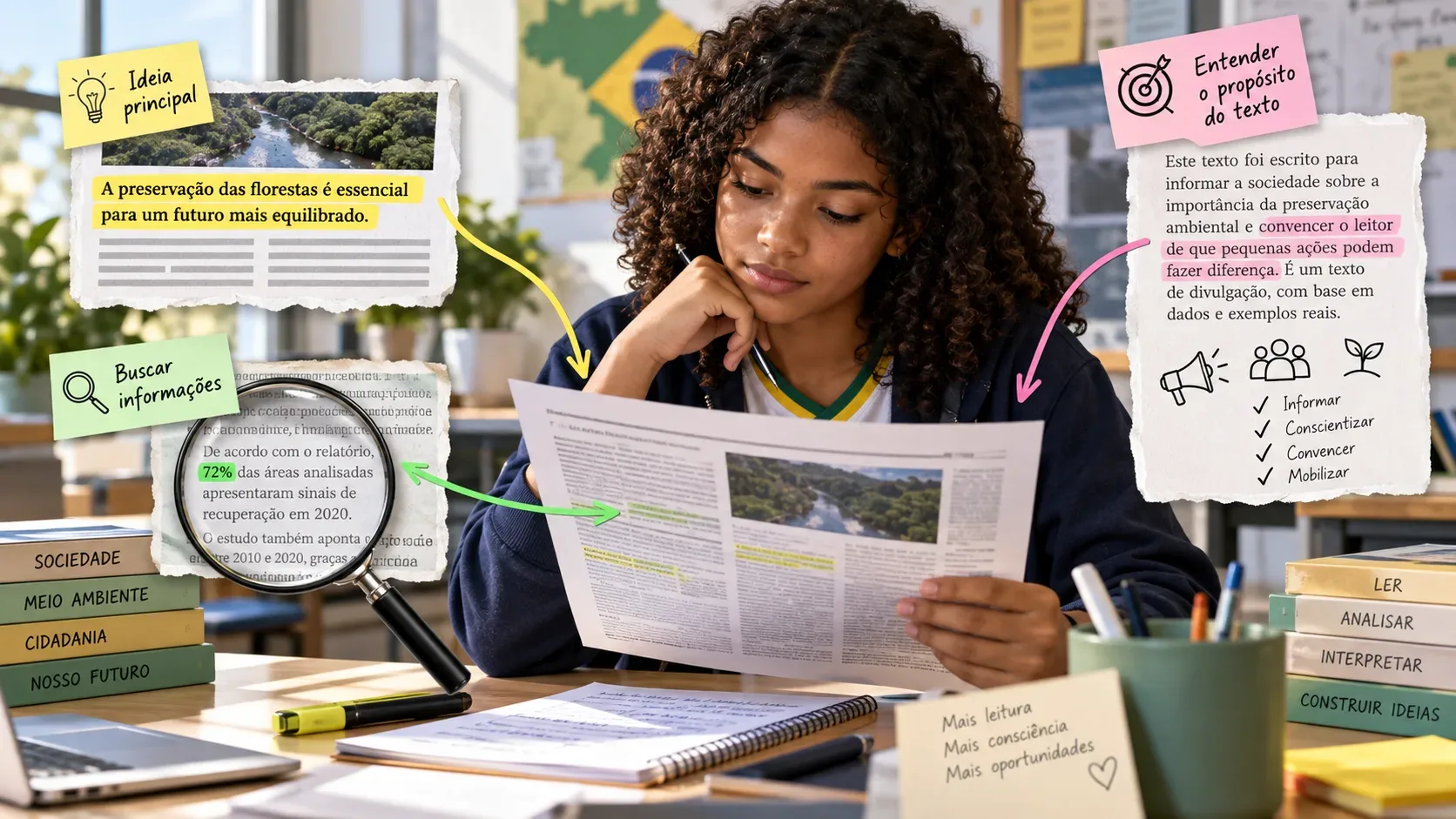
The Ceale Glossary from the Federal University of Minas Gerais School of Education explains inference as a construction of meaning made by the reader by connecting explicit information with prior knowledge. This matters because it rejects two misconceptions at once: the correct answer will not always be copied from the text, but it also cannot come only from the student's background knowledge.
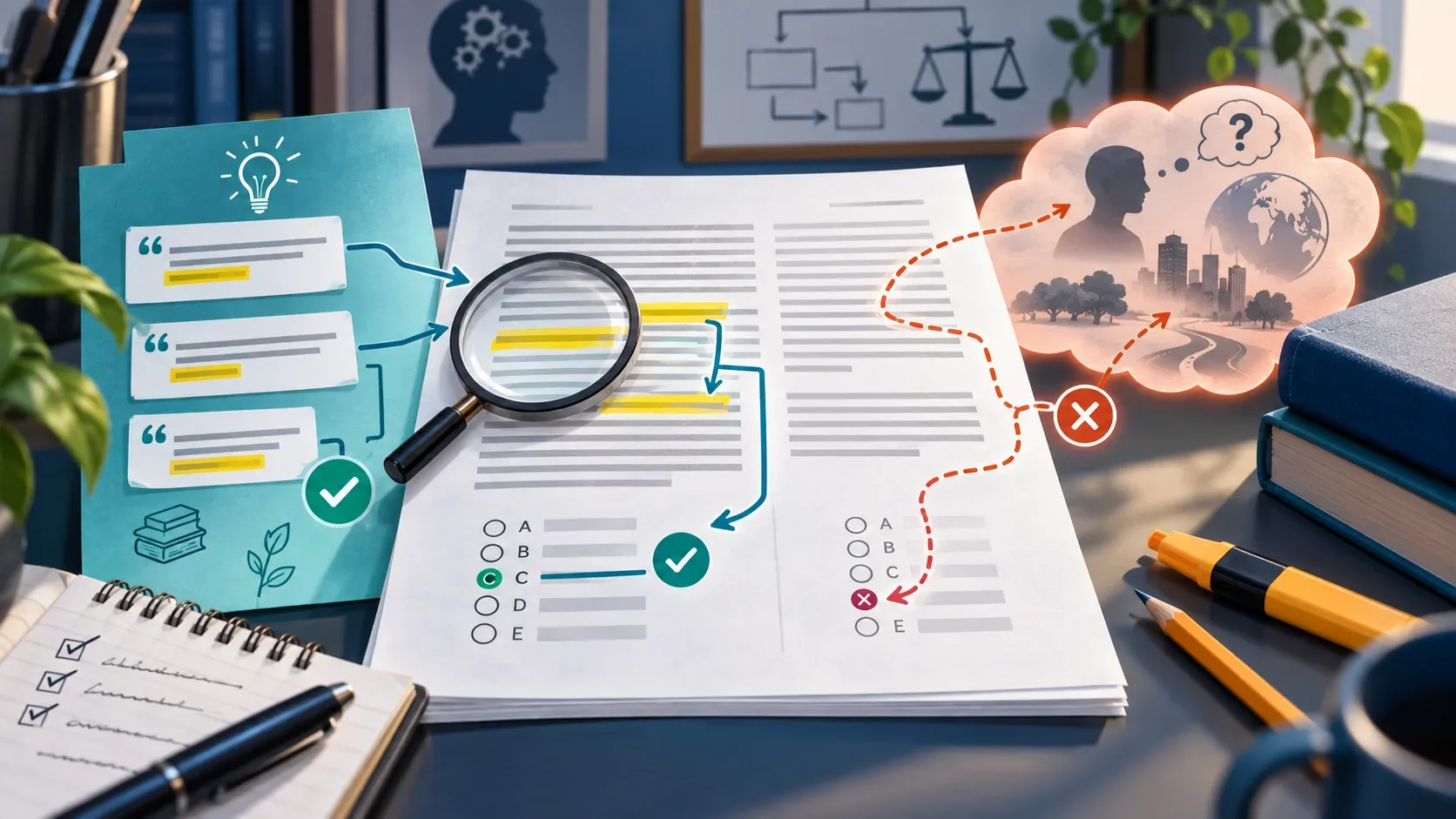
A valid inference has a verifiable bridge: you can point to one or more clues and show how they lead to the conclusion. Extrapolation, by contrast, usually requires a hidden premise imported from outside the text and not requested by the prompt.
The 3-question checklist
- Which passage, image, data point, or relationship supports the option? If you cannot point to the basis, be suspicious.
- Did the option make the claim stronger than the text does? Shifts such as “may” to “proves,” “some” to “all,” “is associated with” to “causes,” or “criticizes a behavior” to “rejects an entire group” often create extrapolations.
- Am I using outside knowledge to complete the text or to replace the text? Background knowledge can help interpret a clue. It should not become the main evidence for a conclusion that the text itself does not provide.
If an option passes all three questions without requiring a hidden leap, there is a good chance it is a supported inference.
What usually changes between inference and extrapolation
| Signal in the option | Supported reading | Typical extrapolation |
|---|---|---|
| Quantity | “some participants,” “most respondents” | “everyone,” “the entire population,” when the evidence does not justify generalization |
| Certainty | “suggests,” “indicates,” “may contribute” | “proves,” “guarantees,” “always,” without enough evidence |
| Causality | “is associated with,” “may help explain” | “is the only cause,” “caused,” when the text shows only sequence or correlation |
| Intention | purpose inferred from language, genre, and argumentative clues | attributing a desire, emotion, or plan that the clues do not show |
| Scope | conclusion limited to the group, time, or situation described | conclusion expanded to other groups, periods, or contexts |
Worked example 1: the leap from sample to population
Original practice text: “In a survey of 300 students from three schools, 62% said they mainly follow news on their phones.”
Option A: “Among the students surveyed, most mainly follow news on their phones.”
Option B: “Most Brazilian students mainly follow news on their phones.”
Option A is supported: 62% is a majority, and the conclusion stays within the surveyed group. Option B changes the scope. The text concerns 300 students from three schools; it does not provide a national sample or authorize turning that group into a portrait of all Brazilian students. The error is not the topic of phones and news but the unwarranted generalization.
Worked example 2: association is not an exclusive cause
Original practice text: “After the municipal library began closing at 9 p.m., the number of loans recorded at night increased. The report does not compare other changes that occurred during the same period.”
Option A: “The longer opening hours may have contributed to the increase in nighttime loans.”
Option B: “The longer opening hours were the only cause of the increase in nighttime loans.”
The first option is cautious and compatible with the sequence described. The second adds two things the text does not demonstrate: definite causality and exclusivity. The word “only” is decisive. Because the text itself says other factors were not compared, the stronger conclusion becomes an extrapolation.
Worked example 3: irony supports an evaluation, not an invented action plan
Original practice text: “Great: only forty more minutes in line to solve a two-minute problem.”
Option A: “The speaker evaluates the delay negatively through irony.”
Option B: “The speaker advocates abolishing all lines in public services.”
The contradiction between “great” and the disproportionate wait provides a clue for recognizing irony and a negative evaluation. The proposal to abolish all lines, however, is an agenda that does not appear in the sentence. Someone in the real world might hold that view; that is not enough to say that this text expresses it.
Nearly identical pairs: one word can push an option beyond the text
- “The text suggests that the measure contributed to the result.” × “The text proves that the measure determined the result.”
- “The criticism targets the behavior described.” × “The criticism targets every person in that group.”
- “The author associates the two phenomena.” × “The author demonstrates that the first causes the second.”
- “In the surveyed group, most prefer X.” × “Society prefers X.”
- “The scene allows the reader to infer discomfort.” × “The scene proves the exact reason for the discomfort.”
When comparing options, pay special attention to quantifiers, certainty verbs, causal markers, and words that expand the universe being discussed. Strong distractors often preserve the vocabulary of the text while quietly changing the strength of the conclusion.
How far can world knowledge enter?
It can enter, but in a controlled role. Reading inferences often depend on prior knowledge: understanding irony, recognizing a genre convention, noticing a likely consequence, or connecting two ideas. The problem begins when outside knowledge becomes permission to answer something that the text does not mark and the prompt does not ask for.
A useful rule is: world knowledge may complete a bridge; it cannot build the entire road by itself. In a question that asks for a relationship with historical context, outside knowledge may be central because the stem opens that door. In a question asking for the effect of a specific expression, an answer based only on external information is likely to miss the target.
A quick method for test day
- Read the stem before judging the options. Identify the verb: infer, identify, relate, explain, compare, recognize.
- Mark the decisive clue. It may be a word, contrast, data point, connector, image, tonal shift, or relationship between parts of the text.
- Compare the strength of the option with the strength of the clue. If the text is probabilistic and the option is absolute, there is risk.
- Check the scope. Did the answer keep the same group, time, place, and situation as the text?
- Run the evidence test. Can you defend the option by pointing to the source material without inventing a new premise?
A final tiebreaker for two plausible options
When two choices seem possible, turn each into a small logical chain: clue → relationship → conclusion. The stronger answer is the one that requires fewer extra assumptions and better preserves the text's level of certainty, scope, and logical relationship.
In short, a good inference goes beyond the surface but stays anchored to evidence. Extrapolation also goes beyond the surface, but it breaks that anchor. On the Enem, the difference may come down to a single word: may or proves, some or all, associates or causes.
The examples in this article are original practice examples and do not reproduce official Enem items.