The Doll (Lalka) is often introduced as the story of an impossible love, but approaching the novel through that frame alone misses what Bolesław Prus is doing. Stanisław Wokulski’s fixation on Izabela Łęcka is also a way of examining money, prestige, social mobility, idealism, and the fractures of late-19th-century Warsaw. This guide lays out the context needed to read the book or approach the new adaptation without revealing the major turns of the plot.
What kind of novel is Lalka?
Prus serialized Lalka in the newspaper Kurier Codzienny from September 29, 1887, to May 24, 1889; the first book edition appeared in 1890. The novel became a landmark of Polish realism and is closely connected to the intellectual climate of Polish Positivism, which, after the failure of 19th-century national uprisings, emphasized work, science, education, and modernization as paths to social change. The novel is not a simple manifesto, however: it tests those ideals against people, institutions, and interests that often limit them.
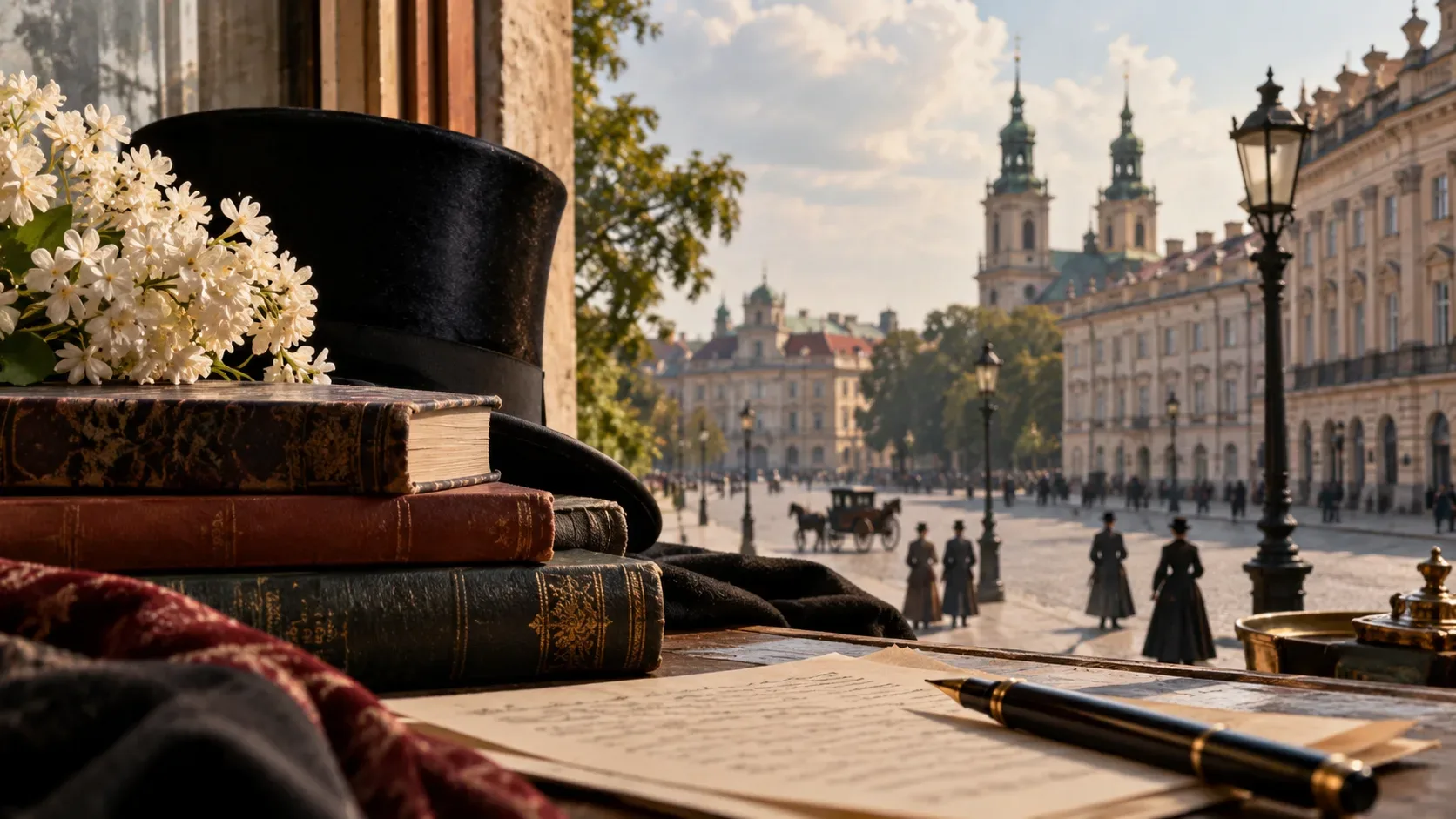
The main action is concentrated in Warsaw in 1878–1879, when the city was under Russian rule. Warsaw is not merely a backdrop. Prus builds a social geography that moves through aristocratic salons, shops, commercial streets, and poor districts such as Powiśle. A historical overview of the city and the novel’s publication is available from Culture.pl.
The central conflict: Wokulski wants love, status, and belonging
Wokulski is a self-made merchant whose life has been shaped by political involvement, exile, and professional reinvention. Izabela belongs to an aristocratic family in financial decline. That difference creates the basic tension: he has capital and the ability to act, but not the inherited prestige the elite considers decisive; she has name and social position, but lives in a world whose economic foundations are weakening.
Wokulski’s interest in Izabela therefore should not be read as romance alone. Getting close to her also means getting close to a class that does not easily accept a man who made his fortune in trade. One of the novel’s persistent questions is less “will they end up together?” than “how far can money, merit, and desire cross a hierarchy based on birth?”
Wokulski matters especially because he contains contradictory impulses. In business he can be calculating, efficient, and modern; in private life he can act like a Romantic idealist. That split between pragmatism and fantasy is one of the keys to both the character and the novel.
Warsaw works as a map of class
Prus wrote about urban life for decades and used that close observation to make the capital an active part of the narrative. The reader moves through spaces where social position is visible in architecture, consumption, forms of address, and even in who can move comfortably through a room. The contrast between salons, commerce, and poverty prevents Wokulski and Izabela’s story from becoming detached from the rest of society.
The novel also records national, economic, and ethnic tensions of the period, including relations between Poles and Jews and the prejudices surrounding them. For a modern reader, it is useful to distinguish the representation of historical attitudes from an automatic endorsement of them. That attention to context helps explain why economic advancement does not erase class barriers or, by itself, produce social integration.
Three generations help unlock the novel
Before settling on the final title, Prus considered Three Generations. The idea remains useful because three characters point toward different ways of imagining the future.
- Ignacy Rzecki, Wokulski’s older employee and friend, carries memories of earlier political struggles and an idealism tied to revolutionary and Napoleonic hopes.
- Stanisław Wokulski occupies an in-between position: he carries the legacy of Romantic sacrifice while also operating in the world of trade, investment, and economic mobility.
- Julian Ochocki looks more confidently toward science, invention, and technological progress.
Those three perspectives keep Lalka from collapsing into a love triangle or a satire of the aristocracy. The novel asks what remains of each generation’s grand projects when they meet a social reality that resists change.
Themes worth watching without looking for spoilers
- Class and status: having money is not the same as being accepted by people who inherited name, networks, and prestige.
- Money and power: fortunes can open doors, rescue families, and reorganize relationships, but they can also turn people into bargaining instruments.
- Idealism and pragmatism: nearly every major project in the novel runs into the distance between what characters want and what society permits.
- Gender and marriage: elite women may occupy privileged positions while still having their choices restricted by family, property, and social expectations.
- Modernization and inequality: commerce, science, and infrastructure coexist with extreme poverty and older social structures.
- Identity after political defeat: characters from different generations carry different responses to failed uprisings and life under occupation.
The way the story is told is part of its meaning
Lalka combines third-person narration with sections from Rzecki’s diary, the “Diary of the Old Clerk.” This creates two temporal and emotional perspectives: one follows the more immediate action; the other recovers the memories and expectations of an earlier generation. The double narration also makes point of view important. Not every judgment about Wokulski, Izabela, or society should be treated as the author’s neutral verdict.
The novel mixes realism, satire, humor, psychological observation, and episodes that shift in tone. That variety, which surprised some early critics, helps explain why an adaptation can emphasize different elements without exhausting the book.
The title does not simply mean that Izabela is “the doll”
A common reading immediately identifies the “doll” of the title with Izabela. That is too simple. Prus himself connected the title to a secondary episode involving an actual toy doll and rejected the idea that the name was merely a label for the female lead. Culture.pl also highlights this point.
That does not rule out symbolic readings about people treated as objects, rigid social roles, or characters moved by forces they do not control. It only means that the title does not provide a single official key for judging Izabela.
What Netflix’s 2026 adaptation has actually confirmed
According to Netflix, the new Lalka premieres on September 16, 2026. It is a six-episode period series directed by Paweł Maślona and written by Paweł Demirski, Jagoda Dutkiewicz, and Maślona. Tomasz Schuchardt plays Wokulski, Sandra Drzymalska plays Izabela, and Dariusz Chojnacki plays Rzecki; the official series page is available in the Netflix catalog.
The most important point for book readers is that the platform itself presents the production as a contemporary reinterpretation rather than a literal transfer. Its publicity confirms new story threads, including an investigation, family secrets, and conflicts created for the serialized structure. It also describes an Izabela with a plan of her own and a Wokulski whose desire is interpreted in terms of belonging, security, and control.
That is the adaptation’s choice. It engages with real tensions in the novel, but it should not be projected backward as Prus’s definitive description. When the series introduces a mystery or makes a character’s motivation more explicit, it is worth asking whether that element comes from the original text or from the 2026 reinterpretation.
How to approach the adaptation without reading a full plot summary
- Keep track of who has money and who has name; in Lalka, those two forms of power are not equivalent.
- Pay attention to places. A shop, a salon, and a poor street can reveal as much about the social order as many conversations do.
- Compare Wokulski’s self-image with the way other people classify him. The conflict between merit and origin lives there.
- Treat Rzecki as another lens, not merely a supporting character: his memory connects the novel’s present to older political hopes.
- Do not turn Izabela into the single explanation for everything Wokulski does. The book is also about ambition, identity, frustration, and the search for meaning.
- In the series, separate from the start what belongs to the novel’s core from what has been announced as an expansion by the adaptation.
With that context, The Doll stops looking like only a historical romance about frustrated passion. What is at stake is an entire society trying to reconcile old hierarchies with new money, science, mobility, and individual desire. That tension is precisely what makes the novel a richer starting point for the 2026 adaptation.