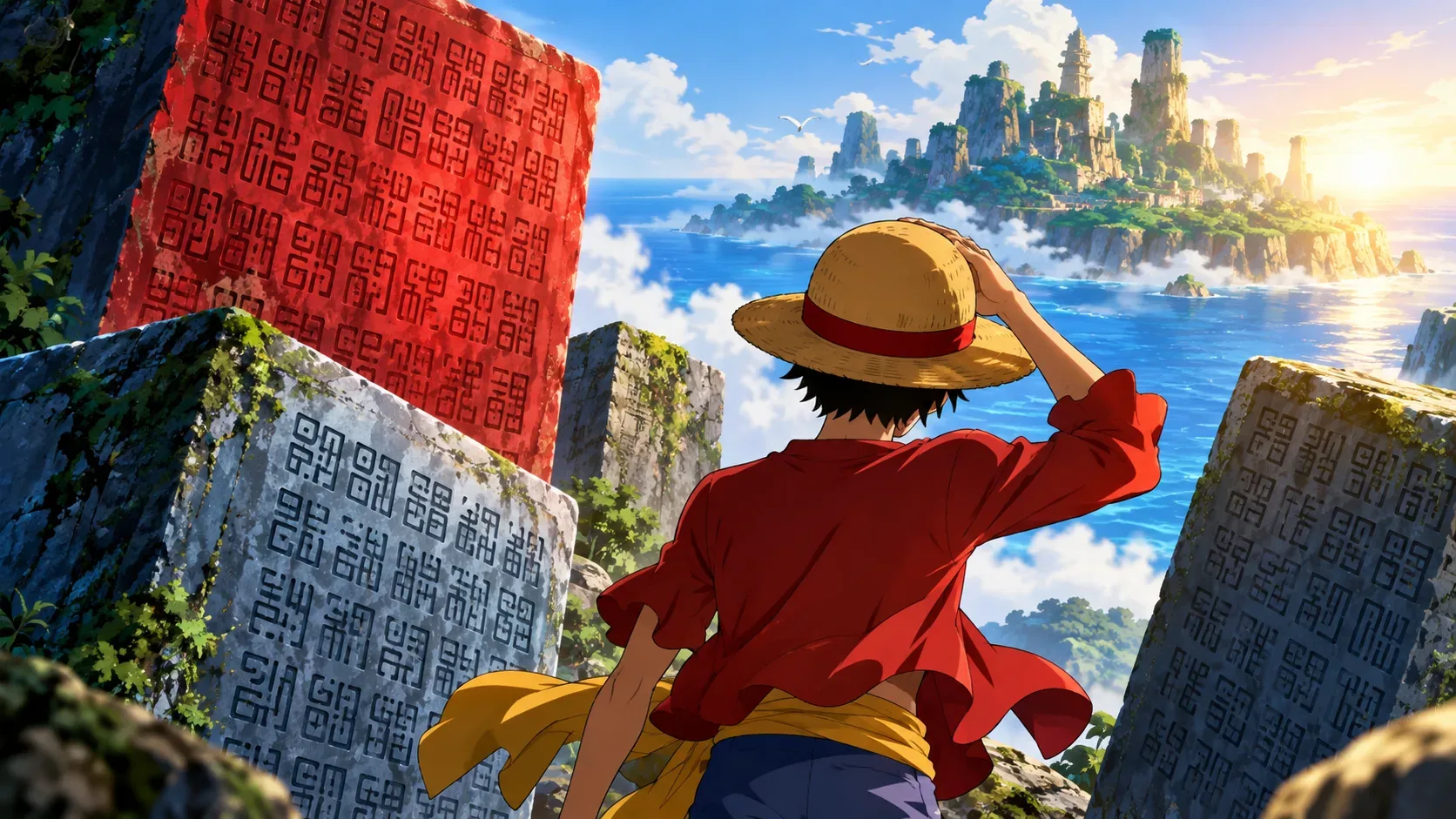
Road Poneglyph, regular Poneglyph and Rio Poneglyph are not three equivalent versions of the same kind of stone. In One Piece, the Road Poneglyphs are a specific set connected to the location of Laugh Tale; “regular Poneglyph” is simply a practical way to refer to blocks that are not part of that set; and the Rio Poneglyph is the “true history” assembled from specific Poneglyphs, not a fifth red stone.
| Term | What it is | Main function | Connection to Laugh Tale |
|---|---|---|---|
| Road Poneglyph | One of four special Poneglyphs associated with geographic points. | Provide one of the four references needed to locate the final island. | Taken together, the four points allow the meeting point described by the story to be determined. |
| Regular Poneglyph | An editorial shorthand for Poneglyphs that are not Road Poneglyphs. It is not a formal in-story category under that name. | Record different kinds of ancient information, such as history, messages or data about the Ancient Weapons. | By itself, it does not function as a coordinate for Laugh Tale. |
| Rio Poneglyph | The “true historical text”, formed by bringing together information from specific Poneglyphs. | Reconstruct the historical truth Robin seeks. | It is connected to the knowledge found at the end of the journey, but it does not replace the four Road Poneglyphs used to get there. |
Why “regular Poneglyph” can be misleading
The label is useful for comparison, but it should not be treated as an official classification equivalent to “Road Poneglyph”. In a 2016 overview published by the official ONE PIECE.com website, about 30 Poneglyphs are mentioned in total: four Road Poneglyphs and approximately 26 other Poneglyphs. The same overview states that nine of those roughly 26 make up the Rio Poneglyph.
That changes how the comparison should be understood. A Road Poneglyph belongs to a clearly defined physical set of four stones with a navigation function. “Regular Poneglyph”, meanwhile, conveniently groups stones whose contents can serve different purposes. The Rio Poneglyph is the historical result produced by combining nine relevant Poneglyphs, not an additional stone placed beside the other categories.
How the four Road Poneglyphs lead to Laugh Tale
The role of the Road Poneglyphs becomes clear when the story separates the normal Grand Line route from the final stage of the voyage. The official episode 966 page explains that Roger reached Lodestar, realized another island was required to complete the journey around the world and concluded that the four Road Poneglyphs had to be deciphered. The official episode 968 page summarizes the mechanism: each of the four points to a location, and the meeting point at the center of those references reveals the position of the final island.
- Find the four Road Poneglyphs or obtain reliable copies of their inscriptions.
- Decipher the ancient text to identify the geographic reference contained in each one.
- Plot the four locations on a map.
- Use the crossing defined by those references to determine the position of Laugh Tale.
- Then navigate to the final island.
The story also demonstrates the practical value of copies of the inscriptions. That makes sense because a crew needs to transport the engraved information, not necessarily move the stone blocks themselves. The decisive requirement is to possess readable data and have someone capable of interpreting it.
Why three Road Poneglyphs do not complete the task
With only three references, one of the pieces required by the story's own rule is missing. Routes or guesses can be imagined from three points, but that is not the same as obtaining the crossing defined by all four Road Poneglyphs. Therefore, “having three and guessing the fourth” is not presented as a reliable substitute.
Where the Rio Poneglyph fits
The Rio Poneglyph answers a different question. The Road Poneglyphs help determine where to go. The Rio Poneglyph is about what to understand about history. Nico Robin's official profile on ONE PIECE.com describes her dream as finding or seeing the “true historical text” recorded in the Rio Poneglyph.
For that reason, it is inaccurate to treat the Rio Poneglyph as if it were “the most important Poneglyph” for navigation. Its importance is historical. The geographic key to Laugh Tale remains the complete set of four Road Poneglyphs.
What the other Poneglyphs can record
The 2016 official inventory shows why non-Road Poneglyphs are not a single-purpose group. The examples listed include information about the locations of Ancient Weapons, records connected to the Void Century and Joy Boy's apology. In other words, the content can vary significantly from one stone to another.
It is also important not to reverse the relationship between these concepts. If nine Poneglyphs among the non-Road group make up the Rio Poneglyph, that does not mean every regular Poneglyph is part of the Rio. Some preserve information relevant to other mysteries and narrative goals.
Laugh Tale is not simply the endpoint indicated by the Log Pose
Roger's journey helps separate the two ideas. According to the official synopsis for episode 966, reaching Lodestar did not complete the discovery of the route. It was there that an additional stage became clear, one that depended on the four Road Poneglyphs. Following the Log Pose to its limit and locating Laugh Tale are therefore different tasks.
This distinction explains why the Road Poneglyphs are so valuable in the race for the One Piece. They are not merely rare historical records. They are part of the specific mechanism that turns the search for the final island into a problem of information, reading and navigation.
Spoiler guide by saga
Safe if you have reached Skypiea
Up to this point, the key facts are that ancient inscribed stones exist, Robin can read them and her goal is tied to the true history. The full concept of the four Road Poneglyphs has not yet been introduced.
Conceptual spoilers for Zou
In Zou, the story directly explains that four Road Poneglyphs exist and that they are required to locate Laugh Tale. From this point onward, understanding the difference between Road Poneglyphs and the other stones stops being a minor lore detail and becomes part of the main route.
General spoilers for Whole Cake, Wano and later stages
Later sagas turn the inscriptions and their copies into strategic resources. Different groups compete for the information needed to advance. To understand the difference between the types of Poneglyphs, however, you do not need to know who holds each copy or where every stone is located at a given moment, so those details can be avoided without weakening the explanation.
Practical summary
- Road Poneglyph: there are four, and they are used to locate Laugh Tale through the geographic references they contain.
- Regular Poneglyph: an informal label for non-Road Poneglyphs; their contents can serve different purposes.
- Rio Poneglyph: the true history formed by combining information from nine Poneglyphs, according to the official 2016 overview.
- To reach Laugh Tale: the story requires deciphering all four Road Poneglyphs.
- To understand the true history: the central concept is the Rio Poneglyph and the reading of the relevant historical records.
Official sources and further reading
- ONE PIECE.com: official overview of Poneglyphs, Road Poneglyphs and the Rio Poneglyph.
- ONE PIECE.com: episode 966, Lodestar and the need for the four Road Poneglyphs.
- ONE PIECE.com: episode 968, the four points and the location of the final island.
- ONE PIECE.com: Nico Robin's official profile and her search for the Rio Poneglyph.