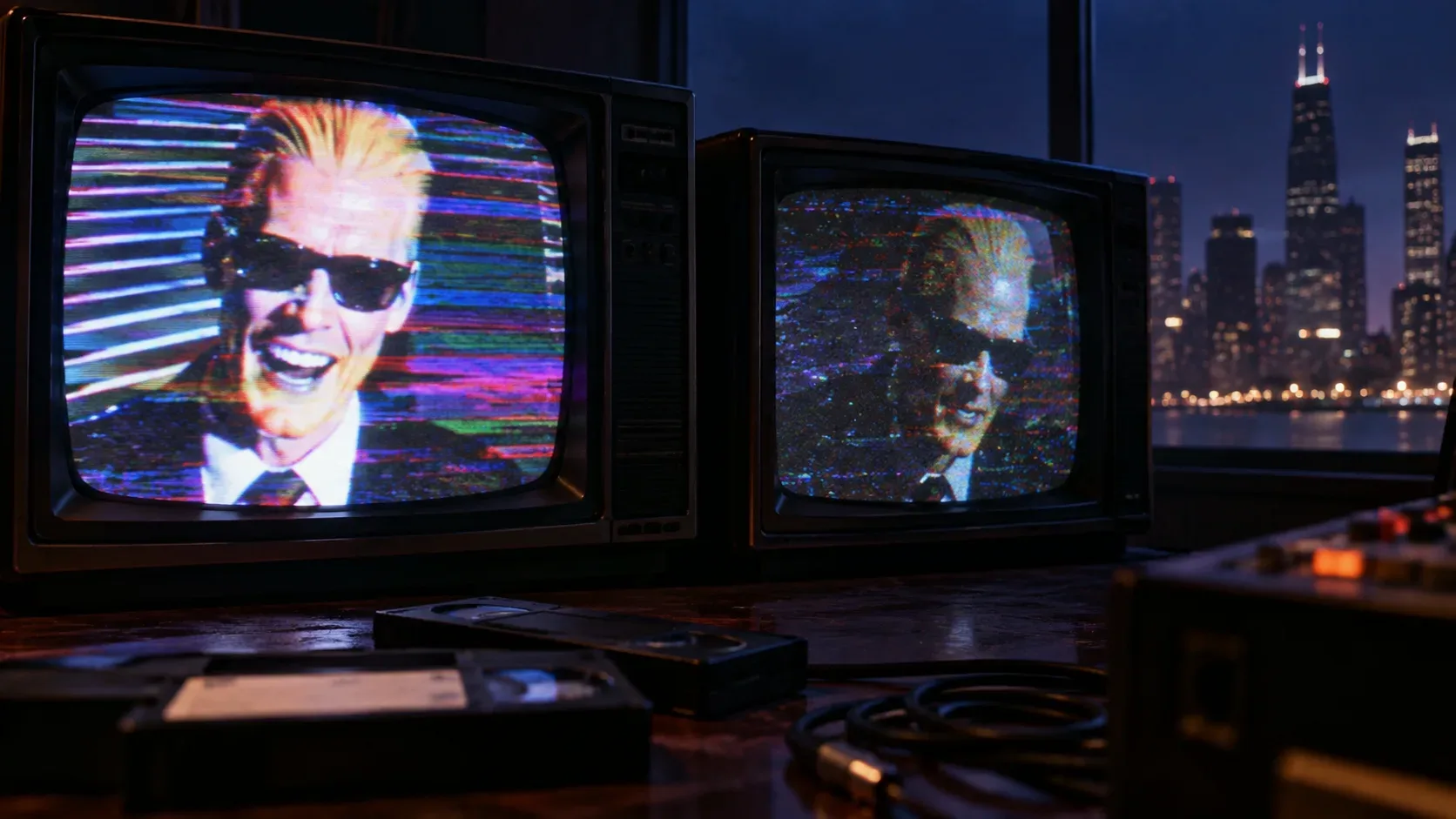
On the night of November 22, 1987, two Chicago television stations had their programming replaced by a pirate video featuring a person in a Max Headroom mask. The first intrusion hit WGN-TV during its 9 p.m. newscast and lasted less than half a minute. About two hours later, WTTW was interrupted during Doctor Who for roughly 90 seconds. The U.S. Federal Communications Commission, the FCC, investigated the case, but no one was formally identified or charged.
The key to understanding the episode is separating what was seen on air from what was reconstructed later. Recordings confirm both intrusions. Reporting published immediately after the event documents the federal investigation and a technical hypothesis involving a stronger microwave transmitter. Names of alleged perpetrators, specific motives and supposed confessions that appeared years later online never became an official identification.
November 22, 1987: the timeline of the two intrusions
| Approximate time | What happened | What is documented |
|---|---|---|
| 9 p.m. | WGN-TV was airing The Nine O'Clock News. | The interruption occurred during the sports segment while Dan Roan was presenting highlights from the Chicago Bears and Detroit Lions game. |
| Around 9:14 p.m. | WGN's signal was replaced by a figure in a Max Headroom mask in front of a moving metallic background. | Contemporary reports put the duration at about 25 seconds. WGN regained its programming by changing the link used between the studio and transmitter. |
| Immediately afterward | Dan Roan reappeared and resumed the sports segment. | The station had recovered control before the intruder could show the longer performance seen later that night. |
| Between 11:10 and 11:15 p.m. | WTTW, Chicago's public television station, was interrupted during the serial Doctor Who: Horror of Fang Rock. | UPI reported 11:10 p.m. in its 1987 coverage. Retrospective accounts commonly place it at about 11:15 p.m. The few minutes of difference do not change the confirmed sequence. |
| About 90 seconds later | The pirate signal ended and Doctor Who returned. | WTTW later recalled that its staff could not stop the intrusion before it ended on its own. |
| November 23 | The investigation became formal. | The FCC confirmed it was investigating and received recordings from people who had taped the intrusions. |
What appeared on screen
On WGN, the appearance was brief and had virtually no intelligible speech. The masked figure rocked in front of a corrugated metal panel meant to imitate the geometric background associated with Max Headroom. The audio was dominated by buzzing and interference. The segment ended when station engineers recovered the link.
On WTTW, the video was longer and included distorted audio. The masked person made disjointed remarks and references to WGN and television culture of the time. The segment ended with the figure exposing his buttocks while another partly visible person used a fly swatter. That content is preserved in surviving recordings and was also described in news coverage the following day.
The second recording showing another person is evidence that the on-camera performance was not entirely solo. It does not establish how many people took part in the technical operation, nor does it prove that everyone visible in the video operated the transmitter.
How the signal hijacking probably worked
The incident is often called a "hack," but the best supported technical explanation does not involve breaking into a computer. In 1987, television stations could send programming from the studio to a transmitter on a tall building through a studio-to-transmitter link, or STL, a point-to-point microwave connection. The main transmitter would then broadcast that content to viewers across the area.
In contemporary UPI reporting, WGN engineer Wally Wright said the culprit probably used a microwave transmitter to overpower the signals the stations were beaming to their transmitters at the John Hancock Center and Sears Tower. In practical terms, the goal would not have been to enter the studio physically, but to make the receiver at the transmission site accept a pirate signal strong enough to prevail over the legitimate link.
Decades later, WTTW broadcast engineer Al Skierkiewicz described the culprit as someone who needed sophisticated technical knowledge, possibly involving broadcast engineering, satellite work or amateur radio. That assessment helps explain the difficulty of the stunt, but it does not establish a specific profession, much less identify a person.
The publicly available material reviewed here does not include a complete FCC technical report reconstructing the position, power, antenna and frequency of the pirate equipment. The STL overpowering scenario should therefore be treated as the technical explanation most consistent with period reporting, not as a complete forensic reconstruction of the hardware used.
Why WGN stopped the intrusion and WTTW did not
The difference between the two interruptions is one of the most useful clues. At WGN, engineers were able to change the studio link frequency and remove the pirate signal from the air within seconds. Reporting from 1987 explicitly described that response.
At WTTW, the control staff saw its program replaced but could not restore the signal before the unauthorized transmission ended. In later recollections, station employees described the frustration of watching the video continue. After roughly 90 seconds, the pirate feed simply disappeared and Doctor Who returned.
This suggests the intruder did not seize control of every part of either station's infrastructure. What appears to have been compromised was a specific point in the signal distribution chain. Once WGN changed its link path, the interference no longer worked. At WTTW, the opening remained available long enough for the full second video to air.
Fact, inference and rumor
| Classification | Claim | Why it belongs here |
|---|---|---|
| Fact | Two Chicago stations were interrupted on the same night. | Recordings, 1987 news coverage and WTTW itself document WGN-TV and WTTW on November 22, 1987. |
| Fact | The first intrusion lasted about 25 to 30 seconds and the second about 90 seconds. | Those durations appear in contemporary reporting and WTTW's retrospective account. |
| Fact | The FCC investigated. | The investigation was publicly confirmed by commission representatives in 1987 coverage. |
| Fact | No perpetrator was formally identified. | WTTW still described the case as unsolved decades later, and there is no known public charge tied to the intrusions. |
| Strong inference | The same group carried out both intrusions. | The matching mask, visual language and close timing make that interpretation highly plausible, but the operators were never identified. |
| Technical inference | A microwave transmitter overpowered the stations' STL feeds. | That explanation came from engineering personnel as early as 1987 and is compatible with the vulnerability of analog links. The exact equipment was never made public. |
| Rumor | A name posted on a forum, social network or anonymous account is "the culprit." | Without official identification, technical proof or charges, such attribution remains speculation. |
| Rumor | The video contained a secret message that reveals the motive. | There are identifiable jokes and references, but no documentary key establishes one proven motive. |
Why no one was identified
The absence of a known perpetrator does not require an extraordinary conspiracy. The episode was brief, took place in analog infrastructure and left an excellent record of what viewers saw but a poor record of who was transmitting it. The images capture the performance, not the transmitter location, travel route, equipment purchase or the face of the person behind the mask.
The technical hypothesis also assumes an operation away from the studio. That would reduce the chance that internal cameras, access controls or station witnesses directly recorded the intruder. The required expertise may have narrowed the field of possible suspects, but technical competence is not evidence of authorship.
The FCC collected tapes and investigated the interference. What never surfaced publicly was the combination needed to close the case: seized equipment, a confirmed transmission location, a unique technical fingerprint, a verifiable confession or corroborated testimony. Without that bridge between the video and a real identity, the incident remained famous but formally unresolved.
What remains unanswered
- Who transmitted it: no perpetrator has been officially identified.
- Where the signal came from: the exact area and transmission point were not publicly established.
- What equipment was used: the microwave transmitter theory is strong, but the model, power, antenna and configuration remain unknown.
- How many people participated: the WTTW recording shows at least one other person in the performance, but the size of the technical crew is unknown.
- What the objective was: the content can be read as provocation, parody or an elaborate prank, but no motive has been demonstrated.
What the case actually proves
The Max Headroom intrusion does not prove that someone "hacked two TV stations" in the modern sense of breaching servers or digital networks. It demonstrates something more specific: an analog transmission chain could be vulnerable if a third party knew the right link and could deliver a competing signal strong enough at the receiver.
It also shows how a well documented event can remain unattributed. There is video, witness testimony, news coverage and an official investigation, but those elements record the event far better than they record the operator. The mystery persists not because images are missing, but because the images never created a verifiable link to an identity.