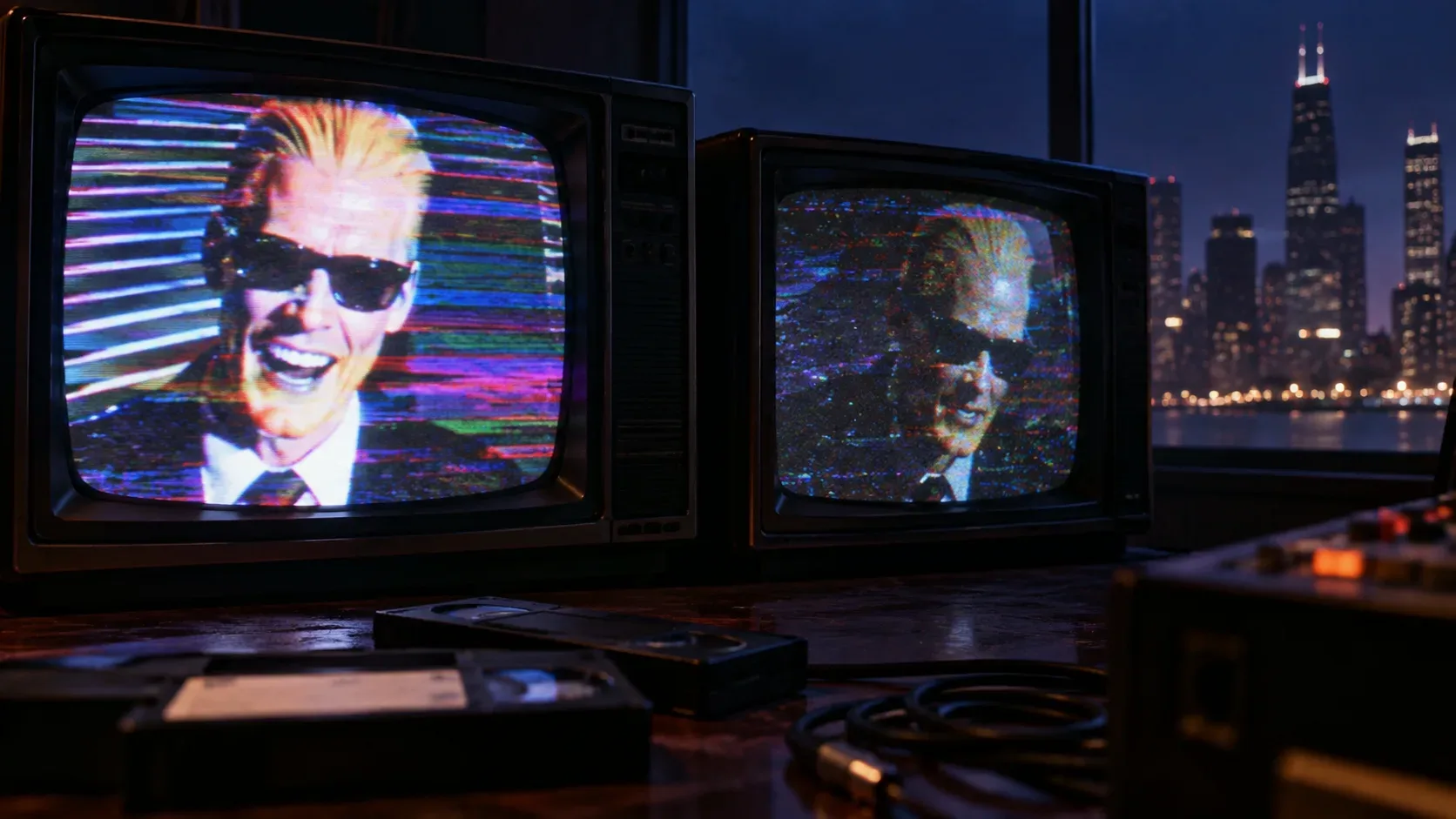
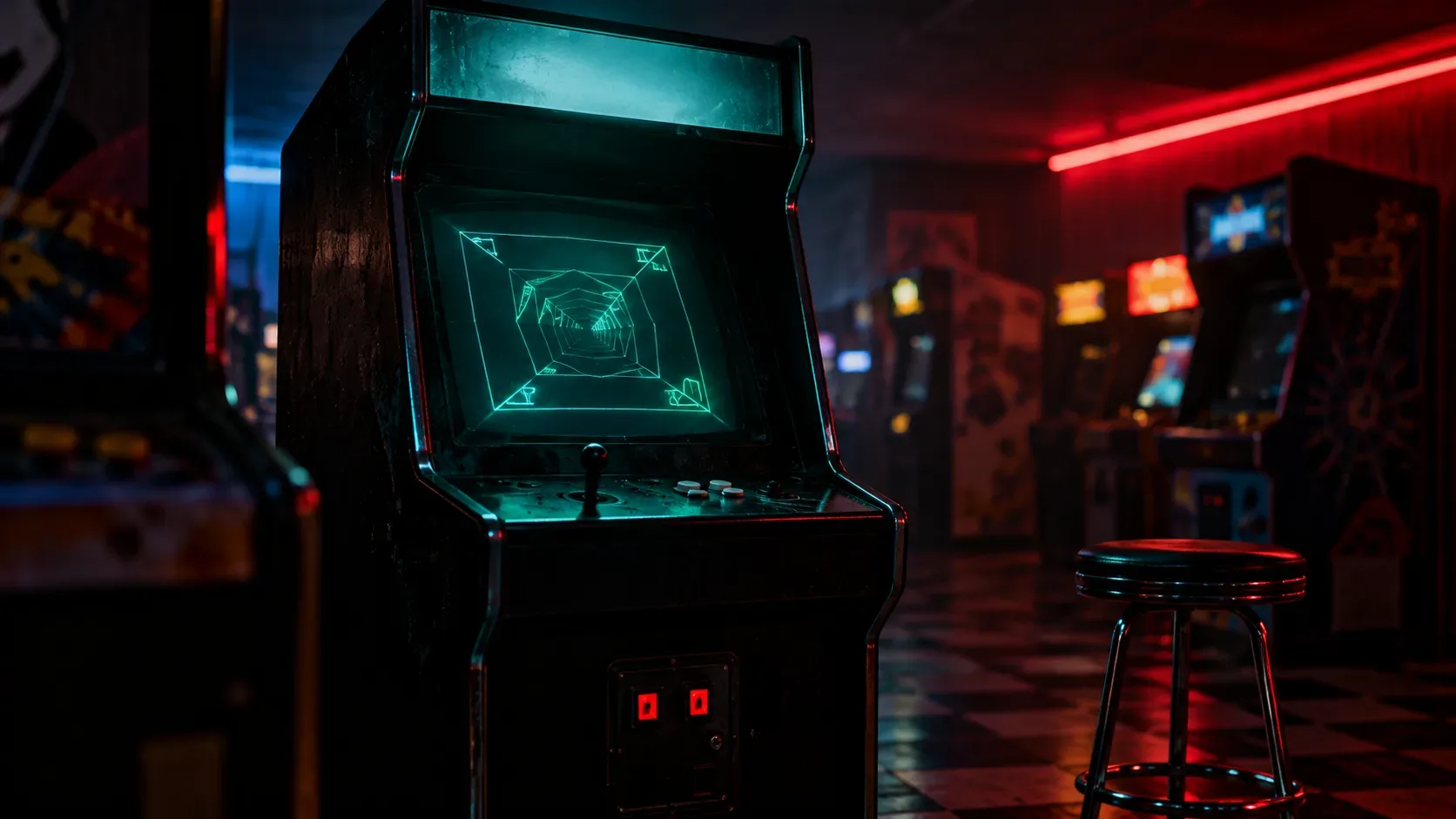
There is no verifiable evidence that Polybius was a real arcade game installed in Portland in 1981. The known documentary trail begins almost two decades later, on a page from the classic arcade site Coinop.org. The key to understanding the legend is to separate the date when the story says the events happened from the date when the story can actually be found in traceable records.
What is the first verifiable record of Polybius?
The current Coinop page presents Polybius as a 1981 game and repeats the elements that became central to the legend: an extremely limited release near Portland, players suffering amnesia and nightmares, an alleged company called Sinneslöschen, and men in black coats interested in data from the machines rather than the coins.
For years, articles about the case repeated that this entry had appeared in 1998. Atlas Obscura, writing in 2016, also treated 1998 as the earliest known date. Later research into archived copies supports a more cautious conclusion: the page appears in a 2000 archive with a modification date of February 6, 2000 and a note describing it as a new addition asking whether anyone had heard of the game.
That changes the evidentiary weight. The earliest traceable record is not a 1981 news report, a distributor catalog, or a contemporary account from an arcade operator. It is a database entry posted online around 2000 that already describes the story as rumor.
Why does 1998 appear in so many accounts?
The discrepancy exists because the Coinop page itself later displayed an earlier date. Subsequent investigations, popularized by analyses such as Ahoy's documentary and summarized in later historical research, noted that archived copies from early 2000 do not establish 1998 as a verified publication date.
The safest formulation is therefore this: 1998 is a date attributed to the entry, but February 2000 is the first widely documented verifiable point in the available online trail. The distinction matters because a legend can acquire a retroactive date without creating a contemporary source for the events it describes.
When did Polybius reach print?
The earliest known print reference appeared in issue 180 of GamePro, dated September 2003. The Video Game History Foundation preserves a record of that issue. The feature, titled Secrets & Lies, collected video game legends and classified the Polybius case as inconclusive.
This step was important to the spread of the story. According to the reconstruction published by Inverse, Coinop owner Kurt Koller brought the story to the GamePro writer. The magazine appearance therefore does not function as independent confirmation of a 1981 event. It shows that by 2003 a story already circulating online had reached a larger audience.
Did the 2006 account solve the mystery?
No. In 2006, a Coinop user presenting himself as Steven Roach posted a detailed story about the supposed creation of the game by a team connected to Sinneslöschen. The account added names, motives, and technical explanations, giving the legend the appearance of an insider testimony.
The problem is that this late account was not accompanied by verifiable documentation connecting its author to a company, project, source code, cabinet, or commercial release from 1981. In investigations of urban legends, details added years later can reveal how a narrative evolved, but they do not replace contemporary evidence.
What actually happened in Portland in 1981?
There were real events that help explain why the story feels plausible. Atlas Obscura documents cases of young people becoming ill at a Portland area arcade while playing real games such as Tempest and Asteroids. Authorities also carried out actions involving Portland arcades amid concerns about illegal gambling and modified machines.
Those facts do not prove Polybius. They only show that important components of the legend existed separately in the real world: players becoming ill after intense or extended sessions, striking vector graphics, law enforcement activity, and agents observing arcade machines. Researchers have proposed that memories of these events may have been combined later, but no document shows that such a fusion occurred in 1981 or immediately produced the name Polybius.
What is missing if Polybius is to be treated as a historical game?
A commercially released arcade game usually leaves several kinds of traces. In Polybius's case, no verified original cabinet has surfaced publicly. Nor has an authenticated ROM, circuit board, manual, sales flyer, distributor record, technical documentation, or 1981 news source identifying the game by name.
The alleged manufacturer Sinneslöschen also has no verifiable company history tied to the arcade industry of the period. The visual material most often repeated online belongs to the later tradition of the legend rather than to a proven independent provenance.
| Date | What can be documented | How to interpret it |
|---|---|---|
| 1981 | The year in which the legend places the machines in Portland. Real but separate arcade incidents occurred in the city. | Historical context, not proof of Polybius. |
| Feb. 6, 2000 | Archived copies of the Coinop entry indicate a new addition about Polybius. | Widely cited first verifiable online record. |
| September 2003 | GamePro publishes Polybius in a feature about video game legends. | Earliest known print reference and a major expansion of the story's audience. |
| 2006 | A Coinop account appears from someone identifying himself as Steven Roach. | Late testimony without sufficient independent documentation. |
Later replicas and games are not evidence of an original
After the legend became popular, fan-made recreations, cabinets, games inspired by the myth, and references in television and other media appeared. They are part of Polybius's history as a digital culture phenomenon, but they do not demonstrate that an original machine existed in 1981.
This is a common mechanism in lost-media legends: the more a story is reenacted, illustrated, and turned into an object, the easier it becomes to confuse later cultural presence with a documented historical origin.
So, did Polybius exist?
Based on the evidence currently available, the best-supported conclusion is that Polybius should be treated as a video game urban legend, not as a documented historical arcade game. The more interesting unresolved question is not where the machine is, but who formulated the earliest version of the narrative and exactly how it took shape before appearing on Coinop.
The known chronology favors an online origin around 2000 and shows that the story acquired new layers in 2003, 2006, and the years that followed. This does not prove who invented each detail, but it establishes a clear line between documentation and fiction: 1981 belongs to the legend's narrative, while the verifiable trail begins much later.