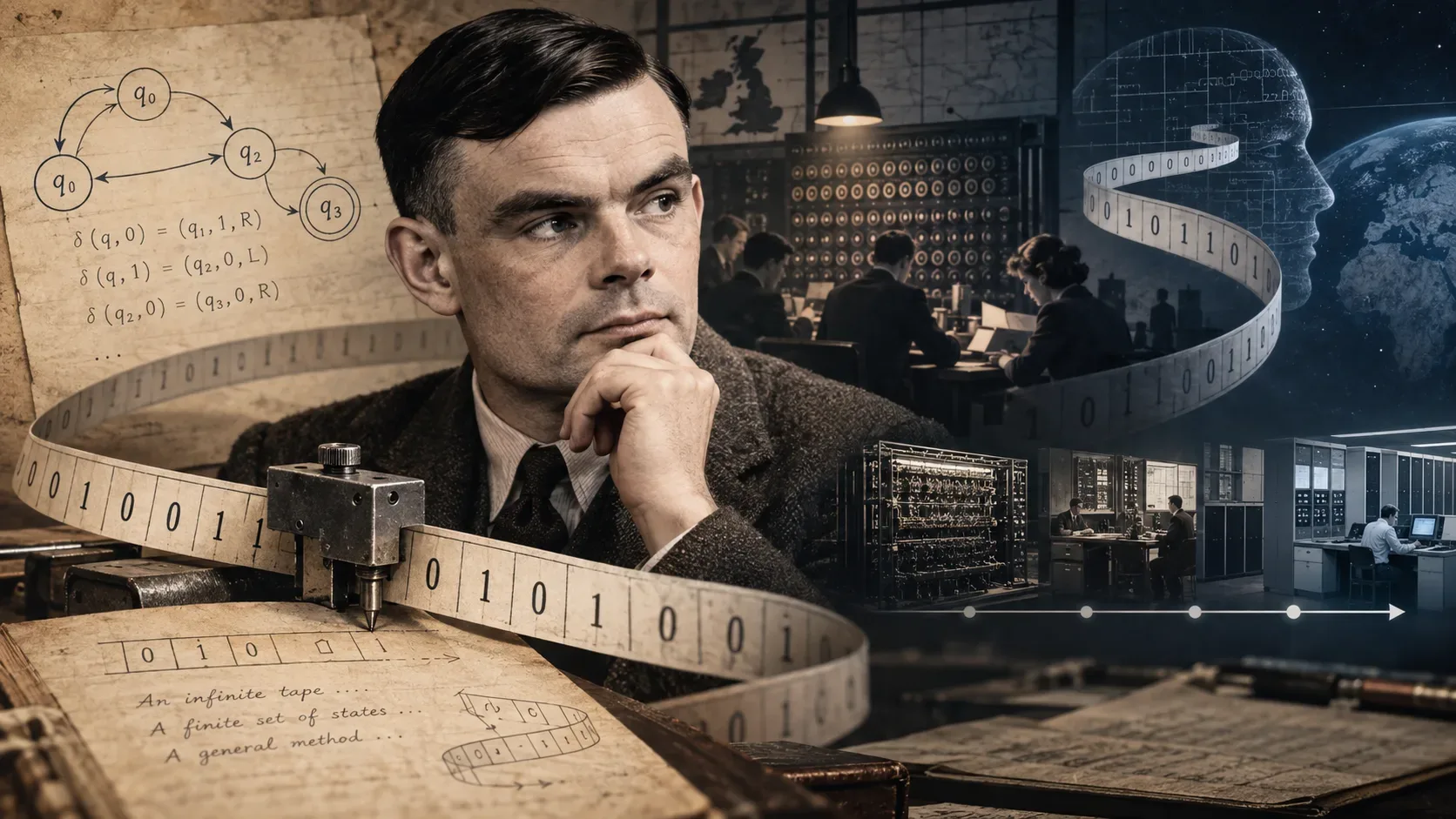
No, Alan Turing did not “invent the computer” by himself. In 1936, he did something different and, for the history of computing, just as decisive as building a machine: he defined mathematically what it means to carry out a mechanical procedure of calculation and showed that a single abstract machine could simulate all other machines of that type when given a description of their rules. This is the idea of the universal machine, now closely associated with the concept of a general-purpose programmable computer.
The key is to separate three stories that are often blended together: the abstract machine in On Computable Numbers, Turing's wartime work at Bletchley Park, and the physical electronic computers that emerged in the 1940s and 1950s. The Computable90 conference, scheduled for 16–18 September 2026 by The National Museum of Computing and the London Mathematical Society, uses precisely this milestone to discuss 90 years of influence from Turing's work.
What happened in 1936 — and why the bibliographic reference says 1937
There is a small date trap. The London Mathematical Society records that the paper was submitted on 28 May 1936 and read on 12 November that year, while the journal's bibliographic record gives its first publication as 1937, in volume 42 of the Proceedings of the London Mathematical Society. That is why it is historically called Turing's “1936 paper” while formal references often list it as Turing (1937). The LMS explains the same chronology in material about the paper and the excerpts used on the British £50 note.
The original text, On Computable Numbers, with an Application to the Entscheidungsproblem, does not propose a cabinet full of valves, relays, or cables. It starts from a question in logic: what do we mean when we say that a number or procedure is computable by an effective method?
What the Turing machine actually was
Turing compares a person performing a calculation step by step with an idealized machine. In the model, there is a tape divided into squares, each able to carry a symbol; the machine scans one square at a time, can write or erase symbols, move left or right, and switch among a finite number of internal states. The next action is determined by the current state and the symbol being read.
This is a mathematical model of a procedure, not an engineering blueprint. The tape can be extended as needed in the idealization; there is no specification for electronic components, clock frequency, physical memory, power supply, or logic circuits. The purpose was to capture the essential structure of mechanical calculation: finite rules applied successively to symbols.
A terminology point also matters: in the paper, Turing speaks of automatic machines and of a universal computing machine. “Turing machine” became the standard later name for the model.
The leap from a special machine to a universal machine
The revolutionary step comes when Turing stops imagining a different machine for every task. In the section on the universal machine, he states that it is possible to devise a single machine that can compute any computable sequence, provided its tape contains a standardized description of the particular machine to be simulated.
In today's language, the rules of another machine can be encoded as data, and a universal machine can interpret them. This anticipates the distinction between a general-purpose machine and the instructions that determine what it does. It is a conceptual root of software and programmability.
But the historical equivalence should not be overstated. The universal machine of 1936 is not, by itself, a wiring diagram for an electronic stored-program computer. It provides the formal idea of universality; the physical architecture of memory, processor, input/output devices, and stored instructions was developed by several groups in the years that followed.
The result was not only “how to compute,” but also “what cannot be decided”
The paper is not merely about what a machine can do. Turing uses the same formalism to show that there are questions about machines for which no general procedure can always produce the answer. He then applies that reasoning to the Entscheidungsproblem, the decision problem in mathematical logic, concluding that there is no universal mechanical method that decides every formula in the system under consideration.
This is one reason the work remains central: it gives us a language for discussing both capability and limitation. Computing is not only about faster hardware; it also requires distinguishing problems that admit algorithms from problems for which no general algorithm exists.
Wartime work: Bletchley Park did not turn the 1936 machine into hardware
When World War II began, Turing went to Bletchley Park. According to the official Bletchley Park biography, he worked on Naval Enigma and, building on earlier advances by Polish cryptanalysts, designed the Bombe, later improved with contributions from Gordon Welchman. The Bombe accelerated the search for possible Enigma settings.
The Bombe, however, was not the physical realization of the 1936 universal machine. It was an electromechanical machine specialized for a cryptanalytic task. Bletchley Park's own educational material explicitly notes that it was not a general-purpose computer. Turing also worked on methods related to Lorenz traffic, but the same biography says he was not directly responsible for the development of Colossus, which is associated above all with Tommy Flowers and Max Newman's team.
There is therefore intellectual continuity — logic, algorithms, and the mechanization of procedures — but not a simple line in which “Turing invents a universal machine in 1936 and builds the computer at Bletchley.”
After the war: ACE was Turing's move toward a physical computer
Turing's transition from theory to concrete design is clearest in the Automatic Computing Engine (ACE). The National Physical Laboratory states that he joined NPL in 1945 and produced plans for ACE in 1946. Here Turing really was designing a physical electronic computer, with stored-program operation and practical attention to performance.
The full design was not built while he remained at NPL. Turing left in 1948; a Pilot ACE based on his ideas was completed in 1950 and used for real applications. The Science Museum Group Collection preserves the machine and describes it as based on Turing's design.
This stage matters for a fair answer to the myth: saying that Turing did not build “the first computer” does not diminish his contribution. He helped establish both the theory of universal computation and concrete designs for electronic computers.
Where ENIAC and the Manchester Baby fit
The question “who invented the computer?” is misleading because “computer” can mean different combinations of features: automatic, digital, binary, electronic, programmable, general-purpose, or stored-program. The Computer History Museum notes that different combinations of these adjectives produce different candidates for the “first.”
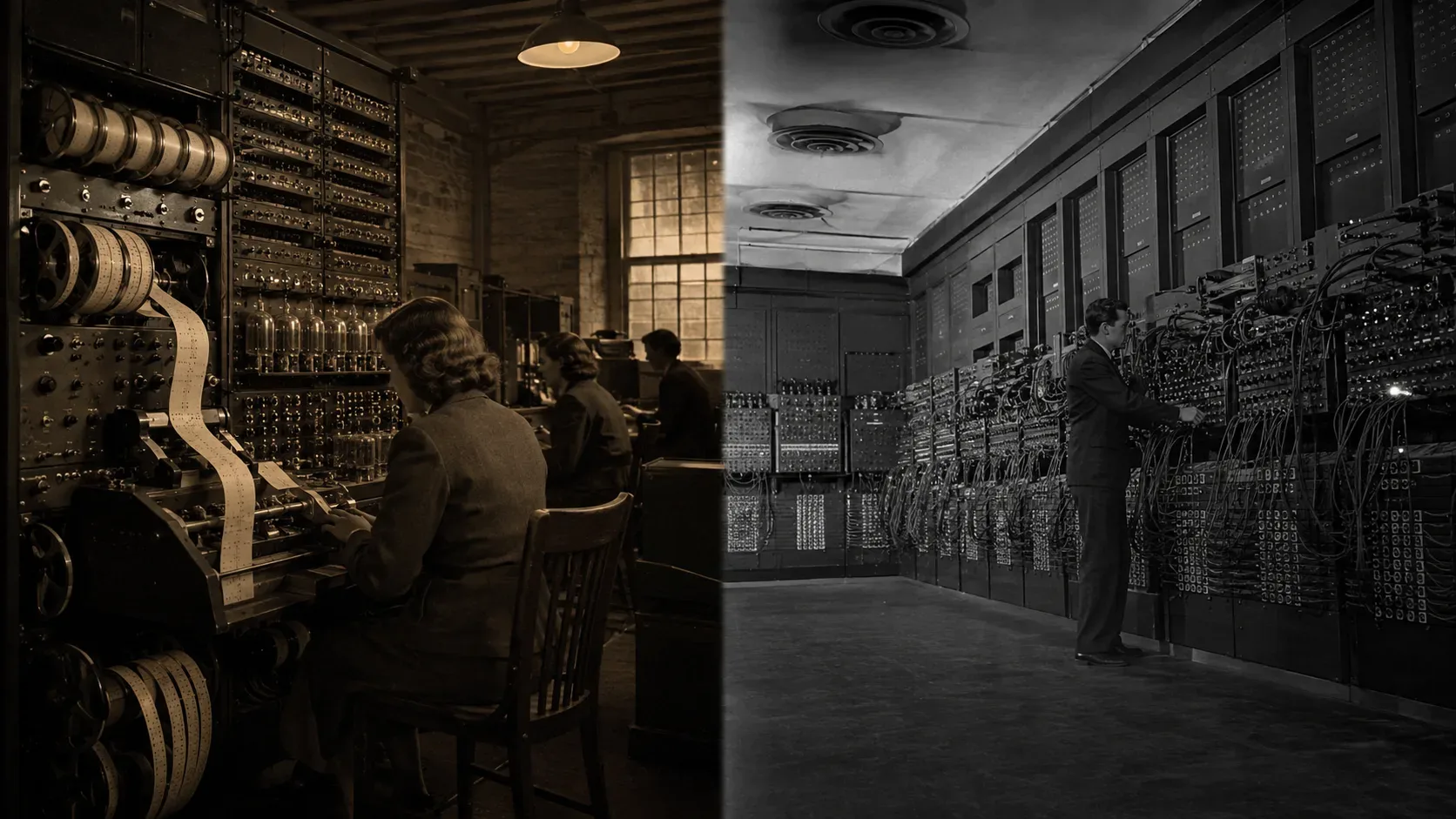
Two milestones help organize the comparison. ENIAC, completed in 1946 in the United States, combined high-speed electronic computation with general-purpose capability, but it was originally programmed through wiring and switches rather than by keeping the program in the same working memory. The Manchester Baby, by contrast, executed a program stored electronically in memory on 21 June 1948. The University of Manchester credits the Baby's design to Freddie Williams, Tom Kilburn, and Geoff Tootill.
Turing arrived in Manchester in September 1948, therefore after that first run. He then contributed to programming and to the Manchester Mark 1/Ferranti Mark 1. This reinforces the conclusion: Turing was a central figure, but the construction of modern computers was a collective history.
Timeline: from abstract machine to physical computers
| Date | Milestone | What it means |
|---|---|---|
| 1936 | Turing submits and presents On Computable Numbers | Formalizes computability and the idea of a universal machine. |
| 1937 | Bibliographic publication of the paper in the Proceedings | This is the date shown in formal academic references. |
| 1939–1945 | Bletchley Park | Turing applies mathematics and mechanization to cryptanalysis; the Bombe is specialized, not a universal computer. |
| 1945–1946 | ACE design at NPL | Turing moves into the design of a physical, general-purpose electronic computer. |
| 1946 | ENIAC | A milestone in general-purpose electronic computing, initially without a program stored in working memory. |
| 1948 | Manchester Baby | First execution of a program on a digital electronic stored-program computer. |
| 1950 | Pilot ACE | Operational machine built from Turing's NPL design. |
What Turing defined — and what came later
| Turing in 1936 | What later engineering still had to solve |
|---|---|
| A formal model of step-by-step computation | How to implement those steps with relays, valves, and later transistors. |
| Tape, symbols, states, and transition rules | Physical memories, registers, circuits, timing, and input/output. |
| A universal machine that simulates other machine descriptions | Practical programmable architectures and efficient ways to store and execute instructions. |
| Formal limits on what can be decided by a mechanical procedure | Choosing what can usefully be automated and dealing with limits of time, memory, and computability. |
Why the universal machine still matters 90 years later
The concept still matters because it separates the physical device from the task described by rules. The same computer can act as a browser, text editor, control system, or scientific tool because its function changes with the program. Real computers are not literally infinite tapes with a head moving one square at a time, but the idea that a general machine can execute encoded procedures remains fundamental to computer science.
The Turing machine also remains a standard tool for reasoning about algorithms, languages, complexity, and decidability. Computable90 in September 2026 is not celebrating a 90-year-old piece of hardware; it is celebrating a way of thinking about computation that still organizes current questions.
The most accurate formulation
If “inventing the computer” means being the single person who built the first modern physical computer, the answer is no. If the question is whether Turing supplied one of the deepest theoretical ideas that made the general-purpose programmable computer intelligible, the answer is yes.
The best summary is: Turing did not invent the computer alone; he formalized universal computation and later participated directly in moving that idea toward real machine designs. The modern computer emerged from the convergence of that theory, electronic engineering, new forms of memory, and the work of multiple teams in different countries.