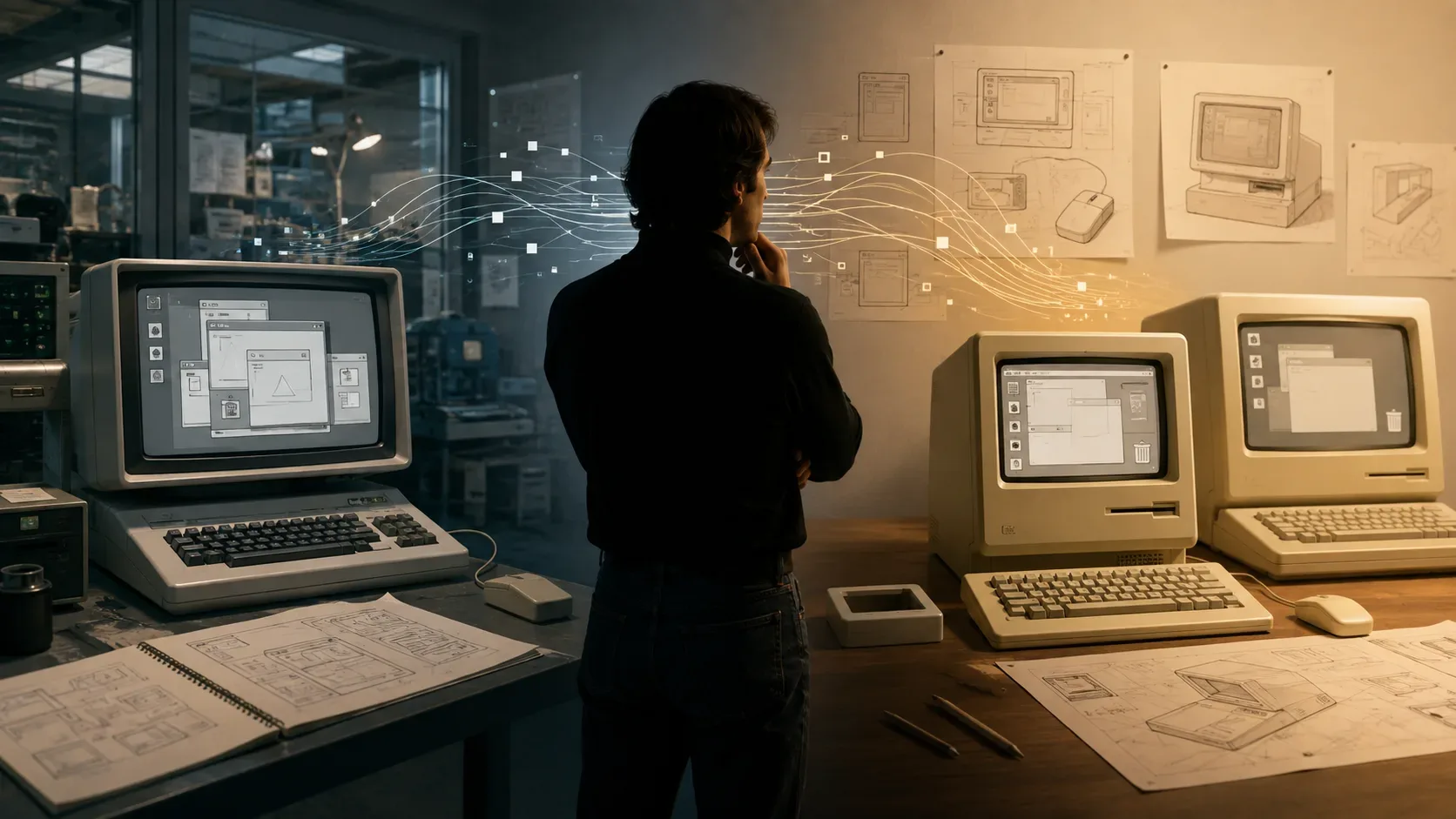
It is not historically accurate to say that Steve Jobs simply “stole Xerox’s graphical interface.” Xerox PARC had assembled, years before Apple, an extraordinary set of ideas: bitmap displays, the mouse, windows, menus, graphical manipulation and, later, the desktop metaphor with icons. The 1979 demonstration materially influenced Steve Jobs and the direction of Lisa. But the Lisa and Macintosh projects already existed, Apple engineers already knew parts of that technological world, and the interface that reached Apple products was rewritten, tested and changed in several important ways.
The best way to understand the episode is to leave behind the binary question “was it stolen or not?” and separate three things: what PARC had already demonstrated, what Apple was already doing before the visit, and what the Lisa and Macintosh teams added afterward.
What Xerox PARC had already created
During the 1970s, PARC built on the Xerox Alto a personal-computing environment that looked radically different from the text terminals of the time. The Computer History Museum (CHM) describes the Alto as combining a graphical display, mouse and software with movable windows and icons. In the Smalltalk environment, PARC also developed overlapping windows, mouse-driven menus and other techniques that would become familiar in later computers.
It is important not to replace one myth with another: not every ingredient originated at PARC. The mouse, for example, had an earlier lineage tied to Douglas Engelbart and SRI. Stanford’s archive also notes that some Apple employees had encountered technologies of this kind before 1979. PARC’s achievement was, to a large extent, integrating many of these ideas into coherent systems and showing how a graphical interface could organize everyday work.
The Xerox Star, commercially introduced in 1981, pushed the office metaphor even further, with documents, folders, a wastebasket and other objects represented visually on the “desktop.” That helps explain why Lisa and Macintosh resemble the PARC tradition, but it also shows that “the Xerox interface” was not a single finished screen that Apple could simply duplicate.
Lisa and Macintosh began before Steve Jobs’s visit
This is the point that most strongly undermines the simplified story. Historical material hosted by Stanford University records that both Lisa and Macintosh were already under development before the December 1979 visit. Macintosh documents associated with Jef Raskin’s work already discussed ease of use, a display capable of showing multiple fonts, graphics and a graphical input device.
On Lisa, Bill Atkinson and Raskin were also pushing for a bitmap display suitable for mixing text and graphics. That does not mean Apple already had the visual system it would ship years later. It means something more specific: the path toward a graphical machine did not begin the moment Jobs walked into PARC.
There were two visits — and Jobs’s visit was not a secret raid
The popular story usually speaks of “the visit” as if Steve Jobs had entered PARC, seen a hidden secret and left with the complete idea. Stanford’s material records two visits by Apple groups in 1979, with Jobs participating in the second. Jef Raskin said he helped arrange them and wanted Jobs to understand the importance of work already taking place inside Apple.
The demonstrations were given by PARC researchers to Apple visitors; this was not a break-in or clandestine access. Historical accounts describe business negotiations between Xerox and Apple around the same period, though details vary among sources. The safe conclusion for this controversy is simpler: Apple received an authorized demonstration, and the experience changed Jobs’s conviction about the value of a mouse-driven graphical interface.
What Jobs actually saw and why it mattered so much
The CHM summarizes the December 1979 visit by saying that Jobs was inspired by PARC’s Smalltalk GUI and decided Lisa should incorporate a GUI. That fits other evidence well: Apple had prior work, but the demonstration served as a concrete proof that a rich graphical interface could be fast, direct and central to the computer, rather than a peripheral experiment.
Participants’ memories differ in emphasis. Raskin maintained that Jobs needed to see at PARC something similar to what he was already trying to advocate internally. Other accounts treat the encounter as a greater revelation for Jobs. The two versions are not necessarily incompatible: an idea can exist inside a company before its most powerful decision-maker fully understands its potential.
Lisa borrowed from PARC — and changed many things
It would be equally wrong to swing to the opposite extreme and claim Xerox’s influence was minor. CHM itself says Lisa was strongly influenced by PARC’s work, while Apple engineers developed their similar interface with their own code. The team also hired Larry Tesler, a former PARC researcher who played an important role in applications, interface design and user testing.
Among the decisions Bill Atkinson highlights in recent CHM material are making the mouse standard equipment, using black text on a white background, and moving the menu bar to the top of the screen. The Lisa team also invested heavily in usability testing and in an interface that people without technical training could learn.
A useful example of influence turning into an original solution is window management. In a CHM oral history, Atkinson recalled leaving the demonstration believing he had seen PARC efficiently draw into visible portions of overlapping windows. He later learned his interpretation was wrong, but by then he had already developed a region-clipping solution that became an important part of Apple’s graphics system. In other words, outside inspiration can trigger a technical solution that did not exist in that exact form in the source system.
The one-button mouse shows why “copy” is an inadequate word
PARC systems used different mouse configurations, often with several buttons. Apple deliberately chose a one-button mouse for Lisa and Macintosh. Larry Tesler later described how the team compared alternatives and concluded that reducing button choices would make the device less intimidating for beginners.
That decision does not erase the debt to PARC — Apple’s adoption of the mouse as a central control device was reinforced by its exposure to those systems. But it demonstrates that Apple’s commercial product went through an intense layer of simplification, industrial engineering and testing. The goal was not to reproduce a laboratory system; it was to make graphical interaction learnable by a much larger audience.
What about Macintosh? It was not simply a smaller Lisa
Macintosh began as a Jef Raskin project before Jobs’s PARC visit. Afterward, the relationship between the two projects became more complicated. Lisa advanced toward a sophisticated GUI; Jobs was eventually removed from direct leadership of Lisa and took over Macintosh, which then moved closer to Lisa’s graphical direction. The CHM documents substantial collaboration and competition between the teams: Bill Atkinson’s QuickDraw went to the Mac, engineers moved between projects, and software concepts crossed in both directions.
So the most accurate genealogy is not “Xerox → Macintosh” in a straight line. It is closer to PARC + Apple’s prior work → Lisa’s evolution → exchange between Lisa and Macintosh → the 1984 Macintosh. The Mac popularized a cheaper, leaner and more consistent version of many ideas that had matured in Lisa, which reached the market in 1983.
Were some elements very similar to Xerox Star?
Yes, and that should be acknowledged directly. In an interview preserved by Stanford, Raskin was especially critical and said Lisa borrowed many elements from Xerox Star. The resemblance in icons, office metaphors and document-oriented interaction is historically visible.
But “borrowing ideas” and “copying an entire interface” remain different claims. Star, Smalltalk, Lisa and Macintosh had different behaviors, architectures, hardware constraints and interaction decisions. Lisa, for example, used a strongly document-centered model with “stationery pads”; Macintosh ultimately followed a more application-centered model. The result was a family of related interfaces, not a bit-for-bit reproduction.
Why the “theft” story remains so popular
Because it offers perfect characters and contrast for a story: a brilliant laboratory, a corporation that fails to recognize the value of its inventions, and an entrepreneur who sees the future. But that version compresses years of research, parallel development, hiring, testing and refinement into one dramatic scene.
It also confuses three different levels of innovation: inventing components, combining components into a system, and turning that system into a market product. PARC was extraordinary at the first two. Apple was enormously important in the third and also added original solutions to the second.
So what is the most accurate answer?
| Question | Most defensible historical answer |
|---|---|
| Did Xerox influence Apple? | Yes, profoundly and demonstrably. The PARC demonstration reinforced Jobs’s commitment to a mouse-driven GUI. |
| Did Lisa and Macintosh begin after the visit? | No. Both projects were already underway, and graphical work already existed inside Apple. |
| Did Apple copy elements from PARC and Star? | Yes. Ideas and conventions were clearly borrowed and adapted. |
| Did Apple clone a finished interface? | No. Lisa’s interface was implemented in Apple’s own code and underwent substantial changes in interaction, engineering and usability. |
| Did Macintosh come directly from PARC? | Not in a straight line. Its path ran through Raskin’s prior work, Lisa’s evolution and intensive exchange between the teams. |
The most precise formulation, then, is: Apple did not invent the modern graphical interface from scratch and owes a great deal to Xerox PARC, but it also did not simply “steal the GUI” as a finished product. The 1979 encounter was a decisive catalyst inside a story that had already begun — and continued through years of Apple’s own development.
Sources for further reading
- Stanford University — The Xerox PARC Visit
- Stanford University — Jef Raskin on PARC and the Macintosh
- Computer History Museum — Apple Timeline
- Computer History Museum — Memories of Lisa
- Computer History Museum — The Lisa: Apple’s Most Influential Failure
- Computer History Museum — Introducing the Smalltalk Zoo