In a recruiting funnel that uses automation or AI, time to hire should not be the main score. Speed measures operational friction; quality of hire measures the outcome that appears later; and human approval measures whether an accountable person can review, challenge, and own the decision. The dashboard becomes more useful when all three dimensions are read together, with fixed definitions, denominators, and observation windows.
The pressure to measure this is already real. In SHRM research, recruiting was the HR practice area where surveyed organizations reported the greatest use of AI, and time savings were the most frequently cited benefit. At the same time, LinkedIn's 2025 recruiting report showed strong concern with quality of hire and low confidence among many teams in their ability to measure it well. These surveys help explain the management problem, but they do not prove that an AI tool, by itself, causes better hires.
The minimum dashboard: three metrics with different jobs
| Metric | Question it answers | Suggested operational definition | Denominator | Interpretation risk |
|---|---|---|---|---|
| Quality of hire | Are the people we hire performing well in the role? | A cohort index built from two or three signals defined before analysis, such as job performance, retention after a minimum window, and a structured hiring-manager assessment. | Hires that have completed the observation window and have valid data for the selected components. | Using retention alone, manager satisfaction alone, or an overly early assessment and calling it “quality.” |
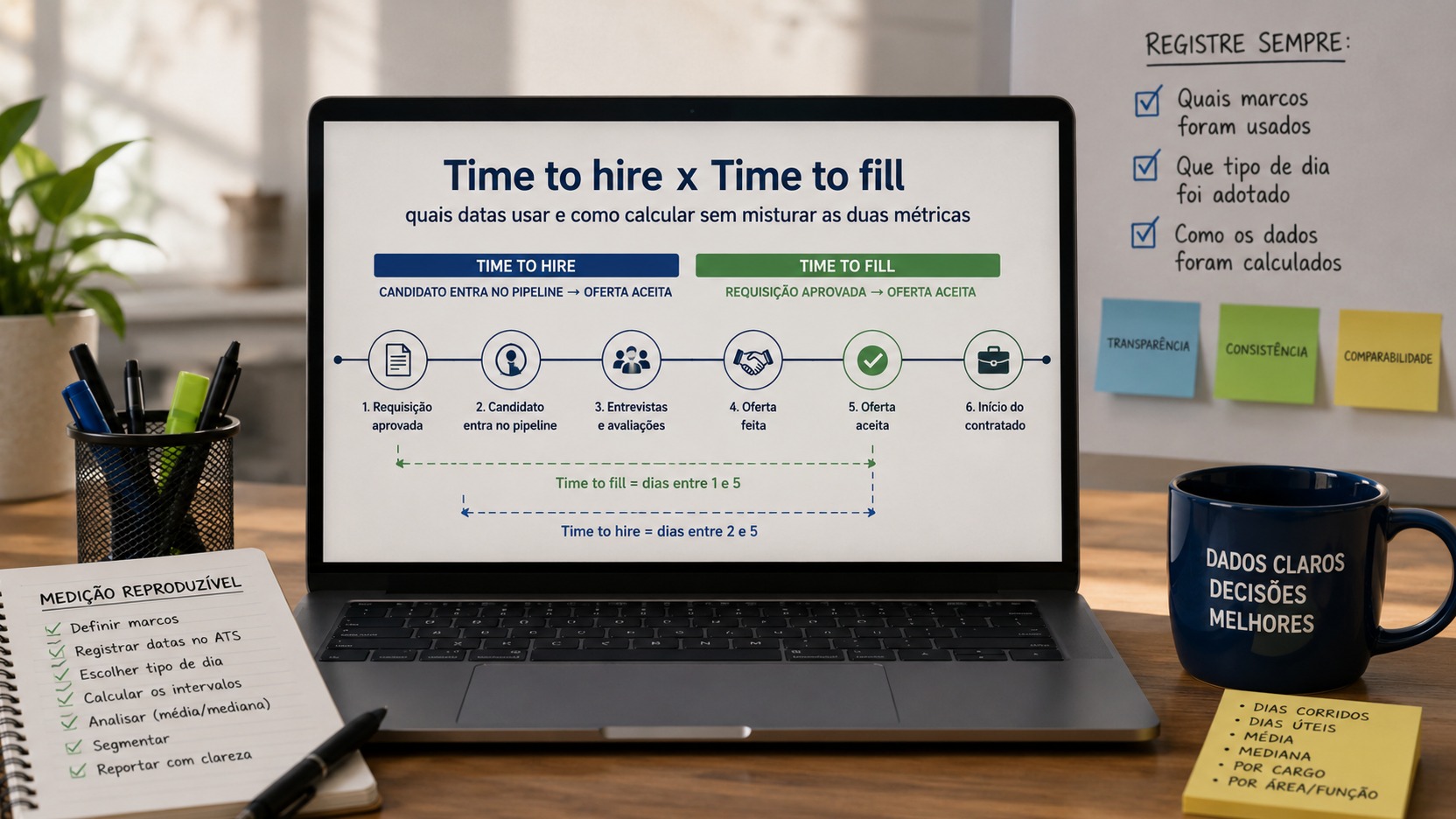
| Time to hire | How long does the process take to convert an active candidate into an accepted hire? | For this dashboard, count days between a defined entry point in the active funnel and offer acceptance; report the median and, when possible, the 75th percentile. | Accepted hires with valid timestamps in the period. | Improving the number by rejecting people too early, moving the start point, or mixing roles with very different complexity. |
| Human approval coverage | Did AI-influenced decisions pass through an identifiable human owner? | Decisions materially influenced by AI ranking, screening, or recommendations that record a human reviewer and outcome, divided by all such decisions. | All in-scope decisions where AI materially influenced advancement, rejection, prioritization, or a final recommendation. | Confusing “a human clicked” with substantive review or creating a rubber-stamp approval ritual. |
A fourth metric is useful as a diagnostic, but not as a standalone target: override rate, the share of AI recommendations that a human reviewer changes. If it is very high, the tool and criteria may be misaligned. If it stays near zero, there may be legitimate agreement — or simple rubber-stamping. The number needs sampling and context, not an isolated reward or penalty.
How to build quality of hire without inventing a universal formula
Quality of hire has no universal denominator because organizations value different outcomes. The safer approach is to define, before the pilot, which signals represent a good hire and when they can be observed. LinkedIn's quality-of-hire material shows that organizations use combinations of performance, retention, hiring-manager satisfaction, skills match, and other indicators.
A simple design can use three components: job performance on a standardized scale, retention after a window that makes sense for the business, and a structured manager assessment. Put the components on the same scale before averaging them and document the weights. If the business cannot measure three inputs reliably yet, two trustworthy inputs are better than a sophisticated index built on weak data.
The denominator is critical. Someone hired this month cannot be fairly compared with someone who has already completed twelve months if twelve-month retention is part of the index. Use mature cohorts: for example, all hires from a period who have completed the defined window. This makes the metric lagged, but it avoids rewarding outcomes that do not yet exist.
Also avoid turning quality of hire into a judgment about the individual employee. Later performance depends on selection, onboarding, management, role design, resources, and changing priorities. The index is for monitoring the hiring system, not for proving that one funnel step caused the outcome.
Time to hire: fix the clock before trying to speed it up
“Time to hire” is only comparable when its start and end points stay stable. For this dashboard, choose a point that represents the candidate's real entry into the active process — for example, when the person becomes eligible for human screening or when the application formally enters the funnel — and stop the clock at offer acceptance. The exact point can vary by organization; the important part is not changing it after seeing the result.
Use the median rather than the mean as the main number because a few very long searches can distort the average. The 75th percentile helps reveal the process “tail”: if the median falls but one quarter of hires remain extremely slow, the gain may be limited to the easiest cases.
Segment at least by job family, seniority, and location when those dimensions materially change the process. Mixing high-volume junior hiring with executive searches can produce a clean aggregate that is not actionable. Also document rules for requisition pauses, candidate unavailability, and internal hiring freezes; otherwise teams can clean the clock in incompatible ways.
Human approval: measure the ability to review, not obedience to AI
A human checkpoint is useful only if the person knows they are accountable, has access to the relevant evidence, and can disagree with the automated recommendation. The NIST AI Risk Management Framework playbook recommends defining roles and responsibilities in human-AI configurations and establishing procedures for AI oversight. The framework also notes that data about how often and why humans overrule AI outputs can be useful to analyze.
That is why the dashboard should measure coverage, not “agreement rate.” If internal policy requires human review for every final AI-influenced decision, expected coverage is 100%. But approval without minimum evidence is not enough. A lightweight audit trail can include owner, stage, decision, reason code, and a short rationale for overrides.
Override rate should be read together with qualitative samples. Overrides concentrated in one role family may point to misconfigured criteria. Zero overrides for months in a complex system may justify checking for rubber-stamping. Neither pattern, by itself, proves failure or success.
A compact dashboard a manager can actually run
| Indicator | Recommended cut | Cadence | Warning sign |
|---|---|---|---|
| Cohort quality of hire | Job family and seniority; mature cohorts only | Monthly or quarterly, depending on maturity window | Persistent decline after accounting for relevant changes in the role mix |
| Median time to hire + P75 | Job family, seniority, and location where applicable | Weekly or monthly | Median improves but P75 worsens, or gains coincide with more withdrawals/early rejections |
| Human approval coverage | Stages where AI materially influences a decision | Weekly or monthly | Decisions without a reviewer, generic ownership, or batch approval without a trail |
| Override rate | By stage, recommendation type, and job family | Monthly | Sudden change or an extreme pattern without an operational explanation |
If there is room for a fifth indicator, use a candidate-experience or candidate-loss measure — for example, withdrawal after an interview invitation — because internal acceleration does not help if the process increases dropout among qualified candidates. Even so, keep the core dashboard small; too many metrics create conflicting incentives and make it harder to diagnose what changed.
How to evaluate an AI rollout without making a causal claim
A before-and-after comparison is useful for monitoring, but weak for proving causation. During the same period, job volume, seniority mix, compensation, employer brand, recruiter headcount, or labor-market conditions may change. To reduce false conclusions:
- keep the same start, end, and denominator definitions;
- compare groups of roles that are similar in job family, seniority, and location;
- separate mature quality-of-hire cohorts from recent hires;
- annotate parallel changes in process, staffing, pay, and sourcing;
- when feasible, use a controlled pilot or staged rollout instead of only one aggregate before-and-after comparison.
The correct language is therefore “the indicator improved after implementation” or “the group using the new flow showed a different result,” not “AI caused the improvement” unless the design supports that inference.
Guardrails that do not fit inside a speed KPI
Automation in selection can also create accessibility and discrimination risks that do not appear in time to hire. In the United States, the EEOC maintains guidance on AI and disability and notes that algorithmic tools can improperly screen out applicants with disabilities; the agency has also published technical assistance on adverse impact in automated selection procedures. These are U.S. regulatory examples, not universal rules for other countries.
From a management perspective, that means the performance dashboard does not replace legal review, privacy work, accessibility, validation of selection criteria, or impact analysis across groups where that is lawful and appropriate in the relevant jurisdiction. A hiring decision can be fast and have documented human approval while still relying on a poor criterion.
The decision rule that avoids “bad speed”
A rollout is promising when time to hire improves without a consistent decline in mature quality-of-hire cohorts, while human-review coverage remains consistent with policy and risk signals stay under control. If speed improves and quality falls, the operational gain is buying a worse outcome. If quality improves without a large reduction in time, automation may still be valuable. If human coverage is perfect on paper but nobody ever challenges the system, check whether approval is substantive.
This reframes the question. Instead of asking “how many days did AI save?”, ask “did the funnel become more efficient without losing decision quality and human accountability?” It is slower to build that measurement system, but much less likely to reward shortcuts.