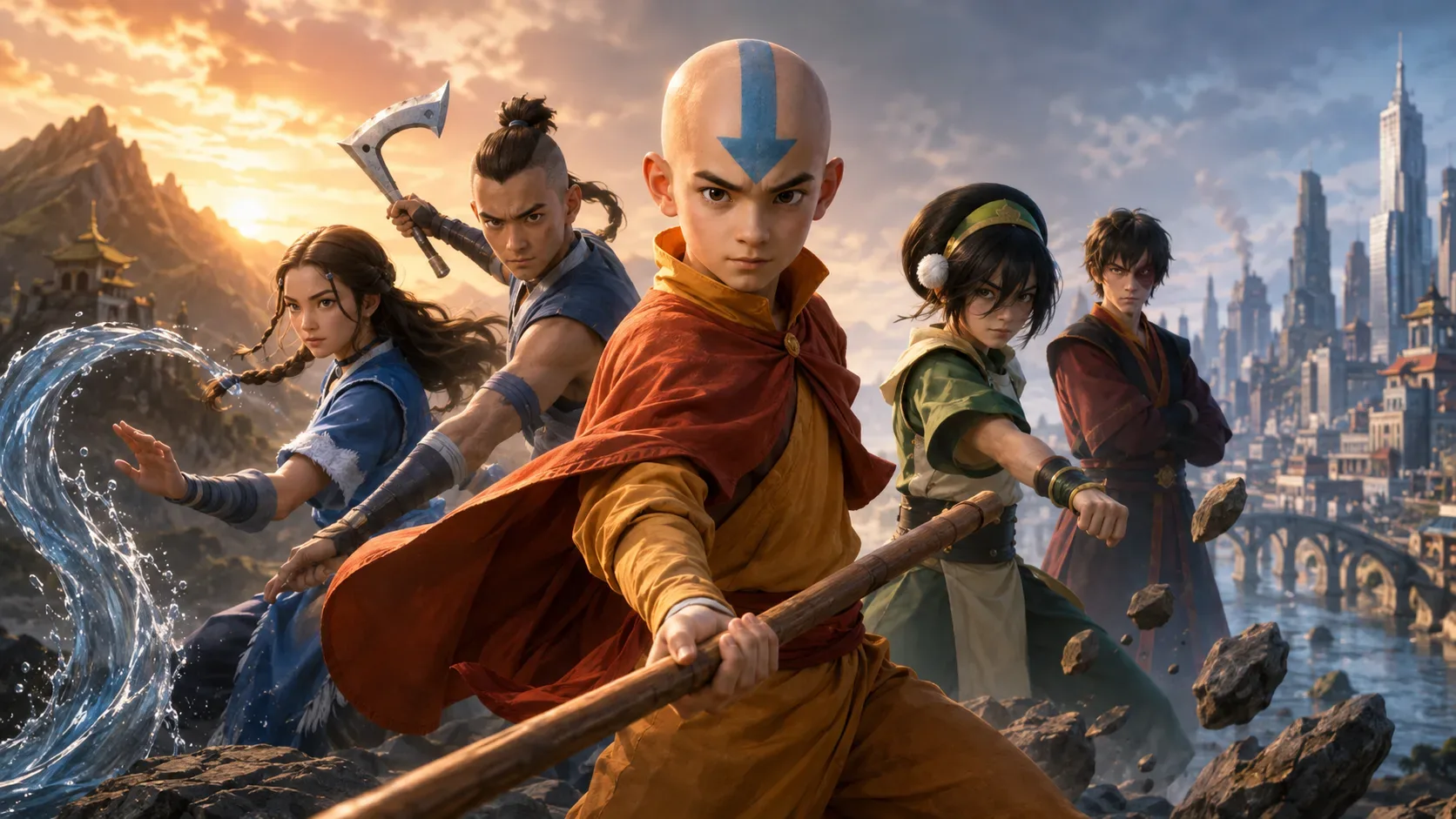
If the question is how much you need to watch or read before Avatar Aang: The Last Airbender, the short answer is: the original animated series is the only really important starting point. The comics add the political and social transition after the Hundred Years War, but do not need to be read before the film. The Legend of Korra is also not a prerequisite — chronologically, it happens later.
Paramount+ itself puts the internal order of the story this way: Avatar: The Last Airbender → Avatar Aang: The Last Airbender → The Legend of Korra. The film is officially described as a continuation of the original series and as a bridge towards the world that later appears in Korra.
This also resolves potential confusion caused by release order. Korra was shown between 2012 and 2014, long before the new film existed, but its story takes place approximately 70 years after the Aang series. The 2026 film goes back in time and follows Aang and his friends as adults, still during his era.
Where exactly does the 2026 movie come in
Avatar Aang: The Last Airbender premiered globally on Paramount+ on July 25, 2026. The story follows an adult Aang who discovers an ancient power potentially linked to the survival of his culture and sets out on a new journey with his friends.
The narrative takes place 13 years after the end of the original series, therefore long before Korra's time.
In simple terms, there are three big moments:
- Avatar: The Last Airbender shows the Hundred Year War and its conclusion.
- The comics and the 2026 film follow later stages of Aang's era.
- The Legend of Korra shows the result of many of these transformations decades later.
For those who prefer to discover the world in the order in which the characters live it, watching the film before Korra makes more sense. Anyone who has already seen Korra, however, does not need to go back or rewatch the series: they will only know in advance some general results of the evolution of this world.
Do I need to read the comics before Avatar Aang?
No.
Comics are official and important for continuity, but they mainly fulfill the function of filling the first years after the drawing.
Avatar Studios' official chronology places the main Aang-era comic books after the series: The Promise, The Search, The Rift, Smoke & Shadow, North & South and Imbalance.
Dark Horse, responsible for publishing, describes this line as an official continuation of the animation after Ozai's defeat.
This doesn't mean that six comic book arcs have become homework to understand a single film. Michael Dante DiMartino explained that Avatar Studios considers these stories part of the universe, although minor continuity adjustments may occur. The creators also said that the audiovisual projects would not be simple adaptations of the comics: new productions could take advantage of elements from them without directly retelling them.
In practice, the film jumps to a much later phase in the group's life and presents its own adventure.
What do comics add, then?
They are most useful in answering another question: how did the world at the end of The Last Airbender begin to transform into the one seen in Korra?
The Promise, for example, draws directly from the consequences of the Hundred Year War and the conflicts involving the former Fire Nation colonies. The Rift works on the tension between tradition, industrialization and the heritage of the Air Nomads. Imbalance shows Cranefish Town undergoing rapid industrialization and the official chronology itself highlights that this place anticipates the future Republic City.
For someone interested above all in this historical transformation, these arcs have a lot of value. For someone who just wants to get to the film without consuming dozens of additional stories, they remain optional.
What's really worth consuming before the movie?
| Work | Necessary before the movie? | What it adds |
|---|---|---|
| Avatar: The Last Airbender — original animation | Yes, strongly recommended | Introduces Aang, Katara, Sokka, Toph, Zuko, the Hundred Year War and the relationships that the film continues |
| Post-series comics | No | They show the first years of reconstruction and the political and technological evolution of the world |
| The Legend of Korra | No | It takes place decades later and reveals what Aang's world will eventually become |
| 2010 live-action film | No | It is a separate reinterpretation and does not belong to the animated canon, according to Paramount+'s own guide |
| Netflix live-action series | No | It is a new adaptation of the original story, not the animated sequel used by the film |
| Kyoshi, Yangchen and Roku Novels | No | Expands on previous eras of the Avatar cycle, but is not necessary preparation for this story |
The film also contains a brief re-presentation of the context of the original series, according to reviews published after its premiere. This helps those who haven't seen the cartoon for years, but it doesn't turn the film into a replacement for the three seasons: the relationship between the members of Team Avatar and the weight of what they experienced come directly from the series.
The minimum order for those who don't want to consume unnecessary content
If the goal is just to follow the main line from Aang to Korra, use:
- Avatar: The Last Airbender — the three seasons of the original animation.
- Avatar Aang: The Last Airbender — 2026 film.
- The Legend of Korra — four books/seasons.
This is the short route in chronological order.
The comics can be inserted between the original series and the film, but this is a choice of in-depth study, not a requirement.
What if I want some extra context without reading all the comics?
In this case, three stories have a greater yield for understanding the transformation of the world.
The Promise directly shows the difficulties of reorganizing territories after the war. The Rift brings Aang closer to the conflict between preserving Air Nomad culture and dealing with a modernizing society. Imbalance takes this change even further and offers one of the clearest connections to the political and urban landscape that later characterizes Korra.
It is not an “official reduced order”. It's just a thematic shortcut for those who want to understand the evolution of the world without going through the entire comic book production.
If you prefer to fully follow the post-series continuity, then it makes more sense to read the six major arcs in sequence: The Promise, The Search, The Rift, Smoke & Shadow, North & South and Imbalance. The order is consistent with the official chronology presented by Avatar Studios.
Does seeing Korra before the movie ruin anything?
Does not impede understanding. Millions of viewers discovered the franchise precisely in this order of release: original series, Korra and, many years later, the film.
But there is a difference between release order and chronological order.
Korra already shows consequences of decisions made during Aang's adult life: the political configuration of the world has changed, Republic City exists and the next generation is established. The 2026 film returns to an earlier stage of this process. Paramount+ explicitly recognizes this inversion: the film was released after Korra, but takes place before it.
Therefore, those who have not yet watched either work have a more natural progression following the original series → film → Korra. Anyone who has seen Korra doesn't need any special preparation to return to Aang's period.
The point at which it is worth stopping
For the purposes of this topic, there is no reason to turn Avatar into an obligatory marathon of series, comics, novels and adaptations.
Want to just watch the movie? Finish the original animation and you can skip straight to it.
Want to understand how the world has changed? Add comics.
Want to follow the main animated timeline? Watch Korra after the film.
The rest expands the universe, but should not be treated as a prerequisite.