The Butlerian Jihad is a remote event in Dune's past that explains one of the universe's defining features: humanity has advanced for thousands of years without relying on computers capable of imitating human thought. In Frank Herbert's original novel, the event appears mainly as historical memory, religious taboo, and the foundation of a social order that developed highly trained people to perform functions that other science fiction might assign to machines.
The most important distinction is this: the ban does not mean that all technology disappeared. Its target is the machine that reproduces or replaces capacities of the human mind. Dune society still uses spacecraft, shields, weapons, communications devices, and many specialized mechanisms. What it avoids is rebuilding the kind of mechanical intelligence associated with the trauma of the Jihad.
What the first Dune actually says about the Butlerian Jihad
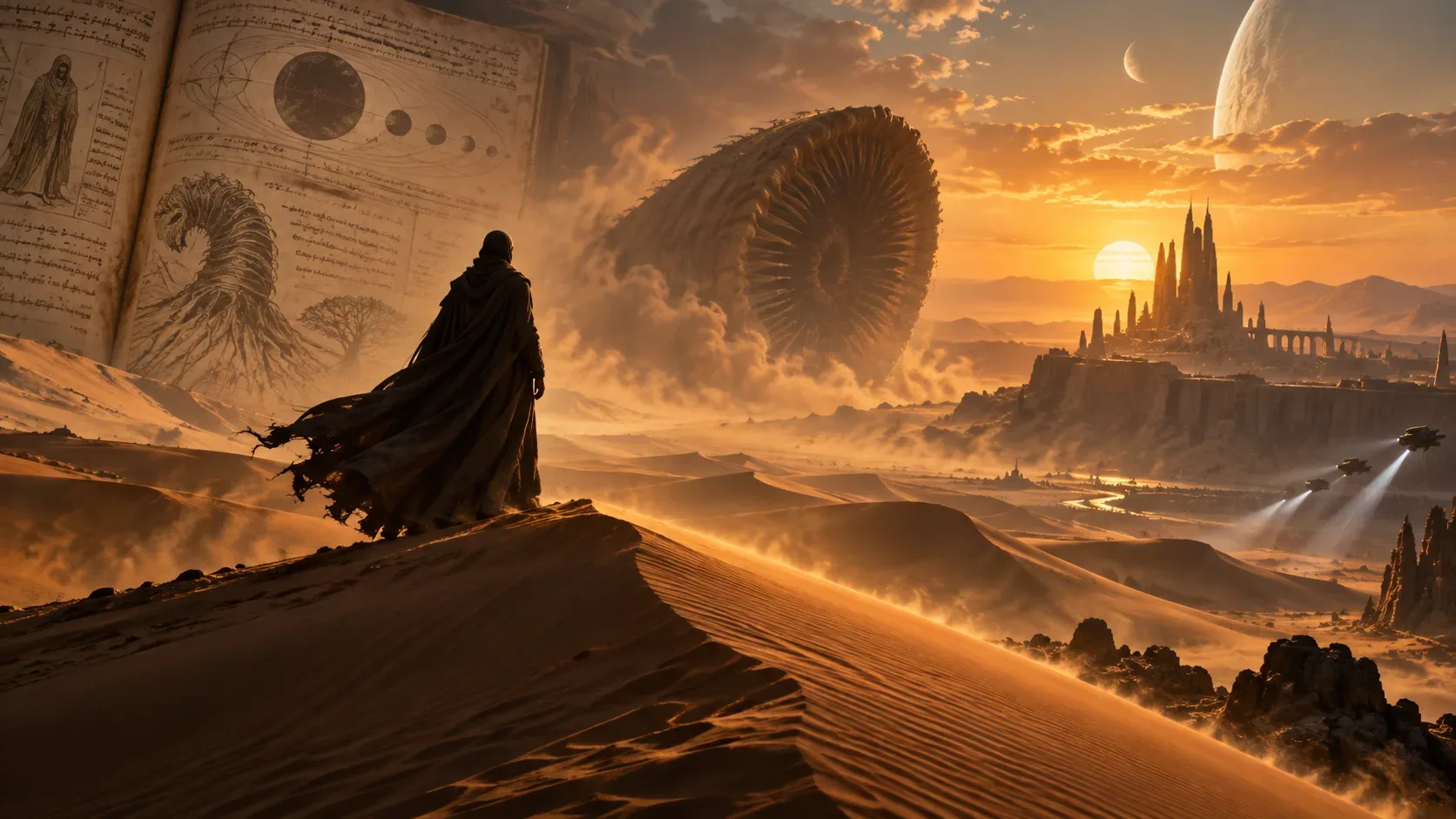
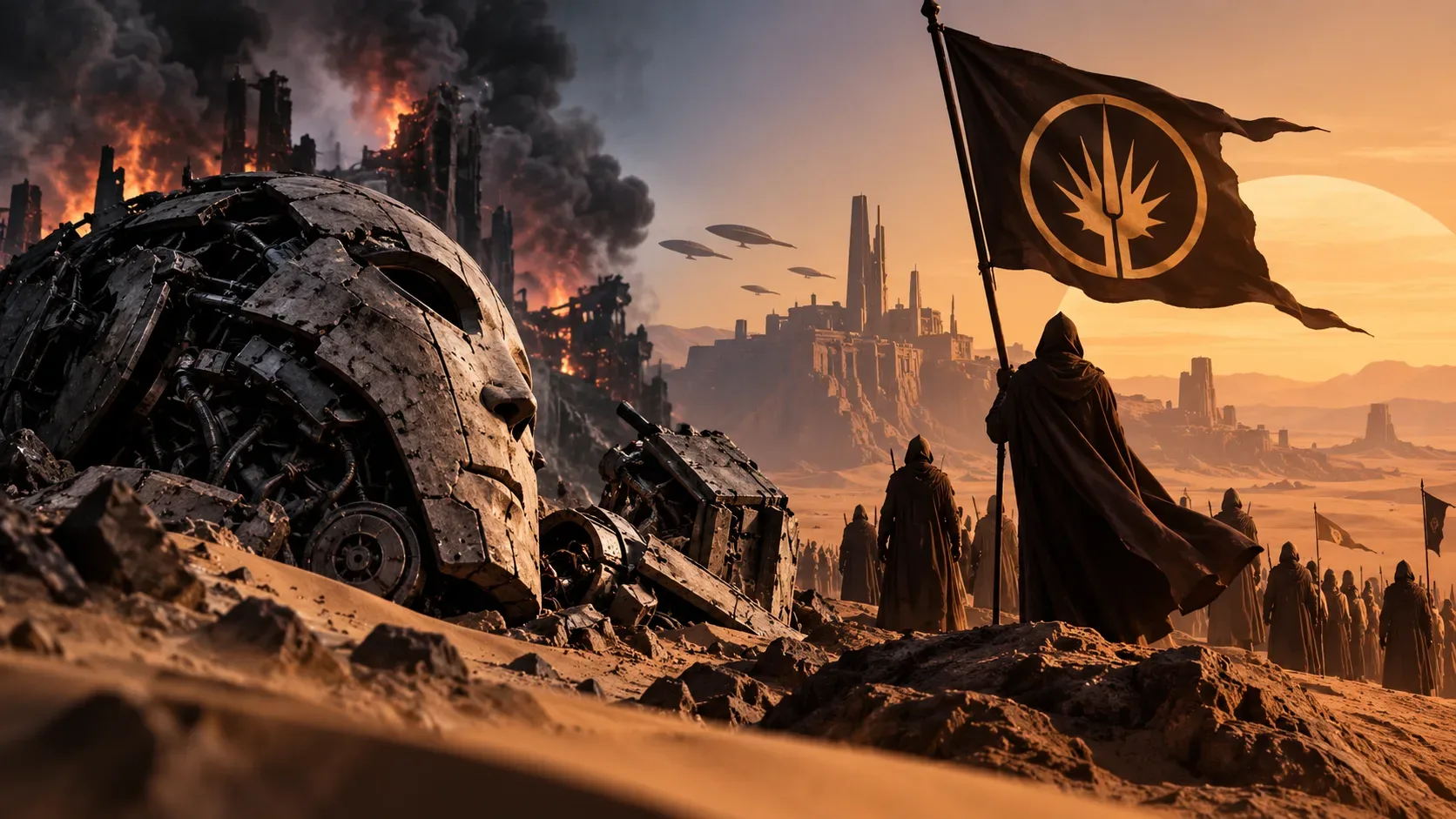
In Dune, published in 1965, Frank Herbert does not narrate the Jihad as a fully detailed war with a complete chronology of battles and characters. He presents its consequences. In a conversation between Paul Atreides and Reverend Mother Gaius Helen Mohiam, the novel explains that people turned their thinking over to machines hoping to become free, but instead allowed other people using those machines to enslave them. The conversation directly connects this past to the Orange Catholic Bible's commandment against creating a machine in the likeness of the human mind.
This passage matters because it makes the conflict more complex than a simple story of robots fighting people. At the core of the original novel, the problem is also political and cultural: delegating judgment and thought can concentrate power in the hands of those who control the systems. The Jihad therefore produces a civilization-wide rule against replacing the human mind with machines.
So what is a “thinking machine”?
Herbert's text leaves the expression deliberately broader than a modern technical specification. The religious formulation condemns machines made in the likeness of the human mind, and Mohiam herself reframes the idea as machines that counterfeit a human mind. Automatically equating “thinking machine” with every contemporary computer therefore oversimplifies the concept.
A careful reading separates specialized mechanical processing from systems that take over human reasoning functions. Dune depicts a technologically sophisticated civilization organized to keep certain decision-making, analytical, and cognitive abilities in human hands.
| Element | How it works in the Dune universe |
|---|---|
| Thinking machine | Subject to the great taboo when it imitates or replaces the human mind. |
| Mechanical and specialized technology | Remains present in transportation, defense, communication, and other activities. |
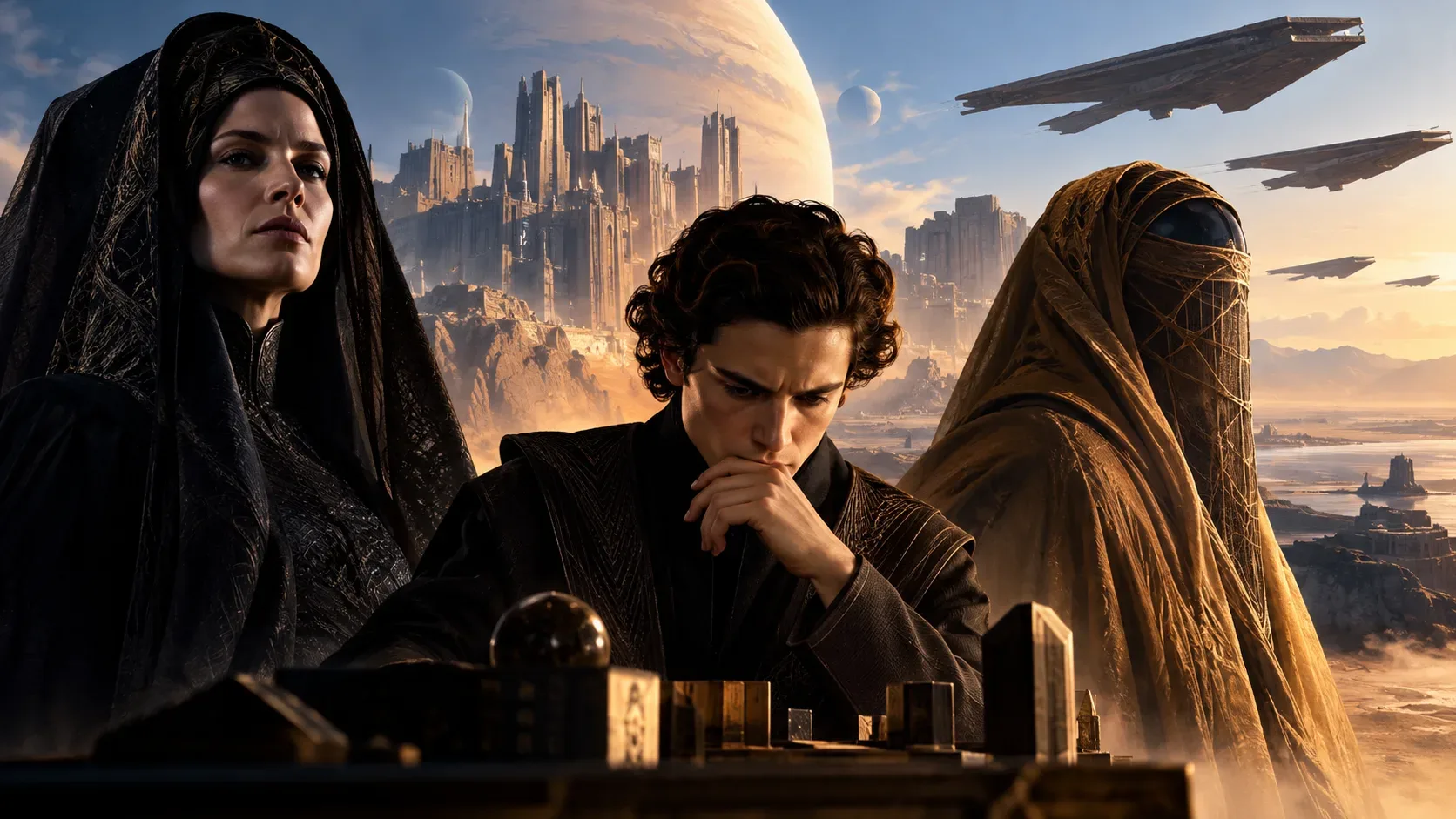
| Mentats | Humans trained for exceptional analysis, memory, and calculation. |
| Guild Navigators | Use human abilities altered by spice to make interstellar navigation viable. |
| Bene Gesserit | Develop memory, observation, bodily control, and other extreme human disciplines. |
Why the prohibition reshapes society
Removing machines that reproduce thought does not simply send civilization back into the past. Instead, it creates incentives to turn human beings themselves into specialized infrastructure. Mentats are the clearest example: they are trained to process information and advise rulers without dependence on thinking computers.
The same principle helps explain the importance of institutions such as the Spacing Guild and the Bene Gesserit. They are not merely mysterious groups surrounding the Atreides. They represent different paths of human development in a civilization that restricted certain forms of cognitive automation. Spice also becomes extraordinarily important because human capacities enhanced by it support essential structures of the Imperium.
The Butlerian Jihad did not ban every machine
This is the distinction that prevents the most confusion. Advanced technology in Dune does not contradict the Jihad. The universe contains ornithopters, personal shields, spacecraft, suspensors, weapons, and specialized devices. The cultural boundary is not “technology versus no technology,” but “tool versus substitute for the mind.”
Frank Herbert also does not provide a list of permitted and forbidden electronic components in the first novel. The rule operates as a religious, political, and social principle. Turning it into a precise contemporary regulation, as if the book specified which chips or algorithms would be legal, goes beyond what the text establishes.
What belongs to Frank Herbert's books and what came later
It is important to separate layers of continuity. Frank Herbert's six original novels treat the Jihad as a foundational past and provide references and reflections on its effects, but they do not tell a complete war narrative with the level of detail found in later works.
The Legends of Dune trilogy, beginning with Dune: The Butlerian Jihad in 2002 by Brian Herbert and Kevin J. Anderson, turns that past into an extended story of conflict against artificial intelligences and dominant machines. This expanded version adds names, factions, events, and a chronology that should not be retroactively treated as details explicitly narrated by Frank Herbert in 1965.
For readers, the practical rule is simple: an explanation focused on the taboo against machines that imitate the mind, humanity's former dependence on them, and the development of specialized human abilities stays close to the foundation established by the original novels. When detailed machine leaders, named figures, and extensively described battles appear, the discussion has usually moved into expanded material.
What about the Dune films?
Screen adaptations have to condense a universe that the books develop through dialogue, appendices, epigraphs, and historical references. Viewers can therefore understand recent films without receiving a complete lesson on the Butlerian Jihad. The absence of familiar computers and the emphasis on human training are part of the world's design even when the ancient history is not explained at length on screen.
It is also useful not to treat one adaptation as automatic proof of every detail in another continuity. Films, series, original novels, and expanded books may select, compress, or represent this past differently.
The Jihad's central effect on Dune
The Butlerian Jihad shifts the future imagined by Herbert. Instead of building a society in which increasingly powerful computers solve every problem, Dune asks what happens when humanity imposes a radical limit on machines that assume the role of the mind. The result is a future that combines advanced technology with extreme human specialization, powerful institutions, religion, training, and dependence on resources such as spice.
That is why Mentats, Bene Gesserit, and Navigators are not disconnected details. They help show how civilization reorganized itself after deciding that certain tasks should not again be surrendered to thinking machines.
Sources and limits of the evidence
The safest basis for the rule is Frank Herbert's Dune itself. An official excerpt provided by Penguin Random House reproduces the conversation between Paul and Mohiam about people surrendering thought to machines and the prohibition on machines resembling the human mind. Academic work also connects the Jihad to the role of Mentats and the cultivation of human capacities.
See the official Dune excerpt from Penguin Random House and an academic chapter on thinking machines and Mentats in Dune and Philosophy. When investigating the war in detail, always check whether a claim comes from the original novels, the expanded universe, or an adaptation.