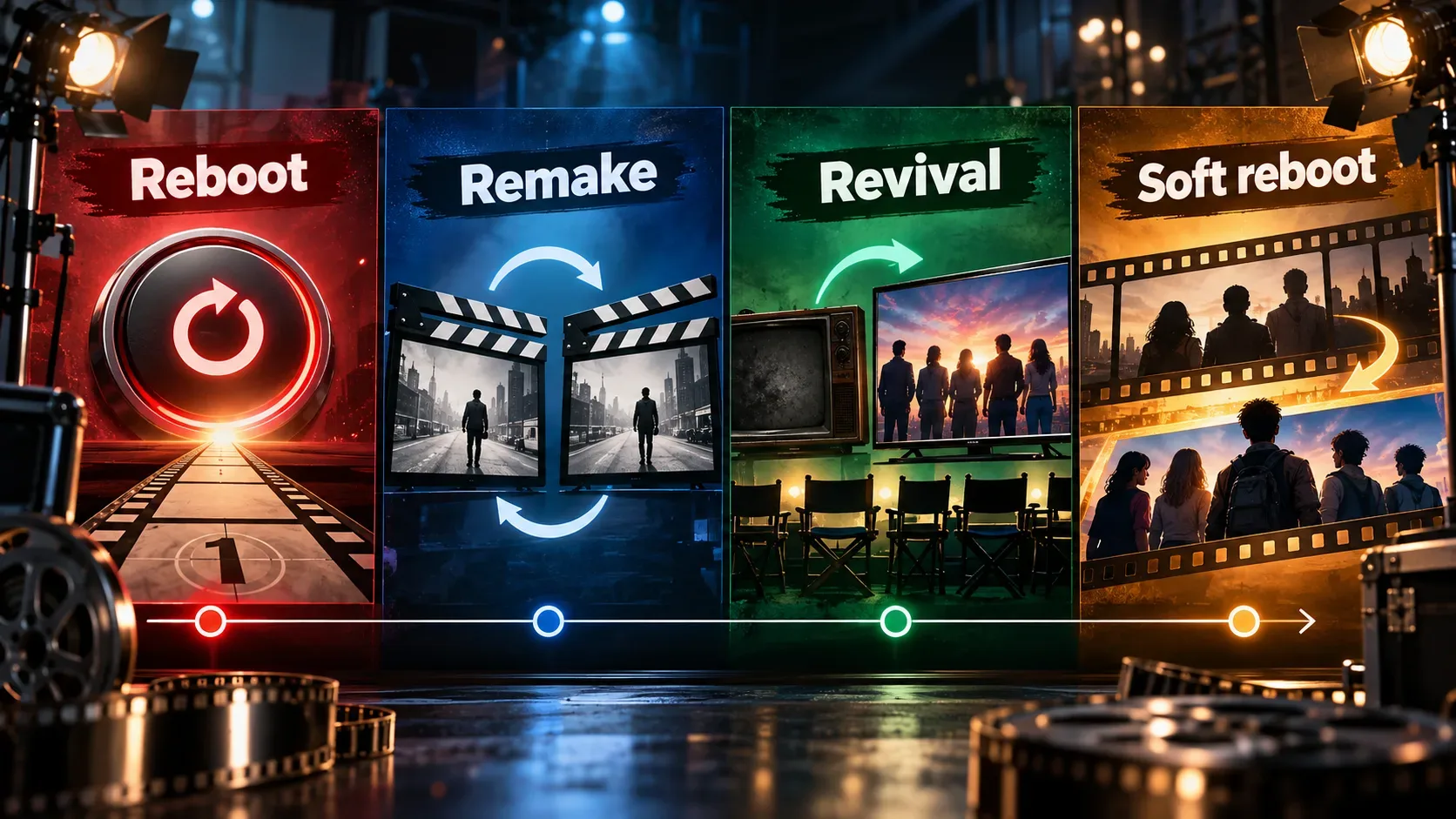
Reboot, remake, revival and soft reboot are not four names for the same thing. The safest way to tell them apart is to ask what the new work does with the previous continuity. A reboot opens a new continuity; a remake retells a story that has already been told; a revival brings a work back after a break while preserving its continuity; and a soft reboot refreshes the franchise without completely erasing the earlier canon. Cast, title and nostalgia can provide clues, but none of them is decisive on its own.
The difference in one sentence
The terms become clearer when repeated story is separated from preserved continuity. Remake mainly answers the question "is this work telling an earlier story again?". Reboot answers "does this new phase still treat the old continuity as valid?". Revival asks "is the same work or narrative returning after an interruption?". Soft reboot sits in the middle: it keeps a meaningful part of the past but reorganizes characters, focus or the entry point to launch a new phase.
| Term | Does it retell the same story? | Does it keep the earlier canon? | Does it reuse cast members? | Does it continue the timeline? | Typical function |
|---|---|---|---|---|---|
| Reboot | Not necessarily | Generally no | It can, but that is not required | Not as a continuation of the previous version | Restart the franchise in a new continuity |
| Remake | Yes, in essence | That is not the central criterion | It can, although recasting is common | No: it retells rather than advances | Create a new version of an earlier story |
| Revival | No | Yes | Usually brings back a meaningful part of the cast or characters | Yes, even after a time jump | Bring a work or series back after a break |
| Soft reboot | No | Partly or selectively | Often mixes legacy and new figures | Usually yes, but with simplification or redirection | Refresh the franchise without starting entirely from zero |
Reboot: the franchise starts again in a different continuity
In the most useful sense for film and television, a reboot is not merely "a new version". It restarts the narrative sequence. The older work still exists for the audience, but the events of that continuity no longer function as required history for the new version. In Reboot Culture, William Proctor treats this discontinuity as central to the concept: a reboot establishes a new sequence instead of continuing the previous one.
This means a reboot can reuse familiar characters, locations, concepts, conflicts and visual elements without preserving the earlier chronology. The point is not to forget the intellectual property. The point is that the new work does not have to behave as "the next chapter" after the events that already happened.
Cast does not settle the classification either. A reboot may replace every actor, but it can also reuse a performer in another role or keep someone for creative or commercial reasons. If continuity has been restarted, a familiar face does not automatically turn the project into a continuation.
Remake: the main question is whether the story is being made again
A remake operates on a different dimension. In a basic sense, dictionaries such as Collins define a film remake as a new production that tells the same story as an earlier film, often with the same title. In practice, the new version can change setting, period, tone, genre, technology, length, point of view or cast and still be recognized as a remake.
That is why remake and reboot can overlap, but they are not synonyms. A remake can simply be a new standalone version of one work. A reboot, by contrast, is a decision about the continuity of a franchise or serial universe. If a new production retells the opening story and also intends to launch a new series that disregards the old continuity, both labels may apply.
The practical test is simple: if the central novelty is "we are telling this story again", think remake first. If the central novelty is "we are starting this franchise again with a different continuity", think reboot first.
Revival: the work returns, but the past still counts
Revival is especially common in television. The basic idea is the return of a series or fictional format after a period off the air. In distinctions used by specialist TV press, a revival shares continuity with the original series and usually brings back at least some of its characters or cast.
A five, ten or twenty year time jump does not turn a revival into a reboot. On the contrary, characters aging, consequences from the earlier ending and changes that occurred during the gap can become part of the story. The new season or limited series exists because the past happened.
It is also unnecessary for the entire original cast to return. Character deaths, actor availability, changes in focus and new protagonists can all coexist with a revival. The stronger criterion is recognized narrative continuity, not a minimum percentage of returning performers.
Soft reboot: refresh without completely erasing canon
Soft reboot is the most flexible term of the four. A University of Glasgow dissertation devoted to the subject proposes the retention of some level of franchise canon as its defining characteristic. Instead of deleting everything, the work preserves part of the continuity and uses that past selectively while creating a new entry point.
A soft reboot commonly introduces new leads, reduces the amount of prior knowledge required, changes tone, simplifies mythology or moves veteran characters into supporting roles. The franchise remains connected to what came before, but the project is designed to feel like the beginning of a new phase.
This is why soft reboot often overlaps with expressions such as legacy sequel or requel. A work can be both a continuation of older events and an attempt to reposition the brand for a new generation. Because there is no official industry taxonomy, the label depends on which aspect is being emphasized.
Cast, title and nostalgia are clues, not rules
Four shortcuts commonly cause confusion:
- "It has old actors, so it is a revival." Not necessarily. A soft reboot can also bring back veteran characters, and a reboot can reuse performers without preserving continuity.
- "It has the same title, so it is a remake." Titles can be reused in reboots, continuations and revivals. What matters is the narrative relationship with the earlier work.
- "It tells the origin again, so it is a remake." It may be, but a reboot can also retell an origin to inaugurate a different continuity. In that case, the labels can coexist.
- "The story takes place many years later, so it is a reboot." Temporal distance does not erase canon. If earlier events still count, continuity remains.
How to classify a project without relying on marketing
The industry itself uses these terms inconsistently. In 2026, Variety reported that studios sometimes avoid or reframe words such as "sequel", "reboot" and "remake" for positioning reasons, in part because some projects sit in gray areas and the labels carry audience expectations. Promotional wording is therefore not always the best tool for understanding narrative structure.
- Ask whether earlier events are still valid. If they are not, that is a strong reboot signal. If they are, move to the next questions.
- Ask whether the new work is substantially retelling a specific story. If yes, that is a strong remake signal.
- Ask whether the same series or narrative is returning after a break. If yes and the earlier continuity remains, revival is a likely description.
- Ask whether the past still exists but the work shifts its center of gravity to make a new phase easier to enter. If yes, soft reboot is a useful description.
Hybrid cases are normal
The categories do not form four completely sealed boxes. Research on reboots emphasizes that the vocabulary of franchise regeneration is porous and often used inconsistently. A production can retell a story and simultaneously restart a franchise. Another can preserve canon while also functioning as a soft reboot because it shifts the lead role and reduces dependence on earlier installments.
Instead of searching for one absolute label, it is more useful to explain which dimension is being described. "It is a remake because it retells the story" and "it is a reboot because it launches a new continuity" can be compatible statements about the same work. Confusion arises when the terms are treated as equivalent without explaining what changed.
Practical summary
To avoid mixing up the four terms, use continuity as the first filter. A reboot starts another continuity. A remake makes an earlier story again. A revival resumes a work while keeping the past inside the narrative. A soft reboot keeps a meaningful share of that past but reorganizes the franchise to open a new phase. Cast, title, aesthetics and nostalgia can help identify the format, but they work better as supporting evidence than as rules.
Sources and references
- Springer Nature: William Proctor, Reboot Culture: Comics, Film, Transmedia
- University of Glasgow: Scott McDonald, Contemporary franchise revitalisation: The soft reboot
- Collins English Dictionary: remake definition
- TVLine: practical distinction between TV reboot and TV revival
- Variety: industry use and ambiguity of terms such as sequel, reboot and remake