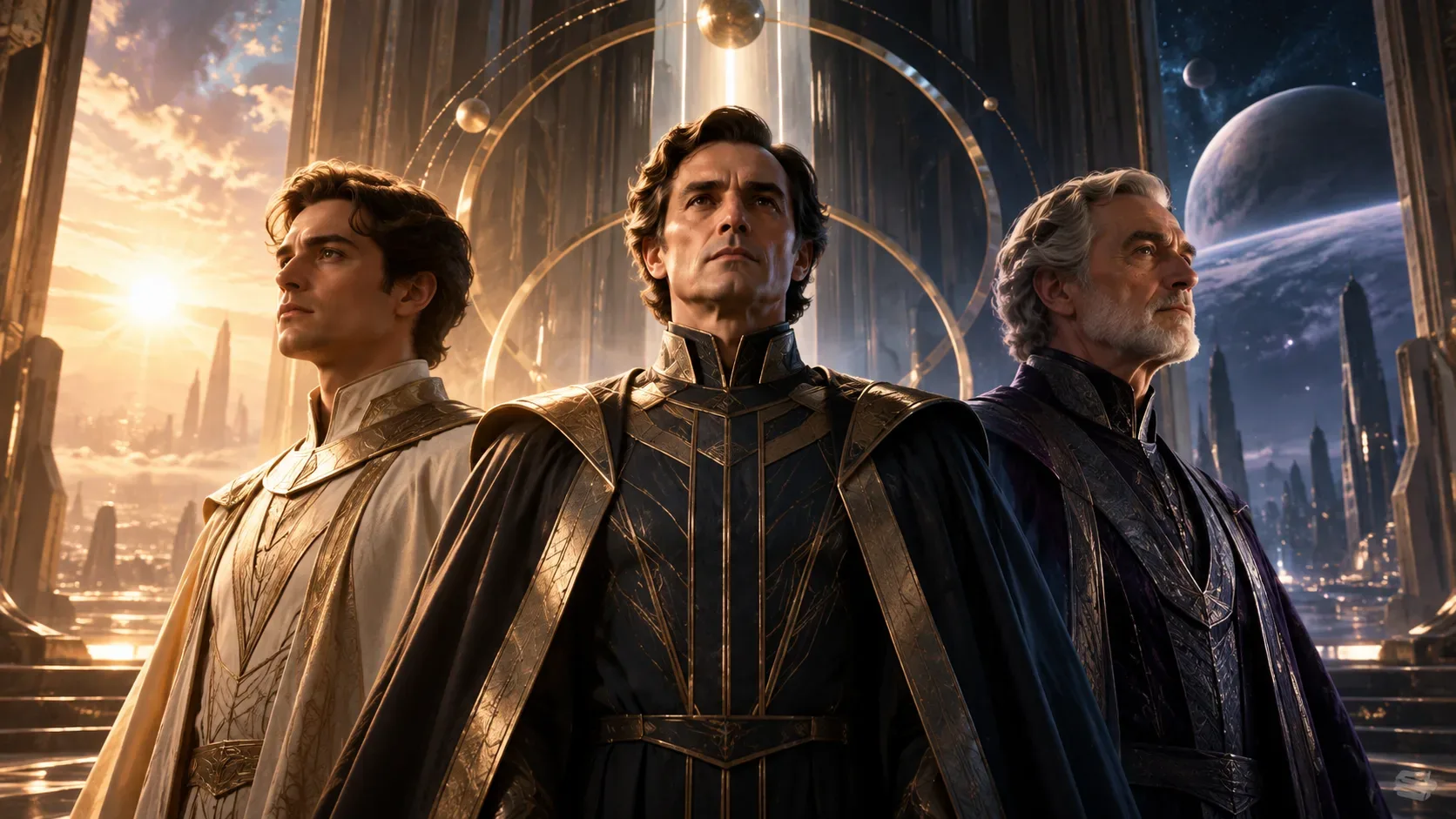
In Foundation, Brother Dawn, Brother Day, and Brother Dusk are not three ordinary members of an imperial family. They are clones of Cleon I at different stages of life and together form the Genetic Dynasty that rules the Galactic Empire. The idea allows the regime to present the same figure of power generation after generation, even though each clone remains an individual shaped by his own experiences.
Who are Dawn, Day, and Dusk?
The three names function primarily as positions within the imperial cycle. Skydance's official page describes the Cleons as a long line of cloned emperors, while Apple lists Brother Dawn, Brother Day, and Brother Dusk among the series roles.
| Position | Stage | Role in the cycle |
|---|---|---|
| Brother Dawn | Youngest Cleon | Grows up and is prepared to occupy the central position in the future. |
| Brother Day | Adult Cleon | Serves as the main face of imperial power and holds the trio's central authority. |
| Brother Dusk | Oldest Cleon | Represents the accumulated experience of the previous cycle and serves as the regime's senior figure. |
Dawn, Day, and Dusk therefore should not be read as fixed personal names. The same Cleon can occupy different positions over the course of his life. The first season itself depicts this transition and makes ascension part of the court's operation.
How does succession in the Cleon Dynasty work?
The system tries to turn succession into continuity. Instead of an emperor dying and being replaced by a genetically different heir, the Empire simultaneously maintains young, mature, and elderly versions of the same genetic template. When the cycle advances, the positions advance as well: the younger Cleon assumes the role of Day, the former Day moves into the Dusk position, and a new generation enters as Dawn.
This structure explains why viewers can encounter Cleons with different numbers performing the same role in different eras. “Brother Day” is a recurring position, not the exclusive identity of one clone. The same principle applies to Dawn and Dusk.
Are the three Cleons the same person?
Genetically, the dynasty was designed to reproduce Cleon I. Narratively, however, the series explores the tension between copying and individuality. Age, experiences, relationships, and decisions can distinguish one Cleon from another even when the regime depends on the idea of permanence.
This distinction matters when following the story: genetic similarity does not mean every Cleon has exactly the same personality, lived memories, or path. The imperial project seeks continuity, but individuals still face different circumstances.
Why are there three Cleons at the same time?
The trio makes the regime's continuity visible. Dawn represents preparation and the future; Day concentrates present rule; Dusk represents experience and the closing of the cycle. The Empire therefore keeps successor, ruler, and senior figure inside a single political architecture.
The choice also solves a dramatic problem for the adaptation. Foundation spans major jumps in time, and showrunner David S. Goyer has explained that the Genetic Dynasty was created to give the Empire recurring characters and embody its resistance to change.
Does the Genetic Dynasty exist in Isaac Asimov's books?
Not in this form. Goyer says the idea of extending Cleon into a line of cloned emperors was developed for the television series. Asimov's novels provide the universe, the Empire, and characters named Cleon, but the television system of Dawn, Day, and Dusk as three simultaneous clones is an invention of the adaptation.
This distinction prevents a common misunderstanding: the series is not simply visualizing an institution already described this way in the novels. It uses a television invention to dramatize a central idea associated with the Empire, its attempt to preserve stability and continuity in a history moving toward change and decline.
How can you tell the Cleons apart?
- Start with the role: Dawn is the youngest, Day occupies the center of power, and Dusk is the oldest.
- Then check the generation: Cleon numbers distinguish individuals within the clone sequence.
- Do not treat the title as a permanent name: a Cleon can change positions when the succession cycle advances.
- Separate genetics from identity: the project seeks copies, but the series uses differences among the clones as part of its conflict.
In short
Dawn, Day, and Dusk are three simultaneous positions in the Cleon Genetic Dynasty of the television adaptation of Foundation. The system keeps a young Cleon in training, an adult Cleon at the center of government, and an older Cleon as the senior figure. As the cycle advances, individuals move into new positions and a new copy enters the structure. This clone dynasty is a creation of the series rather than a literal reproduction of the imperial system in Asimov's novels.
Sources: Skydance, Foundation Season 1; Apple TV, Foundation; David S. Goyer, Foundation Q&A.