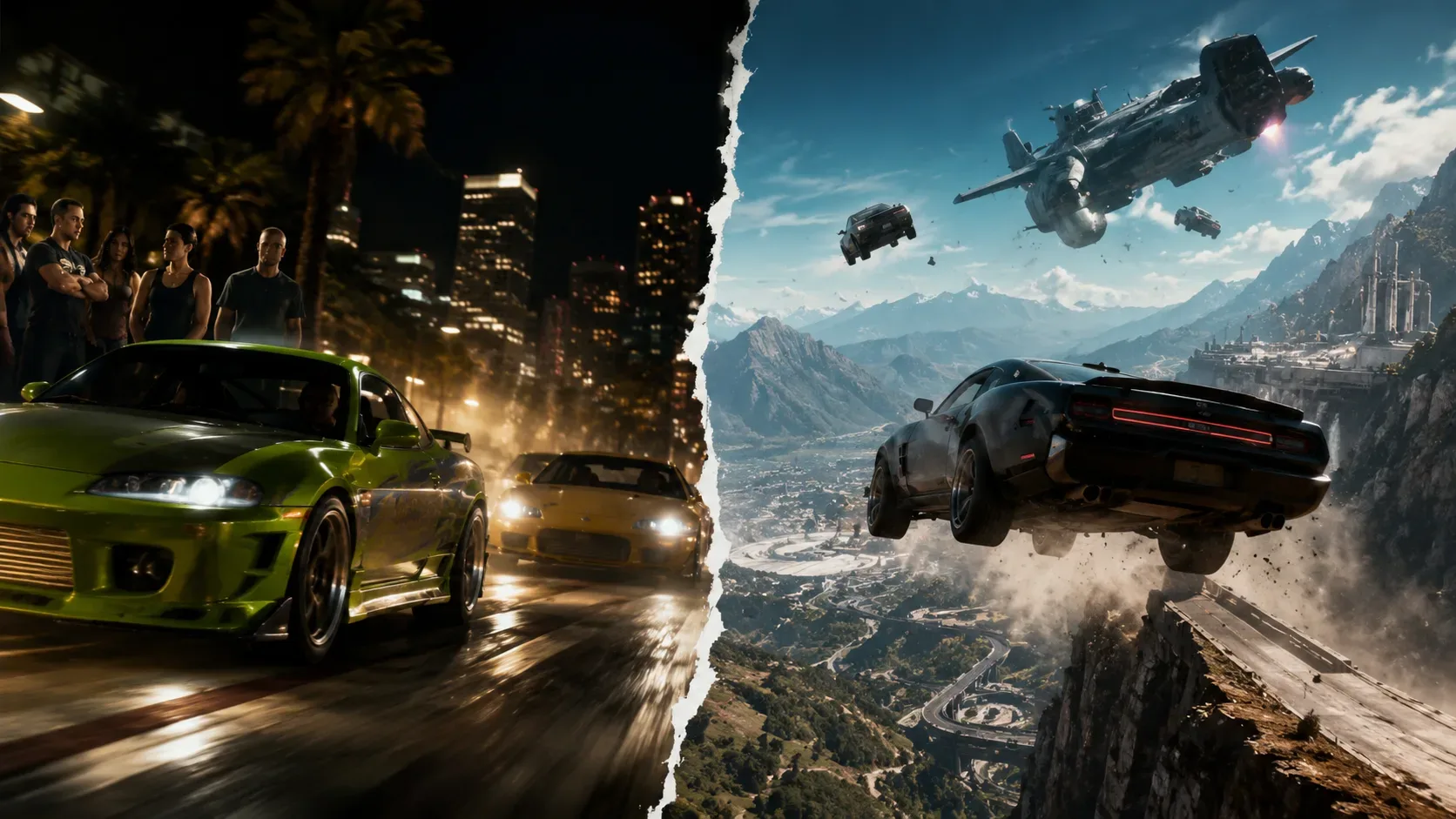
Before sending cars into space, chasing nuclear submarines, and taking on secret organizations, The Fast and the Furious was a relatively small crime story about trucks, DVD players, illegal racing, and an agent who no longer knew whose side he was on.
The first film premiered in the United States on June 22, 2001. To celebrate 25 years, Universal announced a new remastered 4K edition, with Dolby Vision, Dolby Atmos and an unprecedented retrospective, for physical media and digital platforms on August 25, 2026. Separately, the film's return to North American cinemas was scheduled for August 21, 2026. Until the conclusion of this investigation, there was no equivalent official confirmation for Brazilian rooms. sary also arrives as Universal prepares Fast Forever, announced for March 17, 2028 as a sequel to Fast X. Vin Diesel has publicly associated the closure with a return to his origins in Los Angeles, but narrative details should still be treated as preliminary disclosure, not as fait accompli about the final script. The following text contains spoilers for the entire saga, especially the 2001 film, Fast Five, F9 and Fast X.**
Why the first film feels like it belongs to another franchise
The answer isn't just in the size of the explosions. What changed was the very function of the cars, the protagonists, the police, the family and even death within the narrative.
Director Rob Cohen later described his film as a colorful crime drama set in a subculture still largely unexplored by cinema. He also openly acknowledged the structural influence of Thrill Hunters: a police officer infiltrates a charismatic group of criminals, creates bonds with its members and needs to choose between the law and loyalty. The rupture remains visible in 2001. The subsequent franchise transformed the same characters into a traveling team capable of taking part in international heists, intelligence operations and global crises. A retrospective published by The New Yorker in April 2026 summarizes this trajectory as the transition from a medium-scale production to a global mythology of informal agents, extravagant villains and increasingly unrealistic survivals. , seven comparisons show exactly what was left behind.
1. The crime started with consumer electronics, not the fate of the planet
The 2001 scene
The film begins with three black Honda Civics surrounding a moving truck. The robbers shoot a cable at the windshield, approach one of the cars to the cabin and break into the cargo.
The investigation led by Brian O’Conner involves the theft of electronics transported by truck drivers. DVD players, digital cameras and home entertainment devices serve as valuable and recognizable merchandise for the 2001 audience. The director explained at the time that the robbery plot was incorporated because just a succession of races would not sustain the entire film. helps keep the conflict concrete. Criminals need roads, modified cars, buyers and a repeatable method. Violence also produces an understandable reaction: truck drivers begin to arm themselves because they believe the police cannot protect them.
What came next
In the following phases, the coveted object ceased to be a commercial cargo. The series began to revolve around million-dollar coffers, global surveillance systems, technological weapons, codes capable of controlling satellites, nuclear devices and biological threats.
In Fast & Furious 8, Universal's own synopsis defines the group as an “elite force” that crosses Cuba, New York and the Barents Sea to prevent an anarchist from causing chaos on a global scale. Fast X, in turn, spreads the characters from Los Angeles to Rome, London, Brazil, Portugal and Antarctica. is not just quantitative. In the first film, cars allow you to commit a crime. In later chapters, driving well becomes a kind of superpower necessary to save the world.
2. Brian was the protagonist; Dom was still the mystery
The 2001 scene
Although Dominic Toretto is the film's most magnetic presence, it is Brian who drives the narrative. The public discovers the races, the workshop, the Toretto house, the barbecue and the rivalry with Johnny Tran from the undercover police officer's point of view.
Brian needs to gain access to the group. He loses the first race, owes money on his car, helps Dom escape a police raid and starts going to his house. Each approach improves the investigation, but also weakens your willingness to hand over the suspects.
Dom, at this stage, is not a fully deciphered hero. He could be the leader of the robbers, a victim of misguided suspicion, or both. The tension depends on Brian and the audience not knowing how far their responsibility goes.
What came next
After the reunion of the original cast in Fast & Furious 4 and, above all, in Fast Five, Dom becomes the moral center of the saga. The doubt about his criminality loses importance. The character no longer needs to be investigated and starts to be followed.
Brian gradually abandons his role as mediator between police and runners. After Fast & Furious 7, he remains alive within the story, but retired from missions. Dom takes on the role of patriarch, strategist, father and main target of the villains.
Inversion can be summarized by endings. In 2001, Brian makes the decisive decision to hand over the keys to his car so that Dom can escape. In the later films, almost all the big choices are made by Dom, while the other characters organize themselves around their family, their secrets or their enemies.
3. The police are no longer the structure of the conflict
The 2001 scene
Brian is not a generic undercover adventurer on his own. He responds to a task force, receives demands from superiors and needs to produce results before new robberies end in deaths.
The investigation progresses through recognizable procedures: surveillance, parts identification, vehicle analysis, interrogations, search for suspects and institutional pressure. When Brian breaks into Johnny Tran's property and finds several electronic devices, he interprets the discovery as evidence — before learning that the merchandise had been purchased legally.
This error is important because it shows a police officer tainted by his personal preference. Brian wants Tran to be guilty because that would absolve Dom. The dilemma is not just “family versus enemies,” but professional duty versus affection and desire.
What came next
The saga gradually replaced police stations and task forces with secret agencies, autonomous operators and temporary alliances. Luke Hobbs starts out as a persecutor, but becomes an ally. Mr. Nobody recruits the team for clandestine missions. In Fast X, the Agency is already a recurring structure, with internal divisions, international resources and its own interests.
The law, therefore, fails to define the moral limits of the protagonists. It becomes another faction of the narrative universe. Cops can chase Dom in one movie, help him in the next, and join his desk later.
In the original, letting Dom escape destroys Brian's career. In the espionage phase, disobeying authorities is often just a necessary step before the team proves they were right.
4. Racing stopped moving history
The 2001 scene
The first night run is not a visual break. It establishes almost everything:
- Dom is the local champion;
- Brian still hasn't mastered that environment;
- a car can function as a bet and social currency;
- winning generates prestige;
- losing creates a debt;
- helping someone after the race can be worth more than crossing the finish line.
In Race Wars, another dispute produces narrative consequences. Jesse bets the car against Johnny Tran, loses and escapes without fulfilling the agreement. The race directly fuels the conflict that will lead to the attack on the Toretto home.
Even the brief fight between Brian's Toyota Supra and a Ferrari serves to show that the group's rebuilt car is ready. Races are tests of skill, belonging, reputation and character.
What came next
The series did not completely abandon disputes. Cuba, London, Rio and Los Angeles still host races, chases and references to the quarter mile. But they become nostalgic overtures, rituals between characters, or small steps within much larger operations.
The turnaround was deliberate. During the launch of Fast Five, executives and screenwriters were already discussing expanding the franchise beyond automotive culture. The objective was to build robbery stories in which the cars were tools of the operation, and not necessarily the main subject. dragged through the streets of Rio perfectly represents this transition. Driving skills remain essential, but the question is no longer “who is the best driver?”. The question is “how will this team steal millions, defeat a powerful criminal and escape an international police force?”
5. The bodies, the cars and the consequences were more fragile
The 2001 scene
The first feature already exaggerates. The use of nitrous oxide visually dilates time, speeds seem incompatible with some streets and the climax places a Dodge Charger and a Toyota Supra in front of a moving train.
Even so, there is a lingering feeling of vulnerability.
Brian's Mitsubishi Eclipse is destroyed. The truck robbery ends with Vince seriously injured. Jesse is killed outside Dom's house. The Charger rolls over, and Dom has to be pulled from the wreckage. Error costs money, freedom, blood or life.
Cars also carry material limits. They break, burn, are seized, staked or rebuilt. The garage and workshop are important because the machines do not recover on their own between one scene and another.
What came next
The climb goes through the safe in Fast Five, jumping between skyscrapers in Fast & Furious 7, chasing a submarine in Fast & Furious 8 and reaching the Pontiac Fiero sent into space in F9. Director Justin Lin stated, during the promotion of the ninth film, that the team sought to continually push the limits of the franchise and find an emotional justification for each new absurdity. changes along with the shows. Characters survive falls, collisions, explosions and apparent deaths that would have definitively ended their trajectories in 2001. Roman even questions within F9 how the group manages to escape so many missions alive.
This brings the series closer to superhero comics: death can be reversed, physics is negotiable, and the main body exists less to be threatened than to endure the next display of scale.
6. “Family” was an unstable relationship, not an institution
The 2001 scene
The barbecue at the Toretto house contains the image that would become the franchise's signature: food, parked cars, friends and a shared table.
But that family is far from harmonious.
Vince distrusts Brian and feels jealous of his closeness to Mia. Jesse accumulates debt and acts impulsively. Letty and Mia have different ties with Dom. Leon participates in the group, but does not receive the expansive trajectory granted to other characters. When the truth about the robberies emerges, Brian must convince Mia to help him save his own brother.
The family is, therefore, a specific social group, subject to jealousy, hierarchies, exclusions and ruptures. Brian doesn't automatically belong there. You need to conquer space and, in the end, make an irreversible choice to prove your loyalty.
What came next
In later chapters, the family stops designating only the residents and regulars of the Toretto house. It becomes a moral principle capable of incorporating Miami runners, Tokyo characters, hackers, agents, former adversaries and unknown relatives presented retroactively.
The barbecue also changes its function. It stops being just an everyday scene and becomes the closing ceremony of missions. The table confirms who has been accepted, pardoned, recovered or reinstated.
This expansion provides emotional continuity to the franchise, but reduces some of the original ambiguity. In 2001, Brian fears he is protecting criminals. Afterwards, the word “family” usually works as sufficient justification for the public to accept unlikely alliances and accelerated acquittals.
7. The crime thriller became a serial action mythology
The 2001 scene
The first film has a central mystery, a limited number of suspects and a divided protagonist. Its structure could exist without continuations.
Brian identifies the robbers. The latest robbery goes wrong. Jesse is killed. Dom confronts Brian and then suffers the accident with the Charger. By handing over the Supra to escape, Brian resolves his conflict: he chooses personal loyalty and abandons the police identity that supported the plot.
The outcome leaves possibilities open, but ends the main arc.
What came next
The franchise becomes increasingly dependent on its own continuity. Deaths are reinterpreted. Post-credits scenes change the chronological position of Tokyo Drift. New villains are connected to heists from previous films. Brothers, children and former collaborators appear to rewrite the protagonists' history.
Fast X exemplifies this logic by transforming the Fast Five heist into the origin of Dante Reyes' revenge. The official synopsis presents the antagonist as the son of Hernan Reyes, an observer of the destruction of his father's empire and responsible for a plan prepared for 12 years. 2001 uses Dom's past to explain his fear of the Charger and his father's death. The later saga uses the collective past as a permanent reservoir of characters, traumas and twists.
It's this serialization, more than any car jump, that makes the first feature feel like it belongs in another franchise.
The transformation of Fast and Furious in seven milestones
| Year | Film or event | Main change |
|---|---|---|
| 2001 | Fast and Furious | Infiltration thriller, local robberies and races as dramatic center |
| 2009 | Fast & Furious 4 | Reunion of the original nucleus and reconstruction of continuity |
| 2011 | Fast Five | Assumed ticket for heist film with international team |
| 2015 | Fast & Furious 7 | Surveillance technology and clandestine missions come to the fore |
| 2017 | Fast & Furious 8 | The team is treated as a global force against an international threat |
| 2021 | F9 | The car reaches space and impossible survival becomes an internal theme |
| 2023 | Fast X | The saga takes on a structure of chapters, returns and major cliffhangers |
| 2028 | Fast Forever | Closure announced, with launch currently scheduled for March 17th |
The chronology shows that the transformation did not occur all at once. Tokyo Challenge expanded the map. The fourth film recovered the characters. Fast Five changed the genre. The following chapters increased the group's technology, scale, and survivability. the saga really preserved
Despite everything it left behind, the franchise has preserved three elements of the original.
The first is the car as an extension of the personality. The second is the table as a place of belonging. The third is the idea that loyalty does not depend solely on blood or institutions.
The difference is that these elements have changed proportions. In 2001, a car determines whether Brian will be accepted into a race. Then, determine whether a team will save a city. In 2001, the barbecue brings together a small and suspicious group. Then, international missions close. In 2001, loyalty forces Brian to abandon the law. Afterwards, it functions as a moral code for the entire universe.
That's why rewatching the first Fast and Furious at the age of 25 produces such a peculiar sensation. We are not just facing a smaller or less spectacular version of the same formula. We are facing another genre, with more vulnerable protagonists, more intimate conflicts and a story that I didn't yet know would need to sustain a mythology for decades.
Before there were cars in space, there was a police officer, a runner, a truck full of electronics and a decision made in front of a destroyed Dodge Charger.
To continue, follow the Chronologies and Orders series and re-read the guide on what to watch before the main sequels in August 2026.