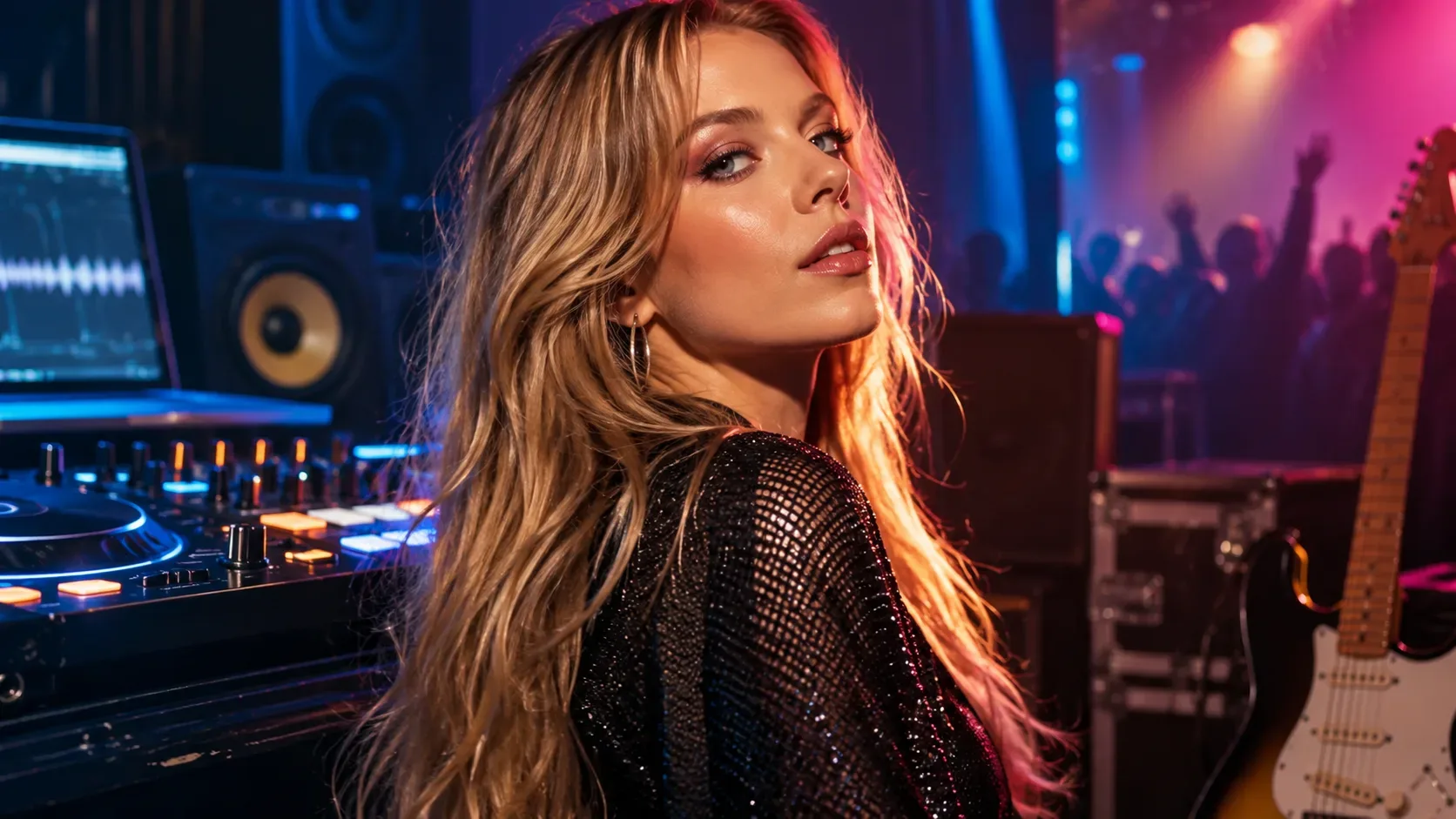
Becky Hill's third album, REBECCA, is officially set for release on September 25, 2026. The artist's official store, within the Universal/Polydor ecosystem, presents the record as a significant evolution: the dance music and drum & bass foundation remains, but it now sits more explicitly alongside guitar music, heavy electro production, alternative influences and euphoric electronics. Becky uses a short, useful phrase to sum up that combination: “curated chaos”.
That does not mean Becky Hill is leaving the dancefloor behind to make a rock album. The official material supports a different reading: REBECCA broadens the palette without erasing its electronic core. The singles released ahead of the album show that continuity, while the artist and label descriptions explain where the change is expected to emerge.
What “curated chaos” means in the context of REBECCA
On Becky Hill's official store, the new album is described as an intentional collision of worlds. On one side are the dance and drum & bass foundations associated with her career; on the other are guitar influences tied to Becky's earlier musical identity, plus alternative elements and heavier electro production.
The key word is curated. The “chaos” is not framed as a lack of direction, but as a deliberate choice to place references that might once have seemed separate inside the same project. The promise, then, is controlled contrast: club-music pulse, bass weight and euphoric electronics living alongside tones, energy and structures that may come from indie and alternative pop/rock.
This framing also helps avoid an exaggerated interpretation. Before the full release, there is no solid basis for calling REBECCA a guitar record in the traditional sense. What is confirmed is that those influences have been brought closer to the electronic vocabulary that already defines Becky Hill.
What continues from the Believe Me Now? era?
The continuity becomes clearer when REBECCA is compared with the official presentation of Believe Me Now?, her 2024 album. That campaign emphasized Becky's connection to club culture and styles such as drum & bass, house, techno and trance. In other words, electronic music was not just a pop wrapper; it was an explicit part of the artistic proposition.
REBECCA does not contradict that direction. Instead, the official description says dance and drum & bass remain foundations of the new album. The shift therefore looks less like a genre break and more like an expansion of Becky's sonic vocabulary.
- Still present: electronic energy, dancefloor dynamics and high-impact vocals.
- Still present: dance music and drum & bass as structural references.
- New emphasis: guitars and alternative influences are explicitly part of the album's concept.
- New emphasis: the lyrics are presented as more open and personal, touching on ambition, identity, visibility, self-worth, desire and self-preservation.
What the singles already reveal before release
The campaign singles work as samples, not as a complete portrait. Universal Music Brasil identifies “Hands On Me”, “More! More! More!”, “what do i have to do?” and “Changes” as previews of REBECCA. In the release for “what do i have to do?”, the song is associated with vibrant electronic production, a strong bassline and the emotional tension between holding on and recognizing when it is time to let go.
That material reinforces two points. First, the electronic center remains highly visible: the singles do not suggest a sudden identity swap. Second, the new language around guitars, indie and alternative pop/rock suggests that the change may emerge in texture and arrangement as much as in song construction, rather than as a full conversion to rock.
“Changes”, introduced on September 11 as the final single before the album, closes that sequence of previews. The label's own communication again defines REBECCA through the combination of dance/drum & bass foundations with broader indie and alternative pop/rock influences.
The other major change is in the lyrics
The new phase is not described only in genre terms. Official material says the album was written during a period of personal and artistic reflection, with Becky addressing ambition, identity, visibility and the contradictions of her own life with greater openness. The tension between desire and self-preservation appears as one of the record's recurring ideas.
That matters because it connects “curated chaos” to the narrative, not just the production. The blend of sonic languages accompanies a set of internal conflicts: wanting more while also protecting yourself; seeking visibility while dealing with its weight; preserving the power of a career built on dance music without being confined to one frame.
What still cannot be claimed about REBECCA
Because the full album has not yet been released, any pre-release reading needs limits. Official sources allow us to identify intention, influences and several samples, but they do not support track-by-track conclusions.
| Already confirmed | Still requires the full album |
|---|---|
| Official release on September 25, 2026. | How much space guitars occupy across the entire record. |
| Dance and drum & bass remain foundations of the sound. | Whether specific tracks lean more toward rock, indie, electro or drum & bass. |
| There are guitar, indie and alternative pop/rock influences. | The final balance between club music and alternative references. |
| The lyrics explore more personal themes and tensions around identity and visibility. | Whether this shift becomes a permanent direction for future projects. |
So what defines Becky Hill's new phase?
Based on what is officially available before September 25, the best definition of REBECCA is expansion, not replacement. Becky Hill keeps the electronic foundations that built her career and adds references that broaden her musical identity, especially guitars and alternative influences. At the same time, the writing is presented as more direct and personal.
The singles released so far show that the dancefloor remains central to the project. What remains to be heard is how this “curated chaos” works across the full album — and on which tracks the new layer of guitars and alternative pop/rock truly changes the architecture of her sound.