Westside Whimsy, Jhené Aiko’s fourth studio album, was released on September 11, 2026 with 20 tracks. The label’s own release materials present the project as a love letter to Los Angeles, the singer’s hometown, and connect that idea to a short guest list: Ab-Soul, Tyga, Larry June, Kendrick Lamar and OHMA. The most useful way to read the record, however, is not as a literal city guide but as an album where personal memory, Californian identity and different West Coast traditions enter a project that remains centered on Jhené’s voice. Universal Music Brazil’s announcement and the artist’s official store confirm the concept, release date, fourth-album status and full tracklist.
Why Westside Whimsy works as a love letter to Los Angeles
Jhené Aiko was born in Los Angeles and has built much of her career in dialogue with Southern California music. On the new album, the city reference is not limited to her birthplace: it frames the project’s public presentation. The label describes Westside Whimsy as a record shaped by love, vulnerability, healing and life’s unpredictability, while placing those themes inside a tribute to where Jhené comes from. The Recording Academy also lists Los Angeles as her birthplace.
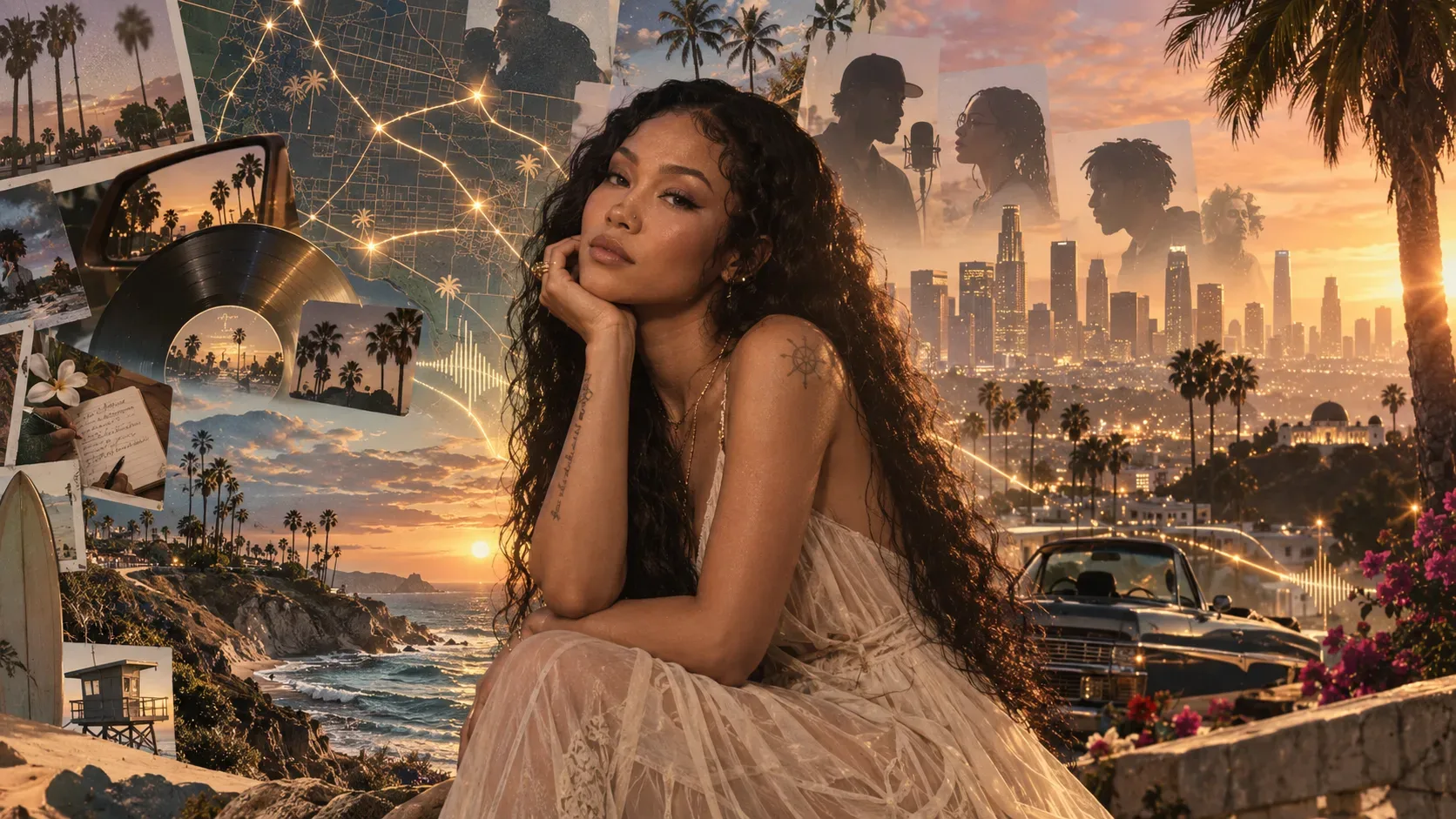
That framing makes it easier to understand the title and sequence without forcing every track to be explicitly about geography. Titles such as Beach Boy and Golden Coast reinforce the coastal imagery, while the rest of the record preserves subjects that recur throughout Jhené’s work—relationships, intimacy, self-reflection and healing. Los Angeles therefore operates both as a real place and as an emotional and cultural setting.
The features form a West Coast map—with one important caveat
Universal’s release groups the guests as names connected to the Los Angeles scene. That description works for the album’s core, but it needs one factual caveat: Apple Music identifies Larry June as a San Francisco artist, shaped by both the Bay Area and Atlanta. It is therefore more accurate to read the guest list as a map centered on Los Angeles and extending across the West Coast, rather than a roster made up only of Angelenos.
| Guest | Track | Confirmed regional link | How it fits the album concept |
|---|---|---|---|
| Ab-Soul | Love Bomb | Carson, California, and a longtime Top Dawg Entertainment artist. | It reactivates the creative neighborhood between Jhené and the Los Angeles County rap ecosystem that was present in the early years of her solo run. |
| Tyga | Like, Whatever | Compton, California, with a musical identity strongly associated with Southern California. | He adds a more pop-facing, party-minded side of Los Angeles rap to Jhené’s more intimate portrait. |
| Larry June | Neighbors | San Francisco, California; closely associated with the Bay Area. | He widens the map beyond Los Angeles and connects the tribute to a broader Californian sensibility. |
| Kendrick Lamar | So Good | Compton, California. | This is the clearest historical link: Kendrick and Jhené’s collaboration goes back to the early 2010s, before either reached their current scale. Coverage of the release of “So Good” revisits that long-running creative relationship. |
| OHMA | Golden Coast | A Los Angeles-based duo associated with jazz, ambient and experimental music. | They close the album with a local collaboration and a track title that sums up the project’s coastal imagery; reading it as a “geographic closing statement” is an editorial inference, not an official explanation from Jhené. |
The 20-track design keeps Jhené at the center
Five of the 20 tracks have credited guests: Love Bomb (track 4), Like, Whatever (8), Neighbors (12), So Good (14) and Golden Coast (20). That leaves 15 tracks without a credited feature. The distribution matters because the outside voices work as checkpoints rather than the record’s dominant structure. The official sequence is available on Jhené Aiko’s store.
This helps avoid reading Westside Whimsy as a “features album.” Kendrick Lamar may be the highest-profile guest, but the project does not reorganize itself around him; the same is true of Tyga, Ab-Soul and Larry June. Los Angeles remains presented through Jhené’s perspective, while the guests add different accents to the same cultural territory.
The gap since Chilombo: six years between albums, not six years of silence
Chilombo was released on March 6, 2020. During the 2021 Grammy cycle, the album earned nominations for Album of the Year and Best Progressive R&B Album, while “Lightning & Thunder,” featuring John Legend, was also nominated. The Recording Academy detailed those nominations. Jhené’s current artist page lists seven Grammy nominations across her career.
Westside Whimsy is therefore Jhené’s first studio album in six years. That gap should not be confused with artistic disappearance: she continued releasing music and returned to the Grammy nominee list with “Guidance.” The real shift is that there is now a complete new album—20 tracks that can reorganize recurring themes in her work inside an explicit geographic identity.
How the guests help explain the album’s idea
The value of the guest list lies in the differences between origins and career paths. Kendrick Lamar and Tyga point directly to Compton; Ab-Soul ties the project to Carson and TDE history; OHMA brings a Los Angeles presence from outside rap; and Larry June moves the map north to San Francisco and the Bay Area. Together, they are not a ranking of importance but a set of perspectives on contemporary Californian music.
It is important to separate confirmation from interpretation. It is confirmed that the label presents Westside Whimsy as a tribute to Los Angeles, that the album has 20 tracks and five credited features, and that those guests have different links to California. The idea that the placement of the collaborations works as a “map” through the album is an editorial reading supported by the sequence and the artists’ origins. Without track-by-track statements from Jhené, it would be unsafe to assign a specific geographic meaning to every song.
In short
Westside Whimsy is a love letter to Los Angeles because the city serves as the point of origin, cultural frame and emotional image for Jhené Aiko’s new cycle. The features reinforce that idea without turning the album into a guest showcase: Ab-Soul, Tyga, Kendrick Lamar and OHMA deepen Southern California connections, while Larry June expands the conversation toward the Bay Area. After Chilombo, Jhené’s studio return does not abandon the introspection that has defined her work; it places it more explicitly inside a Californian map.