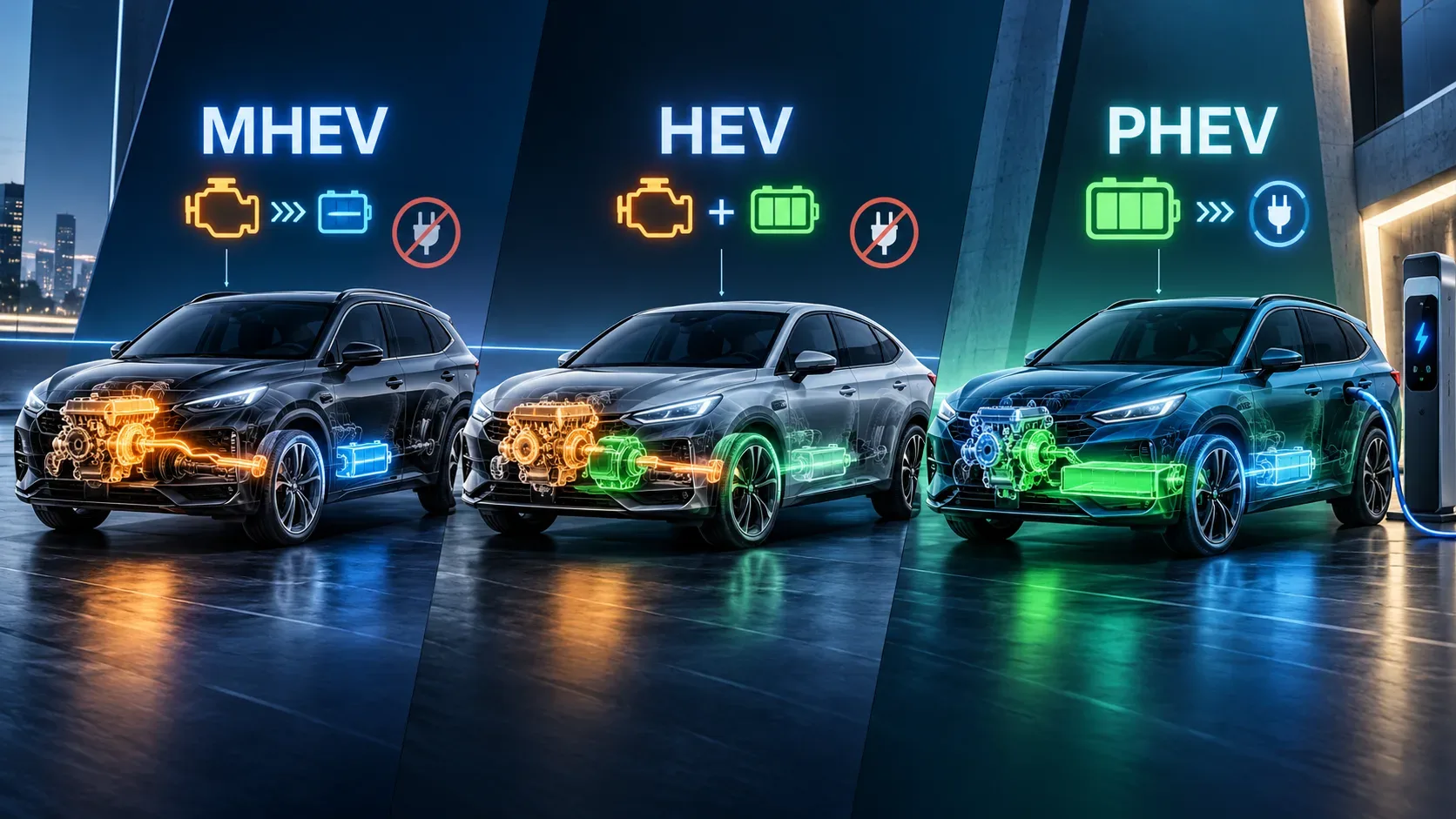
Mild hybrids, full hybrids and plug-in hybrids do not use electricity in the same way. The most useful differences for a car buyer are threefold: whether the electric motor can drive the wheels on its own, where the battery gets its energy from, and whether the vehicle can be charged from an external power source.
In general, an MHEV uses the electric system to assist the combustion engine; an HEV can use the electric motor to propel the car under certain conditions but charges its battery within the vehicle; and a PHEV combines a combustion engine with a larger battery that can also receive energy from the grid. Exact architectures vary by manufacturer and model, so the acronym is a starting point rather than a complete description of every design.
Quick comparison: MHEV, HEV and PHEV
| System | What can drive the wheels? | How is the battery charged? | Does it plug in? | What this means in use |
|---|---|---|---|---|
| MHEV, mild hybrid | The combustion engine is responsible for propulsion; the electric system provides assistance and, in typical configurations, cannot propel the car by itself. | Energy recovery during deceleration and operation of the motor-generator system. | No. | Electrification can assist starts, acceleration, energy recovery and auxiliary systems, but it does not give the vehicle an independent electric driving mode. |
| HEV, full hybrid | The combustion engine, electric motor or both, depending on the architecture and driving condition. | Mainly regenerative braking and the vehicle's own hybrid energy management; it does not rely on external charging. | No. | The car may cover short stretches or low-load situations using only the electric motor, as well as operate with both power sources. |
| PHEV, plug-in hybrid | The electric motor, combustion engine or both, depending on mode and power demand. | External outlet or charging equipment, regenerative braking and, in many designs, energy management involving the combustion engine. | Yes, for external charging. | A larger battery enables more electric driving than an HEV, but the real-world benefit depends on charging habits and travel patterns. |
MHEV: the electric motor assists but does not take over propulsion
MHEV stands for mild hybrid electric vehicle. In this arrangement, a motor-generator and a relatively small battery assist the combustion powertrain. A 48 V system is common, although voltage and implementation can vary.
The key point is that, under the definition used by the U.S. Department of Energy's Alternative Fuels Data Center, a mild hybrid cannot power the vehicle using electricity alone. The electric system can recover energy during deceleration, make start-stop operation smoother, power accessories and provide torque assistance in certain situations.
That is why the question "does the electric motor move the car?" has a different answer for an MHEV and a full hybrid. In an MHEV, electrification reduces some of the work that would otherwise be handled only by the combustion engine, but it does not create an independent electric propulsion mode.
HEV: the electric motor can propel the car without a plug
HEV stands for hybrid electric vehicle. In a full hybrid, the battery and electric motor are capable of participating directly in propulsion. Depending on the design, the car may pull away, travel at low speed or cover short distances using only the electric motor. In other situations, the combustion engine and electric motor work together.
An HEV is not designed to receive charge from an external outlet. Its battery is replenished by the vehicle itself, especially through regenerative braking, which uses the electric motor as a generator during deceleration, and through the hybrid system's energy management. The AFDC notes that HEVs do not plug into off-board electricity sources to charge the battery.
"No plug" does not mean that the battery charges itself from nowhere. Energy ultimately comes from fuel converted by the powertrain and from recovering part of the vehicle's kinetic energy that would otherwise be dissipated mainly as heat through the brakes. Every conversion has losses, so the system is not a source of free energy.
PHEV: the plug adds external energy and extends electric use
PHEV stands for plug-in hybrid electric vehicle. It retains a combustion engine and electric drive system, but adds a larger traction battery and a charging port. According to the AFDC, the battery can be charged from a wall outlet or charging equipment, while also receiving energy through regenerative braking and vehicle energy management.
The larger battery allows a PHEV to operate in electric mode for a meaningful distance, depending on the model, temperature, speed, climate-control use, terrain and the manufacturer's control strategy. In some vehicles, the combustion engine may start even when usable battery charge remains, for example when high power is requested or when the system needs to meet a specific operating condition.
The plug is generally not a requirement for the PHEV to move: the vehicle can continue operating with the combustion engine and in hybrid mode when usable electric charge falls. However, external charging is central to the PHEV concept. If the car is rarely plugged in, the owner gives up much of the opportunity to use grid electricity instead of fuel on compatible trips.
What really changes in the drivetrain
The acronym alone does not explain the whole architecture. Hybrid systems can be parallel, series or use power-split combinations. In a parallel hybrid, the combustion engine and electric motor can both have a mechanical path to the wheels. In a series architecture, the electric motor can be the direct source of wheel propulsion while the combustion engine acts as an energy source to generate electricity. Other systems combine power paths in different ways.
For the buyer, the practical consequence is simple: two vehicles classified as HEV or PHEV can behave differently in acceleration, maximum speed in electric mode, when the combustion engine starts and overall driving feel. The classification indicates the broad level of electrification, but the specification sheet and owner's manual reveal how a particular vehicle actually operates.
When each system uses a plug
- MHEV: it does not use an external plug to charge the traction battery. Its electric system is replenished within the vehicle.
- HEV: it also does not plug in. Charging happens internally, especially through regeneration and hybrid energy management.
- PHEV: it accepts external charging and is designed to use that energy for electric propulsion. It also recovers energy while driving.
This distinction avoids a common misconception: "hybrid" is not synonymous with "a car that must be plugged in." Among these three categories, only plug-in hybrids include external charging as a design feature.
How to choose without assuming universal savings
There is no fixed ranking in which MHEV, HEV and PHEV are always more economical for every driver. Results depend on the specific vehicle's consumption, fuel and electricity prices, access to charging, trip length, average speed, temperature, terrain and driving style.
A PHEV tends to make better use of its battery when it is charged frequently and when a meaningful share of trips fits within the model's electric operation. An HEV may be simpler for someone without convenient charging who still wants greater electric-motor participation than an MHEV provides. An MHEV usually requires less change in routine because it does not depend on external charging, but its electric motor plays a more limited role in propulsion.
When comparing models, check four points on the actual vehicle: the electric motor's power and function, usable battery capacity when disclosed, whether external charging is supported and at what power, and the conditions of electric driving described by the manufacturer. This makes the decision depend on how the car works, not only on its marketing label.
In one sentence
An MHEV assists the combustion engine without propelling the car by itself; an HEV can provide limited electric propulsion without plugging in; a PHEV adds a larger battery and external charging to expand electric driving.