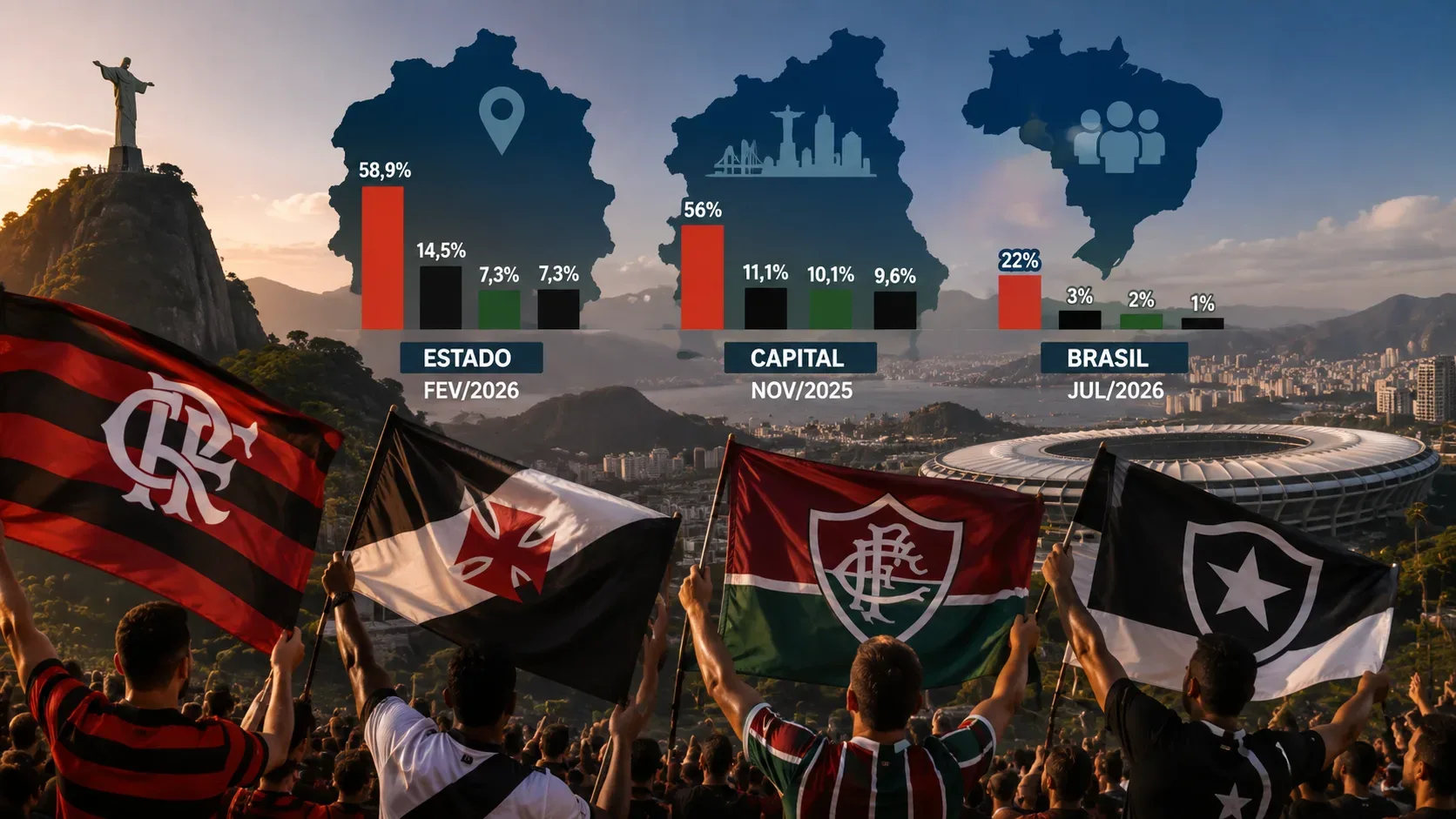

Flamengo are the clear leader among Rio de Janeiro's four major clubs in paid attendance, gate revenue and average ticket value in the 2026 Brasileirão, using only matches in which each club was the home team and data available through August 30. Flamengo total 640,228 paying spectators and R$54.26 million in gate revenue across 11 matches, with an average ticket value of R$84.75. Fluminense rank second in attendance and revenue; Vasco draw fewer paying spectators than Fluminense but have a higher average ticket value; and Botafogo trail in all three metrics.
Comparing the four Rio clubs on the same basis
To avoid distorting the comparison by mixing the full season, membership programs or stadium-related revenue, the table below uses only 2026 Brasileirão matches in which the club was the home side. Because the schedule included postponed matches, the number of home games is not the same for every club; totals and averages therefore need to be read together.
| Club | Home matches | Paying spectators | Average paying attendance | Cumulative gate revenue | Average revenue per match | Average ticket |
|---|---|---|---|---|---|---|
| Flamengo | 11 | 640,228 | 58,203 | R$54,256,696 | R$4,932,427 | R$84.75 |
| Fluminense | 13 | 286,709 | 22,055 | R$15,888,055 | R$1,222,158 | R$55.42 |
| Vasco | 13 | 221,306 | 17,024 | R$13,771,746 | R$1,059,365 | R$62.23 |
| Botafogo | 11 | 154,694 | 14,063 | R$6,974,256 | R$634,023 | R$45.08 |
The average ticket value was calculated by dividing cumulative gate revenue by the number of paying spectators in the same sample. Values are rounded to two decimal places.
Flamengo lead attendance, revenue and average ticket value
Flamengo's advantage is not simply a result of having more matches. Through August 30, the club had two fewer home games than Fluminense and Vasco and still sold 640,228 tickets in the Brasileirão. That is 353,519 more paying spectators than Fluminense, the second-placed Rio club.
The revenue gap is even larger: R$54.26 million versus R$15.89 million for Fluminense. Proportionally, Flamengo drew about 2.23 times Fluminense's paid attendance and generated about 3.41 times the gate revenue. The gap widens because Flamengo's average ticket value, R$84.75, is also the highest of the four.
Fluminense draw more people; Vasco generate more per paying fan
The closest comparison is between Fluminense and Vasco. Fluminense sold 286,709 tickets in 13 home matches, compared with 221,306 for Vasco over the same number of games. That gives Fluminense a lead of 65,403 paying spectators.
Vasco, however, have the higher average ticket value: R$62.23 versus R$55.42. That narrows part of the revenue difference but does not erase it. Fluminense still lead cumulative gate revenue between the two, with R$15.89 million against Vasco's R$13.77 million.
Botafogo have the lowest volume and lowest average ticket of the four
Botafogo total 154,694 paying spectators across 11 home matches, an average of 14,063 per game. Cumulative gate revenue stands at R$6.97 million and the average ticket value at R$45.08. In this sample, Botafogo therefore rank behind Flamengo, Fluminense and Vasco in total paid attendance, average paid attendance, total revenue and average ticket value.
Botafogo 1-1 Fluminense in round 22 drew 21,744 paying spectators and R$840,195 in gate revenue, while Botafogo 2-3 Athletico-PR in round 24 drew 6,209 paying spectators and R$178,760. That variation helps explain why Botafogo's average remains below the other three.
Why a common cutoff date matters
The four clubs did not reach August 30 with the same number of home fixtures. Flamengo and Botafogo had 11 home matches in this sample; Fluminense and Vasco had 13. Postponed fixtures also affect the snapshot. Comparing only total revenue would favor clubs that had more opportunities to host matches, while comparing only averages would hide the overall scale of ticket sales.
The most useful reading therefore combines three questions: how many people paid, how much gate revenue was generated, and how much revenue each paying spectator represented on average. Across that set of measures, Flamengo lead clearly.
The CBF attendance ranking is not the same metric
The CBF also publishes Brasileirão attendance rankings, but its lists use total attendance present in the stadium. That is not necessarily the same as paid attendance used here. After round 20, for example, the CBF listed Flamengo at an average of 61,559 spectators present, while Gato Mestre's first-half survey counted 57,042 paying spectators per home match across eight fixtures. Both metrics are valid, but they answer different questions.
For comparing gate revenue and calculating an average ticket value, paid attendance is the more consistent denominator because it is directly connected to the revenue reported in the match financial statements.
Flamengo's “one million tickets” is a different sample
On August 30, Flamengo surpassed one million tickets sold as the home team across all competitions in 2026: 1,044,968 paying spectators in 21 matches. That figure is accurate, but it should not be treated as the Brasileirão total. In the league alone, through the same date, this comparison counts 640,228 paying spectators in 11 home matches.
The distinction matters because the yearly figure includes matches from other competitions. Mixing the two universes would inflate Flamengo's comparison with Fluminense, Vasco and Botafogo if the rivals were measured only by Série A matches.
What these numbers do not show
Gate revenue is not the same as a club's annual revenue or stadium profit. Nor does it, by itself, measure membership-program income, food and beverage sales, sponsorship, broadcasting rights or the financial result of operating the Maracanã or Nilton Santos. The revenue used here is the ticket income reported for each match in the financial-statement survey.
Likewise, a higher average ticket value does not automatically mean a better commercial policy: ticket pricing, stadium capacity, seating mix, complimentary admissions, demand, opponent profile and sporting form all influence the figure.
How the figures were updated
The starting point is the first-half review published by Gato Mestre/ge, which lists paying attendance, gate revenue and average ticket values for all 20 clubs. The update adds only the four Rio clubs' new home matches through August 30, using data from rounds 20, 21, 22, 23 and 24. For Flamengo vs Botafogo in round 25, the calculation uses 61,934 paying spectators and R$5,770,680 reported by ge on August 30. For Vasco vs Cruzeiro, it uses 18,174 paying spectators and R$757,038 published by SuperVasco, crediting Fim de Jogo.
As a methodological reference, the CBF attendance ranking after round 20 helps show why total attendance and paid attendance must be treated separately. This article's comparison closes on August 30, 2026 for all four clubs.