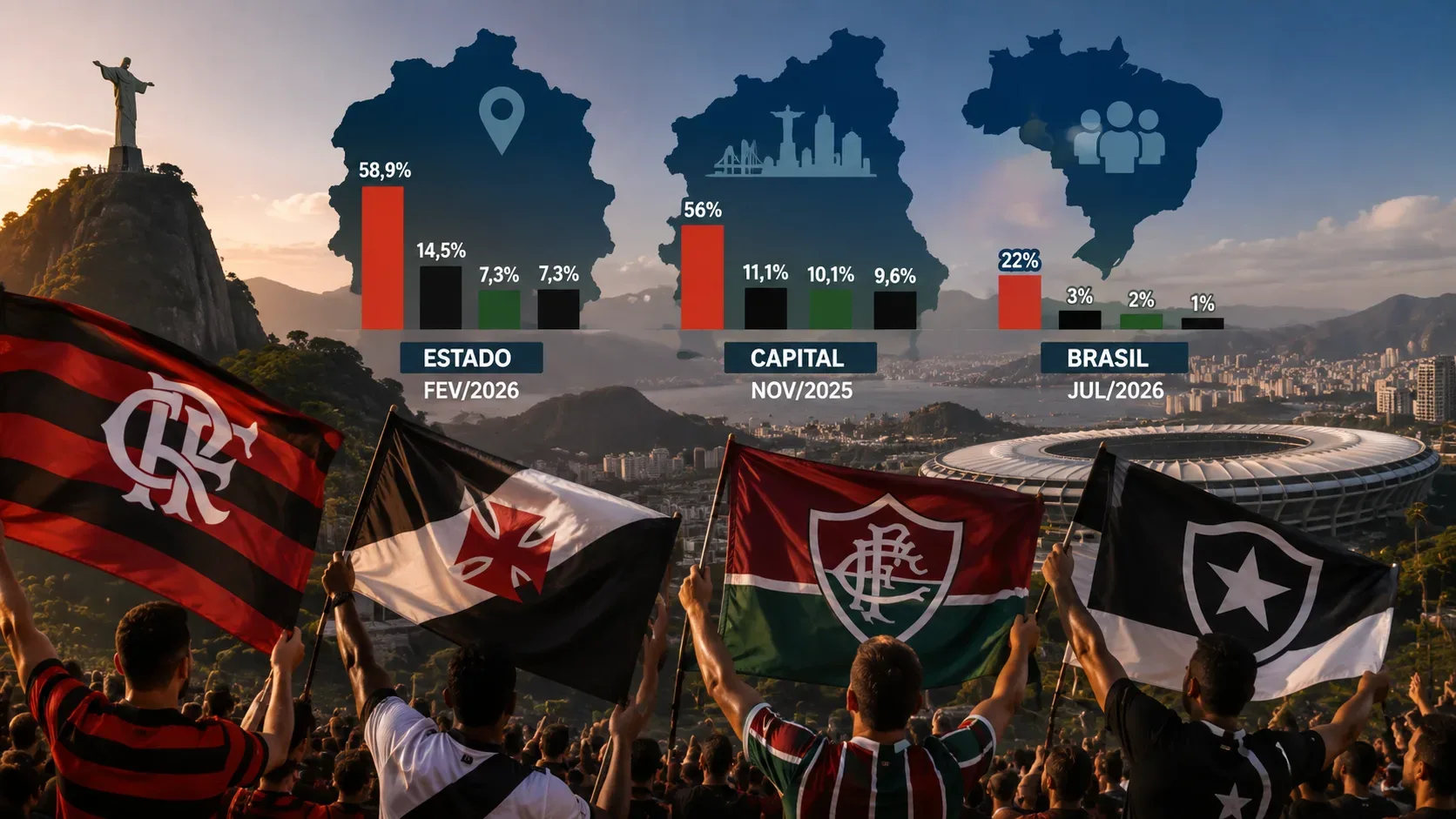
If the question is “which Rio club has the largest fan base in 2026?”, the safest answer starts by defining what “Rio” means. In the three surveys used here — one for the state of Rio de Janeiro, one for the city of Rio, and one nationwide — Flamengo ranks first among Rio clubs. What changes substantially is the percentage, because each survey measures a different population.
Short answer: Flamengo leads, but the percentages cannot be compared as if they came from the same survey
In the statewide Prefab Future survey conducted from February 3 to 7, 2026, Flamengo recorded 58.9%, Vasco 14.5%, and Botafogo and Fluminense 7.3% each. The survey interviewed 2,006 people across the state and reported a 2.19 percentage-point margin of error at a 95% confidence level.
In the city of Rio de Janeiro, another survey by the same institute, conducted on November 3 and 4, 2025 with 1,200 residents, put Flamengo at 56%, Vasco at 11.1%, Fluminense at 10.1%, and Botafogo at 9.6%. The reported margin of error was 3.47 percentage points.
Datafolha, meanwhile, measured the whole of Brazil on July 22 and 23, 2026. Among 2,004 people aged 16 or older in 139 municipalities, Flamengo had 22%, Vasco 3%, Fluminense 2%, and Botafogo 1%. The margin of error for the full sample was 2 percentage points at a 95% confidence level.
| Geographic scope | Institute and field dates | Sample | Reported margin | Flamengo | Vasco | Fluminense | Botafogo |
|---|---|---|---|---|---|---|---|
| State of Rio de Janeiro | Prefab Future, Feb. 3–7, 2026 | 2,006 | ±2.19 pp | 58.9% | 14.5% | 7.3% | 7.3% |
| City of Rio de Janeiro | Prefab Future, Nov. 3–4, 2025 | 1,200 | ±3.47 pp | 56% | 11.1% | 10.1% | 9.6% |
| Brazil | Datafolha, Jul. 22–23, 2026 | 2,004 | ±2 pp | 22% | 3% | 2% | 1% |
Why 58.9% in the state, 56% in the city, and 22% in Brazil are not contradictory
1. The denominator changes
A fan-base percentage only makes sense relative to the population being surveyed. In the statewide poll, every 100 respondents represent the state population within that sample design. In the city poll, they represent residents of the capital. In the Datafolha poll, they represent Brazilians aged 16 or older distributed across all five regions of the country.
That means Flamengo’s 22% nationwide is not a “drop” from its 58.9% in the state. It is a different denominator. Once the map expands to the whole country, populations in which Corinthians, Palmeiras, São Paulo, Grêmio, Cruzeiro, Internacional, northeastern clubs, and other teams have much greater weight are included. Datafolha itself found Corinthians at 14%, Palmeiras at 7%, and São Paulo at 6%, while 22% said they did not support any team.
2. The state and the capital are not the same universe either
Even when the institute is the same, measuring the entire state and measuring only the city of Rio produces different populations. The state includes the capital, the metropolitan area, and the interior. The February 2026 statewide survey reported Flamengo above 59% in the Metropolitan Region and above 60% in the North and Northwest of the state, which helps explain how the statewide result can be higher than the figure found in the capital in November 2025.
This does not allow us to say that Flamengo’s fan base “grew by 2.9 points” from November to February. That conclusion would require surveys designed to track the same population with the same methodology over time. Here, both the date and the geographic scope changed.
3. Field dates matter
The capital survey was conducted in November 2025, the statewide poll in February 2026, and the national survey in July 2026. Club preference is generally more stable than voting intention or government approval, but no survey is timeless. Sporting results, exposure, generational replacement, and demographic change can affect numbers over time. Every percentage should therefore be cited together with its field date.
4. Margins of error keep small numerical gaps from becoming certainties
In the capital, Vasco (11.1%), Fluminense (10.1%), and Botafogo (9.6%) are very close, while the published overall margin is 3.47 percentage points. The prudent reading is that the three are in a statistically tight contest in that survey, not that tenths of a point establish a rigid hierarchy.
Statewide, Botafogo and Fluminense are exactly tied at 7.3%. In the national Datafolha poll, Vasco (3%), Fluminense (2%), and Botafogo (1%) are also clustered at low percentages relative to a 2-point margin for the full sample. The numerical order can be reported, but each gap should not be presented as statistically unquestionable.
What can be concluded safely about the four fan bases
- Flamengo: it is the clear leader among Rio clubs in all three geographic cuts analyzed. The gap over the other three is large in the state, the capital, and the national survey.
- Vasco: it ranks numerically second in both the state and the capital and is also the next Rio club in Datafolha’s national ranking. Its statewide advantage over Botafogo and Fluminense is much larger than the gap observed in the capital.
- Fluminense and Botafogo: they are very close in the local surveys. Statewide they tie at 7.3%. In the capital, Fluminense has 10.1% and Botafogo 9.6%, a small difference compared with the reported margin of error.
- Nationwide: the three chasing clubs have low percentages because the universe includes supporters across Brazil and people who support no club. Vasco appears at 3%, Fluminense at 2%, and Botafogo at 1%, but that national scale cannot be used to automatically recalculate their shares inside Rio.
Why it is wrong to choose one “correct survey” and discard the others
The surveys answer different questions. The statewide poll is the most appropriate for “which club has the largest fan base in the state of Rio de Janeiro?”. The city survey better answers “how are fan bases distributed among residents of the city of Rio?”. Datafolha answers “what weight do these clubs have within the surveyed Brazilian population as a whole?”.
The common mistake is to blend those three questions and treat the percentages as rivals. They are not. A club can account for more than half of respondents in its home state and at the same time around one fifth of the national population. Both statements can be true because they refer to different bases.
How to compare fan-base surveys without creating a misleading ranking
- Check geography: city, state, region, or country.
- Check who entered the sample: minimum age, residence, territorial distribution, and sample size.
- Keep the field date: compare equivalent periods if you want to claim growth or decline.
- Read the margin of error: small gaps may not support a firm ranking.
- Check the question and method: open-ended or prompted answers, whether more than one club is allowed, and the collection mode can affect results.
- Do not convert percentages into absolute head counts without the proper base: multiplying a percentage by an arbitrary population can produce a misleading estimate if the survey was not designed for that extrapolation.
So, which Rio club has the largest fan base in 2026?
If “Rio” means the state of Rio de Janeiro, the strongest available figure among the surveys compared here is the February 2026 Prefab Future poll: Flamengo 58.9%, Vasco 14.5%, Fluminense 7.3%, and Botafogo 7.3%. If the question is limited to the city, the available November 2025 poll also places Flamengo first, at 56%, but shows Vasco, Fluminense, and Botafogo much closer to one another.
Across Brazil, Datafolha’s July 2026 poll keeps Flamengo as the country’s largest fan base at 22%, with Vasco at 3%, Fluminense at 2%, and Botafogo at 1%. The national ranking reinforces Flamengo’s lead, but it does not replace local surveys when the goal is to measure the relative size of fan bases inside Rio.