
Yes. Being in judicial recovery does not, in itself, create a prohibition on signing players. Vasco himself stated this in his official FAQ from March 2025, after the 4th Business Court of Rio de Janeiro granted the judicial recovery of the club and SAF. The answer, however, became more complex in 2026: in addition to the rules of the judicial process, the CBF Financial Sustainability System, supervised by ANRESF, came into effect, with specific restrictions for clubs in a situation of insolvency.
In practice, the correct question is no longer just “can Vasco hire?”. It is necessary to check where the money comes from, how much the operation increases the payroll, what is the balance between purchases and sales in the window, whether the new obligations can be paid when due and whether there is any court order, CNRD decision or sports sanction affecting the business.
Judicial recovery is not a transfer ban
Judicial recovery was designed to allow a company in crisis to reorganize debts and preserve its activity. Law 11,101/2005 is based precisely on preserving the production source, jobs and the interests of creditors. Therefore, entering into recovery does not shut down the company's normal operations or transform all future expenses into a prohibited act.
In the case of Vasco, the Court accepted the request from Club de Regatas Vasco da Gama and Vasco SAF on February 26, 2025. On March 12 of that year, the club published a direct question in its FAQ: does judicial recovery affect sports management and can Vasco sign players? The official response was that SAF could continue negotiating and strengthening the squad, as long as the signings were aligned with the financial reality and the restructuring process.
The recovery plan was approved by 97.7% of creditors present at the meeting on October 9, 2025 and approved by the 4th Business Court on December 21. This reorganized the relationship with creditors, but did not eliminate the need to comply with the plan, court decisions and sporting rules that came into force later.
Therefore, "being in RJ" and "being prohibited from registering athletes" are different situations. A transfer ban must have its own cause, such as failure to comply with an obligation recognized by a sporting body, sanction from the SSF or other applicable decision. RJ alone does not produce this automatic effect.
What changed with financial fair play on April 30, 2026
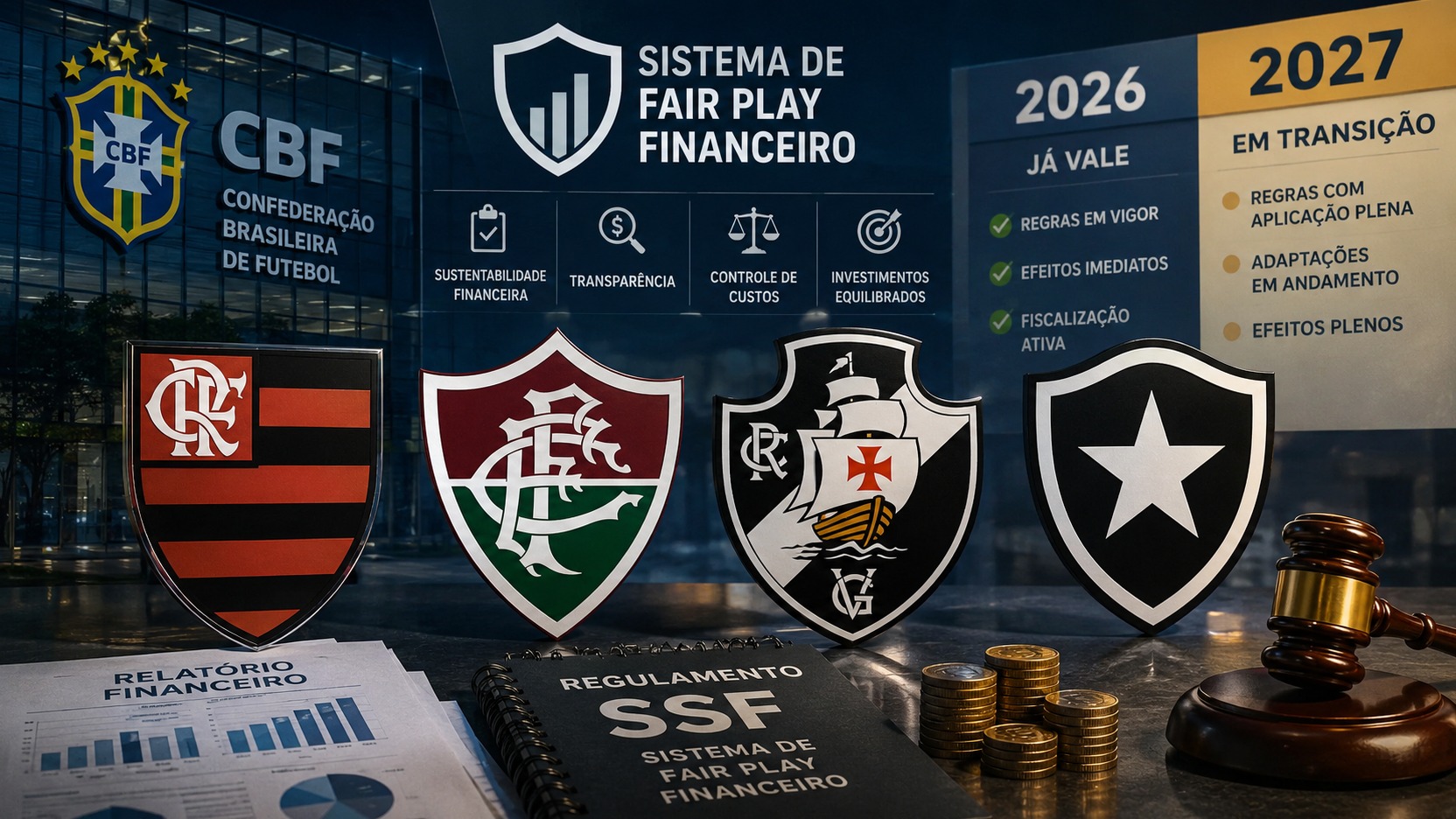
The CBF presented the Financial Sustainability System at the end of 2025 and installed the National Football Regulation and Sustainability Agency, ANRESF, in February 2026. The SSF has general rules on solvency, sustainability, cost control and debt, but reserved specific treatment for so-called insolvency events.
ANRESF itself informs that the granting of a judicial recovery is an insolvency event. The special restrictions came into effect on April 30, 2026. For a club in this condition, therefore, it is not enough to look at the general squad cost limit foreseen for the 2026 transition. There are additional restrictions created precisely to prevent the suspension or restructuring of old debts from freeing up cash and, at the same time, allowing disproportionate sporting expansion.
Historic leaf ceiling
The first obstacle is the limitation of costs with the so-called Relevant People, a concept that includes athletes on the professional squad and the main coach. While the insolvency restriction is applicable, the monthly value of this payroll cannot exceed the average of the six months prior to the recovery request.
This means that a signing without a large transfer fee could still be problematic if it raises the monthly cost beyond the cap. And "free player" is not synonymous with a free player: salaries, image rights, charges, bonuses, gloves, prizes and intermediary commissions are included in the cost metrics of the SSF squad.
“Zero to zero” transfer market
The second lock is the so-called "zero to zero" market. In transfer windows, the club in the event of insolvency can only spend the same amount on new signings as it raised from athlete sales in the same period. The logic is not to prevent any reinforcement, but to force the club to finance market expansion with equivalent sports divestments.
This also explains why different window numbers cannot be compared without date. On March 4, 2026, ge calculated around R$110 million in Vasco's investments in the first international window, with six reinforcements, before the special insolvency restrictions came into force on April 30. Obligations assumed in 2026 were already subject to the solvency requirement, but that window occurred before the special "zero to zero" came into effect.
Restructuring Agreement with ANRESF
The SSF also determines that the club in the event of insolvency negotiates a Restructuring Agreement with ANRESF. The agency checks, among other points, the treatment of football creditors. According to public guidance from ANRESF itself, until there is a validated agreement, hiring and salary limitations remain.
This detail is important because it avoids two opposite simplifications. It is not correct to say that judicial recovery frees the club to spend as it wants. It is also not correct to say that judicial recovery, in itself, closes the window. The contracting regime is subject to financial limits and regulatory supervision.
DIP loan is not the same thing as purchasing a player
The discussion about the R$150 million DIP loan made the confusion even greater. DIP financing is a credit instrument for companies undergoing judicial recovery. Law 11,101 allows, during recovery, the judge to authorize financing contracts intended for the company's activities, restructuring expenses or preservation of the value of its assets, subject to the legal conditions and guarantees involved.
In July 2026, the Court authorized Vasco to receive R$40 million in a DIP from Almirante S/A. The decision considered favorable statements from the Judicial Administrator, the watchdog and the Public Prosecutor's Office and understood that the financing served the interests of recovery and helped to preserve activities.
In August, the scenario changed. Vasco requested authorization for a new DIP of up to R$150 million. On August 18, judge Simone Gastesi Chevrand stopped the financing analysis and demanded a new audit, noting that new debts would not be admitted until at least a summary report was presented. On the morning of August 21, the money remained unreleased and the club had already filed an appeal against the decision.
The legal point is simple: stopping a loan is not equivalent to issuing a general order "not to sign a player". Justice is controlling the creation of new debt and the form of financing within the recovery. The sporting effect can be enormous, because without the money the club may run out of cash to pay incoming negotiations, salaries or other obligations, but the nature of the decision remains financial and judicial, not a transfer ban.
There is still a second difference. For the SSF, money that comes in as a loan and increases liabilities is not treated as an equity contribution capable of increasing the squad's spending limit. ANRESF distinguishes equity, which effectively increases net worth, from borrowed money, which creates debt. Therefore, obtaining a DIP can solve liquidity, but it does not automatically transform this value into new regulatory margin for contracting. And, under the "zero to zero" insolvency lock, the loan also does not replace the revenue required from selling athletes in the window itself.
Where Justice comes into Vasco's hiring process
As a rule, the recovery judge does not choose reinforcements, does not assess whether a defender is expensive or cheap and does not replace the football board. Judicial control concerns acts that may affect assets, financing, execution of the plan and protection of creditors. In the specific case of Vasco, however, the recovery began to coexist with an additional layer of SAF governance monitoring.
Decisions released in July 2026 established the role of a watchdog and information duties on relevant operations. Reports about the process mentioned communication to the court for businesses above certain amounts, while the August discussions began to deal with authorization and auditing for new debts exceeding the limit set by court. This does not mean that each contract depends on a judicial "stroke", but it does mean that the way of financing and formalizing certain operations may be subject to specific control of the process.
The distinction helps when reading the news: buying an athlete, assuming salaries, taking out a loan and offering an asset as collateral are different acts. Some can be practiced by management within ordinary operations, as long as applicable restrictions are respected. Others, especially financing with guarantees or new debts subject to express decision, may depend on judicial authorization.
What ANRESF can monitor
ANRESF is the instance created to manage the SSF. The CBF assigned the agency the functions of monitoring, inspecting, judging and applying sanctions. In practice, it can cross-reference registered contracts, transfer values, due dates, salaries, image rights, commissions, financial statements and solvency information to check whether the club is complying with the regulations.
For obligations assumed from January 1, 2026, the agency clarified in a letter dated June 17 that the solvency requirement applies fully and immediately, without a transition period. In the window from July 20th to September 11th, ANRESF recommended that transfer amounts, salaries, salaries, charges and commissions be sized according to the real cash generation capacity and the schedule of obligations.
Possible sanctions in the SSF range from a warning and fine to withholding of revenue, prohibition of registering athletes, deduction of points and, in the foreseen cases, consequences of licensing and demotion. But these sanctions do not arise automatically because a club is in judicial recovery. It is necessary to identify the breached requirement and follow the corresponding regulatory procedure.
It was in this context that Flamengo sent, on August 18, a notification to ANRESF asking the agency to evaluate Vasco's economic and financial situation in light of the SSF. Flamengo argued that there was an apparent tension between the request for emergency financing and the rival's performance in the transfer market. This is a regulatory provocation by an interested club, not a decision by ANRESF nor proof of irregularity. Until there is an analysis and decision by the agency on the matter, it is not correct to treat the simple notification as a condemnation of Vasco's hiring.
CNRD and transfer ban form another layer
In addition to Justice and ANRESF, there are sporting obligations discussed in the National Dispute Resolution Chamber, the CNRD. On August 10, the Chamber defined a plan for credits being processed by the body: Vasco must allocate R$15 million per year and 10% of the gross revenue from prizes from CBF and Conmebol competitions to pay these creditors.
The decision published at that time established that non-compliance with the conditions could result in a transfer ban, preventing players from registering. The August 25th payment was indicated as the first major test of the new schedule, with amounts corresponding to January to August.
This is an essential difference. Judicial recovery itself is not a transfer ban. Failure to comply with a CNRD order may result in a registration ban expressly linked to the sports debt. Likewise, a possible ANRESF sanction may prevent registrations due to violations of the SSF. They are different legal and regulatory paths, although they can all affect the same transfer window.
Timeline: 2025 to August 2026
February to December 2025
On February 26, the 4th Business Court granted the judicial recovery of Vasco and SAF. In March, the club published the FAQ saying that RJ did not prevent signings, as long as they were compatible with financial reality. In October, the plan was approved by 97.7% of creditors present. On December 21st, judicial approval came.
January to April 2026
Since January 1st, new obligations have come under full application of the SSF solvency requirement. In the first window, which ended at the beginning of March, Vasco invested around R$110 million in reinforcements, according to a survey by the ge. On April 30, ANRESF's special insolvency rules came into force, with a historic payroll ceiling, "zero to zero" market and the need for a Restructuring Agreement.
July and August 2026
In July, the Court authorized a DIP of R$40 million. The second national window opened on July 20 under the special insolvency rules and the solvency alert issued by ANRESF. On August 10, the CNRD defined the payment schedule that could lead to a transfer ban in case of non-compliance. On August 18, Flamengo requested analysis from ANRESF and, on the same day, the Court blocked the new DIP of up to R$150 million until the presentation of a new audit. On August 21, the release of the loan was still pending and Vasco had appealed.
Practical map: can, depends or cannot without fulfilling conditions
Can
Vasco can negotiate with athletes and clubs, close contracts and register reinforcements if there is no active transfer ban and if the operation simultaneously respects judicial rules, the SSF and other sporting obligations. You can also sell players and use the revenue from the window itself to open up space within the "zero to zero" regime. Judicial recovery alone does not block these activities.
It depends
A transfer fee purchase depends on the balance allowed in a club's window in the event of insolvency. A contract that increases the payroll depends on there being space within the applicable historical ceiling. DIP financing depends on legal conditions and, when required, judicial authorization. The use of investor money depends on the accounting nature of the input: contributions that increase equity are treated differently from loans that create liabilities.
It also depends on the updated solvency framework. Even a contract formally compatible with "zero to zero" can create a problem if the club assumes installments, salaries, salaries or commissions that it is unable to pay when due. The SSF controls not only the size of the business, but the fulfillment of new obligations.
Cannot without fulfilling the condition
While the special restrictions remain in place, the club cannot simply increase the Relevant Persons list above the historical ceiling nor spend more on signings than allowed by the window's sales balance. You also cannot circumvent a court order that blocks new debt by taking the same credit in another way, nor ignore the conditions imposed by the CNRD or a possible sanction from ANRESF.
The correct "cannot", therefore, is almost always accompanied by the condition that remains to be fulfilled. It is not the existence of judicial recovery that closes the door; These are specific limits on payroll, cash, sales, solvency, financing, payment of creditors or sports registration that can impede a concrete operation.
How to evaluate a hire without jumping to hasty conclusions
To find out whether a reinforcement is compatible with the 2026 rules, the first question is when the obligation was assumed and in which window it falls. A February transaction is not under the same special insolvency lock as an August transaction, although both can be analyzed by SSF solvency.
Then, it is necessary to compare the arrival cost with the sales revenue for the same period and check the effect on the Relevant Persons' payroll. Next, the origin of the money must be identified. Operating revenue, athlete sales, capital contributions and loans do not have the same regulatory treatment. Having R$100 million available in cash does not mean, in itself, being able to spend R$100 million on transfers.
Finally, it is necessary to check whether there is a court decision on financing, information obligation in the process, CNRD condition or ANRESF sanction that affects the registration. Only after this crossing does it make sense to say that a contract is released, conditioned or irregular.
The answer to the Vasco case in 2026
Vasco can sign players even in judicial recovery. What changed in 2026 was the number of locks that need to be respected at the same time. The Court controls the recovery process and can condition relevant financing and patrimonial acts. ANRESF controls the SSF, including solvency, costs and special insolvency restrictions. The CNRD may impose registration consequences if the club fails to comply with the payment plan defined in football.
The R$150 million DIP episode sums up the difference well. The Court blocked the creation of new debt until further audit; this is not a blanket prohibition on hiring. At the same time, even if the loan is released, the money does not automatically become margin for new purchases in the SSF, because a loan is not an equity contribution and does not replace the "zero to zero" rule of the window.
Similarly, Flamengo's notification to ANRESF does not prove that Vasco violated financial fair play. She asks the regulator to examine the case. The conclusion depends on the recorded data, the window balance, the payroll, solvency and applicable decisions. In 2026, therefore, the answer is neither “RJ can” nor “RJ prohibits”. The correct answer is: you can hire, but each operation needs to fit into the map of permissions and restrictions that surround the club.